

A long history of running gaps under 10 seconds.
To understand the significance of 9.94 seconds, it needs to be placed in its historical context. The SEA Games (SEAP Games) were first held in 1959 in Bangkok. Thai athlete Suthi Manyakass became the first person to be honored as the "fastest man in Southeast Asia," with a time of 10.40 seconds.

From then until the 1970s, Thailand was the "cradle of speed" in Southeast Asia. Names like Suchart Jairsuraparp and Reanchai Seeharwong were the pride of the Land of Smiles, dominating the short-distance races at the SEA Games for many consecutive editions.
In the next generation, Indonesia emerged with Suryo Agung Wibowo – who set the SEA Games record of 10.17 seconds in Laos in 2009, a performance considered the regional "gold standard" for over 15 years.
At the Asian level, China, Japan, and several West Asian countries continuously improved their performance, pushing the continental record down to 9.91 and then 9.83 seconds, while the SEA Games record remained at 10.17 seconds.
The gap between Southeast Asia and Asia in particular, and between Southeast Asia and the world in general, is not measured in fractions of a second, but in an entire sports ecosystem.
In fact, the region is not lacking in talent that comes close to the "sub-10 mark": Lalu Zohri (Indonesia) once ran 10.03 seconds; Azeem Fahmi (Malaysia) achieved 10.09 seconds at just 18 years old; Puripol himself, before the SEA Games 33, had also repeatedly reached the 10.06 - 10.15 second mark in Asian competitions. But all of them seemed to stop right at the finish line.
It wasn't until Bangkok 2025 that the door opened, on an afternoon meticulously prepared both professionally and psychologically.
The qualifying round of the men's 100m at the 33rd SEA Games saw Puripol sprint to the finish line with a near-perfect time of 9.94 seconds – a time that shattered the SEA Games record of 10.17 seconds and also surpassed the best performance ever achieved by a Southeast Asian athlete.
Two hours later, Puripol returned to the race, winning the gold medal with a time of 10.00 seconds, ahead of Lalu Zohri and Danish Iftikhar Roslee (Malaysia). If the Suphachalasai race course is considered a stage, then that was the day Southeast Asia first showcased a "speed performance" that approached Asian standards.

Why wait until 2025? The "bottlenecks" holding back the region's progress.
In theory, a Southeast Asian athlete running the 100m in under 10 seconds isn't entirely surprising. However, it took over 60 years since the first SEA Games for this milestone to be achieved. The answer doesn't lie in a single factor, but rather a combination of many contributing factors.
First of all, Southeast Asia is not a unified entity. As former UK athlete Shyam – Singapore's silver medalist in the 100m at the 2001 SEA Games – analyzed, each country in the region has its own sporting model, with very different levels of professionalism.
Thailand and Indonesia have long-standing athletic traditions, with relatively systematic investment. Some other countries prioritize football or martial arts, considering athletics as a "foundation sport" but lacking a comprehensive strategy. This disparity makes it difficult for the region to create a synchronized "speed wave."
Furthermore, biological factors are also a reality to consider. Studies show that Caribbean and West African athletes have a higher proportion of fast-twitch muscle fibers, which is suitable for short-distance running.
Southeast Asian athletes don't have an absolute disadvantage, but they rarely possess the optimal muscle structure for the 100m. This makes achieving a sub-10 time impossible with conventional training alone; it requires a more sophisticated, personalized training system, deeply rooted in sports science .
And here's the third "bottleneck": sports science in Southeast Asia has only really been applied extensively in a few countries for less than a decade.
Modern 100m running is no longer a matter of "training hard enough." From the angle of foot placement on the starting blocks, arm swing range, stride frequency, force applied to the track, to indicators such as lactate and VO2max, everything is continuously measured, analyzed, and fine-tuned.
Those technologies and those experts are still largely concentrated in Europe, the US, Japan, China, and South Korea. Southeast Asia is only just beginning to "catch up."
Finally, and perhaps most importantly, there's the regional competitive ceiling. When a time of around 10.30 seconds is still enough to win a SEA Games gold medal, athletes aren't under pressure to improve to 10.10 or 10.00 seconds. Nazmizan Muhammad – a former Malaysian athlete who won gold medals in the 100m and 200m at the 2003 SEA Games – frankly commented: in Jamaica or the US, 10.10 seconds is just an "entry ticket," and no one celebrates that achievement. But in Southeast Asia, 10.30 seconds is still considered "excellent." When the finish line is set too low, few have the motivation to push beyond it.
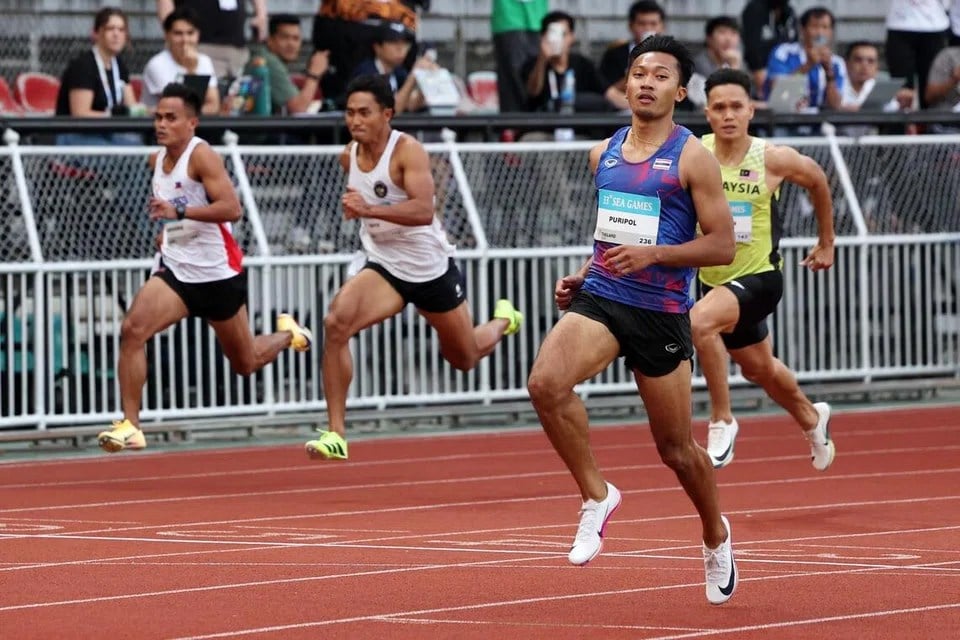
The Puripol case: The product of an “upgraded version” in training.
Looking at Puripol's journey, the shape of a new strategy becomes clear. He wasn't a "superman" who appeared out of nowhere, but rather the product of a system undergoing transformation.
Born in 2006, Puripol was quickly included in the Thai athletics youth training program. The 31st SEA Games in Hanoi was his opening stage, where he won the "triple crown" in the 100m, 200m, and 4x100m relays, much to the astonishment of experts.
But just two years later, an injury forced him to leave the track, missing the 32nd SEA Games in Cambodia. At the time, many feared this would be another case of a "short-lived" talent.
The turning point came when the Athletics Federation of Thailand decided to bring in a foreign coach to work directly with Puripol about 3-4 months before the 33rd SEA Games.
The training program was redesigned from scratch, emphasizing explosive power and the ability to maintain maximum speed in the final 30–40 meters, alongside an intensive injury rehabilitation program.
Weight training, plyometrics, drag running, uphill running, etc., are specifically programmed for each week and each phase. Every training session is recorded and analyzed step by step.
The result was a new Puripol: not only faster, but more consistent, more mature tactically and psychologically. He entered the 33rd SEA Games with a silver medal in the 100m at the Asian Games, a silver medal at the Asian Championships, and a time of 10.06 seconds at the continental level. He was no longer a "rising star," but a genuine contender for a historic milestone.
At the same time, the competitive environment also provided ideal conditions. Lalu Zohri remained a formidable opponent, Malaysia's Danish Roslee was improving rapidly, while Azeem Fahmi – who could push the pace of the race even higher – was not participating due to his studies in the US. Even so, simply having to compete against athletes with times around 10.10–10.20 seconds was enough to force Puripol to raise his expectations.
And the rest is the story that the electronic scoreboard told.

What does it mean to go beyond the race track, and what does Southeast Asia need to do to avoid becoming just another Puripol?
In sports, a record is more than just a statistic; it's a source of inspiration. When one person achieves it, others believe they can too. What was once considered "impossible" suddenly becomes an achievable goal.
Puripol's time of 9.94 seconds is therefore not just an asset for Thailand. It's a psychological boost for all of Southeast Asia. Azeem Fahmi, Lalu Zohri, and other young athletes currently in the 10.20–10.30 second range now have even more reason to believe that sub-10 seconds are no longer just the domain of Jamaica or the United States.
For athletics nations seeking restructuring, such as Malaysia, Indonesia, Singapore, or even Vietnam, this milestone serves as a vivid case study demonstrating the value of sound, scientific, and long-term investment.
However, if we only stop at pride, the 9.94-second time will soon be surpassed by history without creating any structural changes. The question is whether Southeast Asia dares to turn the "Puripol moment" into a "Puripol leverage."
If sub-10 countries want to become the trend instead of the exception, Southeast Asia must change its approach, at least on three levels.
First, a regional strategy for short-distance running training is needed. The idea of a Southeast Asian sprint training center – bringing together top coaches, state-of-the-art analytical equipment, and world-class nutrition and recovery conditions – is not just a romantic notion of cooperation. It could be a practical solution for countries that lack the resources to build their own center but are willing to share costs and benefits within a common model.
Secondly, a more systematic "athletic export pathway" must be created. The success of Joseph Schooling (swimming), Shanti Pereira (athletics), and Azeem Fahmi himself shows that the NCAA environment in the US, the European Grand Prix, etc., are effective training grounds where Southeast Asian athletes can compete against the best of the world. Sports scholarship programs and collaborations between regional federations and foreign universities and clubs are indispensable steps if we want to bring athletes out of the "local pond."
Thirdly, it is necessary to raise the performance standards within domestic competitions and selection systems. When 10.30 seconds is still considered excellent, any efforts towards 10.10 or 10.00 seconds will only be aspirations. National standards, team standards, academy standards… all need to be tightened, even if this means the “comfort zone” of many athletes will disappear.
Finally, the cultural factor cannot be ignored. To produce more Puripols, families must believe that sports is a serious career choice, backed by policies, support, and post-competition pathways. As long as the risk of "hanging up your boots means losing everything" remains, many talents will stop before they can truly shine.
In the 100m race, all limits are temporary until someone breaks them. 9.94 seconds in Suphachalasai proved that. The question is: will Southeast Asia dare to run faster, further?
Source: https://baovanhoa.vn/the-thao/toc-do-va-gioi-han-vi-sao-sea-games-can-hon-60-nam-de-co-mot-vdv-chay-duoi-10-giay-187697.html


![[Photo] Prime Minister Pham Minh Chinh holds a phone call with the CEO of Russia's Rosatom Corporation.](/_next/image?url=https%3A%2F%2Fvphoto.vietnam.vn%2Fthumb%2F1200x675%2Fvietnam%2Fresource%2FIMAGE%2F2025%2F12%2F11%2F1765464552365_dsc-5295-jpg.webp&w=3840&q=75)
























































Comment (0)