


Speaking at the sixth session (the regular year-end session of 2025) of the 10th term of the Ho Chi Minh City People's Council on December 10th, Chairman of the Ho Chi Minh City People's Committee Nguyen Van Duoc stated that in 2025, Ho Chi Minh City will resolve 80% of the obstacles for 670 out of 838 projects, covering an area of 16,200 hectares, attracting investment resources of over 804,000 billion VND. With this result, budget revenue from land use fees in the city is expected to increase by 269% compared to the same period.
According to Mr. Nguyen Van Duoc, in the spirit of "not letting files sit idle," many large projects and constructions will be restarted in 2025.
The head of Ho Chi Minh City's government stated that 2025 will be a year of many important historical and political events, marking the first year the city operates as a "megacity" after the merger; simultaneously reorganizing its administrative apparatus and implementing a series of strategic tasks. This period is considered a "test" for the governance capacity of the new city.
However, the socio -economic achievements in 2025 are very important, serving as a foundation for the next five-year plan. Specifically, most socio-economic indicators in 2025 are expected to meet or exceed the set targets; in particular, the economy will maintain good growth momentum: GRDP is estimated to increase by 8.03%, reaching nearly 3 trillion VND (accounting for 23.5% of the national GDP). GRDP per capita will reach 8,755 USD.
State budget revenue (as of December 8th) reached VND 720,580 billion, achieving 107.3% of the central government's projected target and 103.3% of the city's People's Council's projected target; the goal is to reach VND 800,000 billion by the end of 2025, exceeding the projected target by 20% and accounting for one-third of the national total.
The city's investment and business environment has significantly improved. Specifically, the city has reviewed, reduced, and simplified 441 administrative procedures; of which, 435 procedures related to production and business activities have been eliminated; the investment approval process has been shortened from 35 days to 17 days; and the satisfaction rate of citizens has reached over 90.6%. This has contributed to improving the effectiveness of attracting domestic and foreign investment, with the city establishing 59,750 new businesses with over 2 trillion VND in registered capital; attracting 8.9 billion USD from FDI, an increase of over 30% compared to the same period; of which, over 2 billion USD was invested in science and technology and innovation.
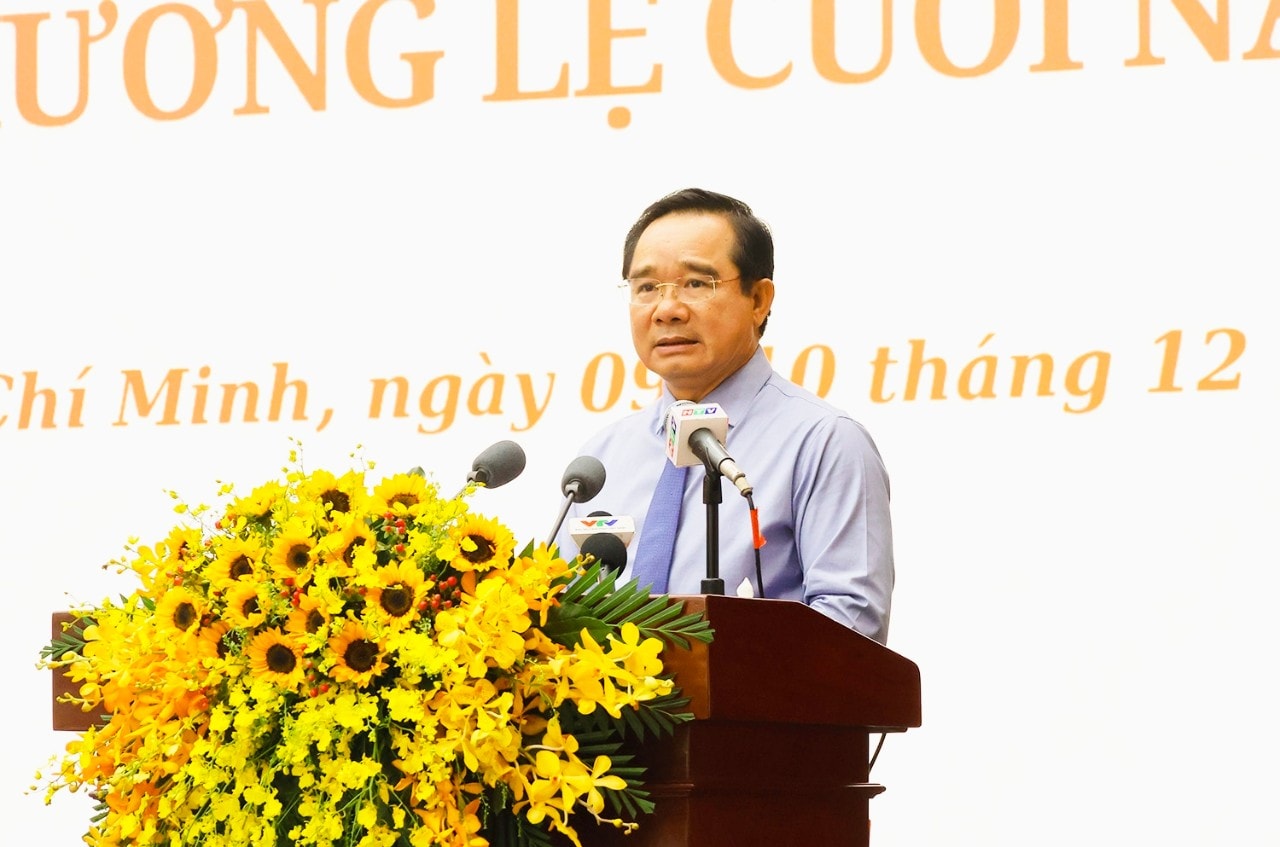
However, the city also clearly recognizes its limitations and weaknesses, such as: unsatisfactory disbursement of public investment; uneven efficiency in the operation of the new administrative apparatus; and inadequate technical infrastructure in some areas. "These are issues the city frankly acknowledges, confronts, and is determined to overcome in the coming time," emphasized Chairman of the Ho Chi Minh City People's Committee Nguyen Van Duoc.
Regarding key tasks for 2026, Ho Chi Minh City has set the highest goal for 2026 as: Creating substantial, tangible, and measurable changes in governance methods (results-based governance), economic development, and the quality of services provided to citizens and businesses.
The city has set the theme for 2026: “Unlocking institutions – Unleashing resources – Infrastructure breakthroughs – Enhancing service efficiency – Creating substantive changes in the city's development (after the merger)”. This theme reflects the determination to change mindsets, innovate models, unleash all potential, and build an administrative apparatus that serves better, faster, and more efficiently.
Accordingly, the city has set out 5 main groups of targets with 26 sub-targets, including: 6 economic targets; 8 cultural and social targets; 6 urban development and environmental protection targets; 2 administrative reform targets; and 4 security targets.
The city has identified five key tasks and solutions: Unlocking resources - innovating urban governance models, ensuring the achievement of double-digit GRDP growth by 2026; restructuring the economy - developing the digital economy as a growth driver; in which, science, technology, and innovation are identified as the main drivers; striving for the digital economy to account for 30% of GRDP.
The city's architecture is being redesigned to develop in a multi-polar, integrated, and interconnected direction; in which, the new Ho Chi Minh City Master Plan is being finalized and adjusted, closely adhering to the orientation of forming "3 regions - 1 special zone - 3 corridors - 5 driving forces".
At the same time, Ho Chi Minh City promotes cultural and human values in the direction of truth, goodness, and beauty; and strengthens foreign relations and international integration.
Source: https://hanoimoi.vn/tp-ho-chi-minh-thu-tu-tien-su-dung-dat-tang-dot-bien-726302.html

























![[Video] The craft of making Dong Ho folk paintings has been inscribed by UNESCO on the List of Crafts in Need of Urgent Safeguarding.](https://vphoto.vietnam.vn/thumb/402x226/vietnam/resource/IMAGE/2025/12/10/1765350246533_tranh-dong-ho-734-jpg.webp)
















































Comment (0)