

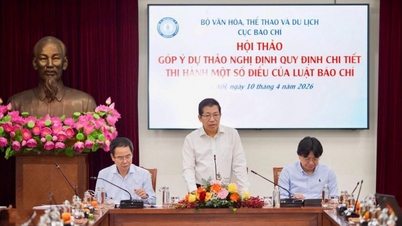
I believe that the National Assembly's adoption of the amended Press Law is extremely timely and in line with global press trends as well as the current requirements for managing the domestic press. The Press Law No. 103/2016/QH13, enacted nearly 10 years ago, has become too restrictive after years of implementation, no longer compatible with the current space, nature, scale, and impact of journalistic activities. The press is now operating with new tools, new means, and new platforms; the public has changed, and management methods are no longer the same as before.
Furthermore, the restructuring of the national press system, coupled with the organization of a two-tiered local government, also requires a new legal framework to suit the streamlined press organizational model. Adding to this the rapid development of journalistic technology, social media, and digital communication, the amendment and promulgation of the Press Law at this time is entirely justified.
A new, superior, and important feature of the amended Press Law is the clear establishment of the scope of journalistic activities in cyberspace. This expands the scope of journalistic activity, no longer confined to traditional spaces, thereby creating more job opportunities and opening up significant development potential for press agencies and journalists. In my opinion, press agencies need to quickly exploit this advantage, updating their operating models to suit the changing landscape of journalism and media driven by social networks and the digital environment.
The amended Press Law also includes other new points such as regulations allowing press agencies to provide services on digital platforms; recognizing the model of leading multimedia press agencies; establishing the position of scientific journals; providing clearer regulations on issuing journalist cards; and many contents related to the economics of journalism, revenue sources, prohibited activities, the operation of the Journalists' Association, and especially regulations on copyright in cyberspace – which is very necessary in the current context of journalism.
Article 15, point 5 defines the concept of a leading multimedia press agency as having multiple types of media and affiliated press agencies; possessing a specific financial mechanism; and being established in accordance with the Strategy for the Development and Management of the Press System approved by the Prime Minister. Point 6 stipulates that press and radio/television agencies under provincial and city Party committees have multiple types of media and journalistic products.
Combining these two points, I believe that Hanoi and Ho Chi Minh City – the two largest media centers in the country – are fully capable and strongly encouraged to adopt the model of a leading multimedia news agency. This would expand the scope of operations, leverage the potential and advantages of these major localities, and align with international media trends.
Source: https://hanoimoi.vn/tien-si-nha-bao-tran-ba-dung-luat-bao-chi-sua-doi-mo-rong-khong-gian-hoat-dong-tao-dong-luc-moi-cho-bao-chi-viet-nam-726348.html
![[Photo] Standing Committee member of the Party Central Committee Tran Cam Tu working with the Central Inspection Committee](https://vphoto.vietnam.vn/thumb/1200x675/vietnam/resource/IMAGE/2026/05/28/1779969579668_ndo_br_bnd-2495-jpg.webp)










































































Comment (0)