

The amended Press Law introduces many new points, creating a strong and practical legal framework for the press to play its important role in the digital age, meeting the requirements of national development and integration in the new period.
The need for a new legal "framework"
In social life, the press is not merely a voice of information, but also a bridge between the Party, the State, and the people; a forum for ideology and public opinion; and a force for guiding, critically analyzing, and disseminating cultural values. As the country enters a period of deep integration, strong digital transformation, and socio-economic development with many new demands, this role becomes more important than ever.
First and foremost, with the demands of developing a knowledge-based economy, urbanization, institutional reform, state governance, and ensuring transparency, society requires the press to be responsive, multifaceted, and thorough; it must reflect truthfully and promptly, with analysis and critical commentary, to help the public and policymakers clearly see the reality, recognize their responsibilities, and adjust policies.
Next, under the pressure of globalization, with information spreading rapidly from multiple sources, Vietnamese journalism needs to adapt: Content competition, pressure for digital transformation, the need for multiple platforms, increased format and interaction, all while maintaining journalistic quality, ethical principles, and professional conduct. Not only print media, but also online media, multimedia, social networks, and digital content all require quality control, ensuring credibility, protecting readers, safeguarding copyright, and preventing information overload.
Furthermore, in the context of streamlining the press apparatus, especially at the local, ministerial, and departmental levels, a clear mechanism is needed for newspapers, radio, and television stations to merge and reorganize while ensuring content production capacity, diverse formats, maintaining political orientation, and professional quality. Without a suitable legal framework, overlapping and confusion in management are likely to arise, affecting journalistic activities.
A new source of strength for Vietnamese journalism.
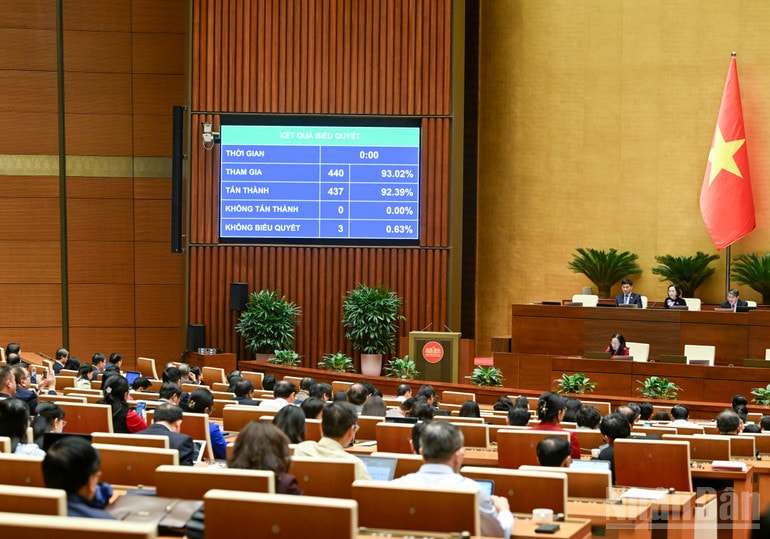
The National Assembly's approval of the amended Press Law with a majority vote (437 out of 440 attending delegates voted in favor) demonstrates a high level of political determination to meet the demands of modern innovation. The amended law introduces many new provisions, creating a strong and practical legal framework for the press to play its role in the digital age, in line with development and integration requirements.
One of the key new features of the amended Press Law is the concept of a "multimedia flagship press agency," allowing the press to operate across multiple platforms—print, online, radio, television, and digital content platforms—under a single management authority. This regulation aligns perfectly with current trends, as the press needs diverse formats to meet public needs, from reading, listening, watching, and interacting online. The multimedia flagship mechanism helps consolidate resources, avoid duplication, reduce costs, and improve the efficiency of information production and distribution. For localities, ministries, and agencies with multiple newspapers, magazines, and radio stations, the Press Law paves the way for restructuring the press system towards a more streamlined and efficient structure, while maintaining the multi-platform capabilities of the press.
In the report on the acceptance, explanation, and revision of the draft Law before the National Assembly's vote, the Chairman of the Culture and Social Affairs Committee, Nguyen Dac Vinh, clarified that the phrases "leading multi-media media agency" and "leading multi-media press agency" are being used in various documents and are not the names of the agencies. They merely identify the "leading" status and "multi-media" nature of the six leading press agencies as defined in Decision No. 362/QD-TTg of the Prime Minister approving the National Press Development and Management Plan. Based on the Law's scope of regulation, which is the organization and operation of the press, the National Assembly Standing Committee directed the revision to "leading multi-media press agency" to ensure accuracy and consistency.
The amended Press Law has also added policies for press development, such as a system for planning the press network; prioritizing investment in infrastructure and technology; supporting training and human resource development; and protecting copyright, intellectual property rights, and the rights of journalists. In particular, the financial mechanism for the press has become clearer. Legitimate press agencies are allowed to exploit various legitimate revenue sources, along with tax incentives and investment support, creating sustainable conditions for the press to be self-reliant, develop professionally, and innovate. This is of great significance, especially for agencies undergoing mergers or restructuring, helping them to operate with peace of mind, plan for long-term development, invest in staff, technology, and digital platforms, and meet the diverse demands of modern readers.
The amended Press Law also specifies the conditions for establishing press agencies, organizational structure, from the governing body, subordinate agencies, resident reporters, representative offices, etc., to the procedures for issuing press cards. The initial issuance of a press card requires completion of a professional training course on professional ethics. The law clearly defines the rights and obligations of agencies and reporters, helping to increase transparency in journalistic activities, protect journalists, ensure accountability to readers, and enhance the prestige and public trust in mainstream journalism.
With the new legal framework, Vietnamese journalism has the conditions to develop according to modern models: multimedia journalism, data-driven journalism, and multi-format journalism. The amended Press Law lays the foundation for the application of technology, digital platforms, diverse cooperation, improved quality and efficiency of information, and faster and wider dissemination. For merged entities, the multimedia model helps leverage shared resources, human resources, technology, and infrastructure, while preserving identity and increasing competitiveness, synchronization, and modernization.
The law was drafted in the context of the government's policy of streamlining the administrative apparatus, reducing duplication, and improving management efficiency, and the press is not exempt from this change. The consolidation and reorganization into a single-agency model helps reduce the number of departments, lower costs, avoid overlaps, and increase the effectiveness of management and practical operations.
With the new legal framework, Vietnamese journalism now has great opportunities for development, but at the same time faces many challenges, requiring leaders, journalists, and the entire system to work together and decisively innovate.
Seize opportunities, overcome challenges, and fulfill your responsibilities.
The newly passed amended Press Law will create opportunities for reorganizing the press system to better suit modern requirements, identity, capacity, multimedia, and efficiency; while simultaneously leveraging resources and support policies, fostering creativity, and experimenting with new models, data journalism, multi-platform journalism, and diverse content. The regulations and provisions help increase autonomy, reduce dependence on the state budget, create a healthy and professional competitive environment; and improve the quality of content, analysis, critique, and investigation, thanks to a trained workforce with legally valid press cards and clear legal responsibility.
Regarding challenges, mergers and reorganizations require media organizations to manage effectively, ensuring the unique identity of each publication and avoiding the loss of content and professional personnel. Investment in technical infrastructure, technology, CMS, data, and digital platforms demands resources and clear direction. Above all, it is essential to uphold journalistic ethics, copyright, and professionalism, avoiding sensationalist headlines and clickbait for profit; ensuring freedom of the press within the legal framework; and objectively identifying and reflecting social issues, shortcomings, and negative aspects while maintaining political direction and national interests.
It can be affirmed that the amended Press Law is a very important step forward, creating a powerful legal tool for Vietnamese journalism, suitable for the digital age and the requirements of innovation, integration, and sustainable development. With the new legal framework, journalism will have the opportunity to restructure, upgrade its capabilities, become more autonomous, diversify its forms, and specialize in more areas.
However, to turn opportunities into reality, press agencies, especially at the local, ministerial, and departmental levels, need to proactively innovate, build systematic development strategies, allocate resources, train high-quality human resources, invest in technology, and at the same time, maintain their journalistic integrity, professional ethics, and sustainable development orientation. Only then will Vietnamese journalism truly become stronger, not only in scale and form, but also in depth and prestige, making a worthy contribution to leading the way in development and international integration.
Regarding the pilot program for a multi-media flagship press group or corporation in Hanoi and Ho Chi Minh City, the National Assembly Standing Committee stated that the Government has directed the Ministry of Culture, Sports and Tourism to summarize the Plan for the Development and Management of the Press, and is expected to propose to the competent authorities the continued implementation of some viewpoints of the Plan and the addition of new viewpoints, including the establishment of a multi-media flagship press agency in Hanoi and Ho Chi Minh City. Based on the direction and approval of the competent authorities, the Ministry of Culture, Sports and Tourism will concretize these contents in the Strategy for the Development and Management of the Press System, ensuring feasibility, consistency, and alignment with the national press development orientation.
Source: https://hanoimoi.vn/quoc-hoi-thong-qua-luat-bao-chi-sua-doi-bao-chi-se-manh-hon-khi-co-cong-cu-phap-ly-quan-trong-moi-726318.html
![[Image] National Assembly discusses the implementation of the socio-economic development plan.](https://vphoto.vietnam.vn/thumb/1200x675/vietnam/resource/IMAGE/2026/04/20/1776696707422_ndo_br_img-20260420-185419-jpg.webp)

![[Photo] General Secretary and President To Lam meets with National Assembly delegates from ethnic minorities.](https://vphoto.vietnam.vn/thumb/1200x675/vietnam/resource/IMAGE/2026/04/20/1776696701056_a1-bnd-8331-3342-jpg.webp)





























































































Comment (0)