

 |
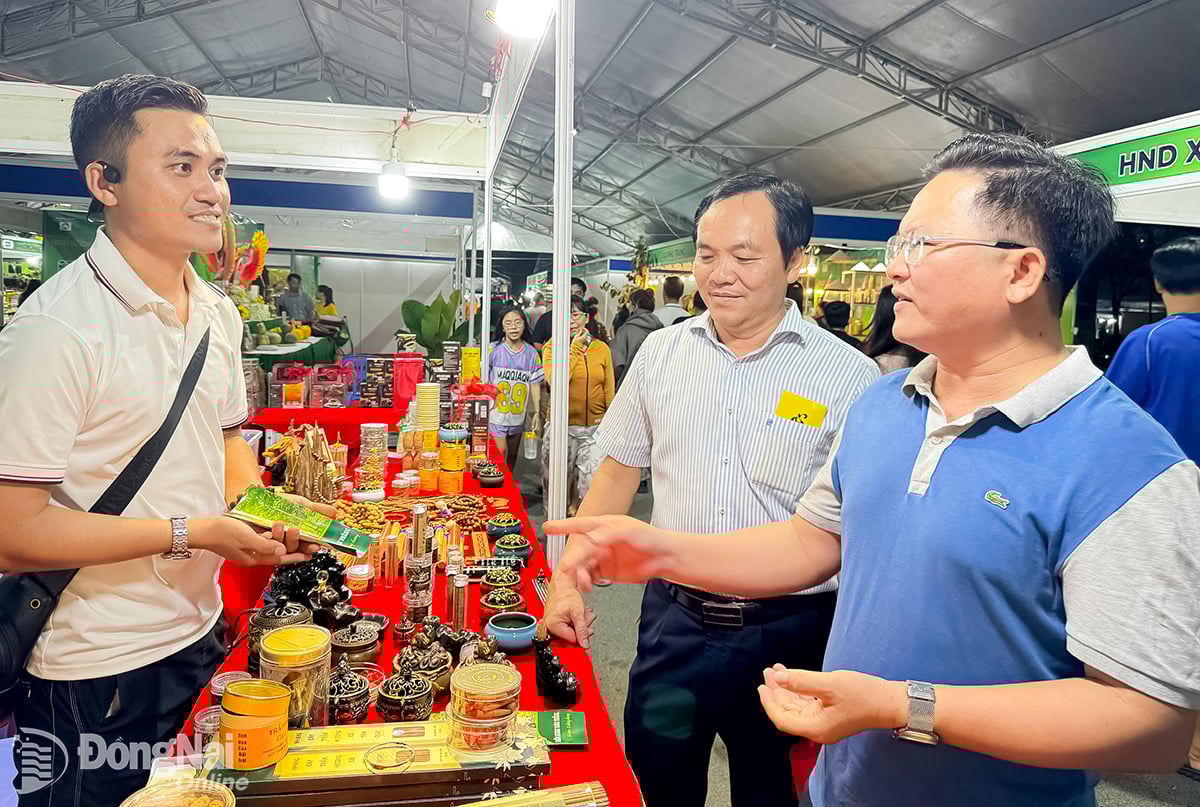
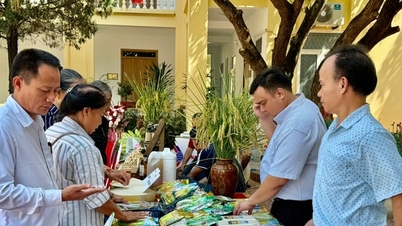
| Participating in the Dong Nai Province Agricultural Achievements Exhibition 2025, Toan Thang Agarwood Establishment attracted many visitors interested in learning about and purchasing its products. Photo: B. Nguyen |
This young farmer also started an investment in a production facility for handcrafted agarwood products, bringing high value. Notably, the facility has three products – agarwood bead necklaces, agarwood incense sticks, and agarwood incense cones – that have been certified as OCOP (One Commune One Product) products.
Grafting and renovating agarwood trees
Mr. Pham Xuan Toan recalled: “My family is originally from the former Phu Yen province, now Dak Lak province, which has a tradition of cultivating and harvesting agarwood in Vietnam. Since I was a child, I've known about agarwood and smelled its fragrance. Later, my family moved to Long Khanh to start a new life, buying 1.2 hectares of agricultural land to grow fruit trees. Because this is a barren, rocky hillside area, growing fruit trees wasn't effective. Therefore, in 2008, my family switched to growing agarwood trees.”
According to Mr. Toan, his family spent about 10 years perfecting the process of planting agarwood trees and creating resin from them. Mr. Toan shared: "The value of agarwood lies in its fragrance, so we cultivate the trees in a natural way, minimizing the use of chemical fertilizers and pesticides to preserve the pure fragrance." His family's agarwood forest is designed according to a circular economy model. He proactively implements preventative measures rather than curative ones to ensure the agarwood forest develops naturally. In each agarwood garden, he digs ponds to store water and raise fish, primarily feeding them with weeds from the forest. The water in the fish ponds, containing fish waste and various microorganisms, is used to irrigate the agarwood forest, resulting in rapid growth and a lush, green environment.
Toan Thang Agarwood Establishment has developed a mother tree garden of the Aquilaria species, including approximately 200 mother trees of the Ky Hai Nam variety. Due to market demand for agarwood products exceeding supply, the establishment wishes to cooperate with more farmers to expand the planting area of the new Ky Hai Nam Aquilaria variety.
When agarwood trees reach five years of age, growers must intervene to induce agarwood formation. The cost of purchasing chemicals to induce agarwood formation is often very high, and there is still a risk of unsuccessful agarwood production. Throughout the process of cultivating agarwood trees, his family independently researched and experimented to find a solution using biological products to induce agarwood formation at a lower cost, while simultaneously achieving a high agarwood yield.
After harvesting agarwood, growers usually have to replant a new batch of agarwood trees. But Mr. Pham Xuan Toan chose to preserve the agarwood roots and graft them to rejuvenate the agarwood forest. In 2018, after accidentally obtaining an agarwood variety from Hainan Island (China), Mr. Toan experimented with grafting to improve naturally grown agarwood trees, using the rootstock of a native agarwood tree and grafting it with the Hainan variety to create a new tree that he named the "Ky Hainan" variety. The outstanding advantage of this new agarwood variety is that after only 3 years of grafting, the tree can produce agarwood, and after about 6-7 years it can be harvested, reducing the time for planting and agarwood production. Importantly, this agarwood variety can use a physical method that is closest to the natural agarwood production process, so it carries virtually no risk compared to the biological or chemical methods used previously.
Investing in deep processing
After 10 years of cultivating agarwood trees, the facility began harvesting its first batch of agarwood-producing trees. Driven by his passion for agarwood, Mr. Toan researched and learned about making agarwood products. Initially, the facility mainly produced agarwood bracelets. Seeing the high market demand for agarwood products, the facility focused on investing in deeper processing.
Mr. Toan commented: Since ancient times, agarwood has been considered the "king of woods," bringing good fortune, exuding a luxurious and refined fragrance, and offering many benefits to those who appreciate it. Each agarwood core has countless shapes that can be used to create various art products, such as agarwood statues, feng shui agarwood ornaments, bracelets, bead necklaces, pendants, and Buddha car ornaments...
No part of the agarwood tree is wasted; the wood near the core can be ground into agarwood chips, incense sticks, agarwood cones, etc. The collected agarwood dust is used to make incense or distill agarwood oil, which is worth hundreds of millions of VND per liter. The facility is currently processing about 50 product lines from agarwood. Among them, the high-end product line made from agarwood from Ky Hai Nam is very popular in the market, bringing much higher economic value than agarwood grown using traditional methods.
Mr. Pham Xuan Toan compared: With traditional Aquilaria trees, it takes about 8 years to harvest 5-6 kg of agarwood, which sells for over 2 million VND on the market. The Ky Hai Nam Aquilaria tree, however, only yields about 1 kg of agarwood after 7 years, but sells for 25-30 million VND/kg because this agarwood is very similar to natural agarwood, has a very fragrant scent, and contains a high concentration of agarwood essential oil.
The facility's products sell well on e-commerce platforms and are supplied to many provinces and cities nationwide. Toan Thang Agarwood Facility has expanded its agarwood cultivation area to 11 hectares, including 2 hectares planted with the Ky Hai Nam agarwood variety.
Mr. Tran Ba Linh, Chairman of the Long Khanh Ward Farmers' Association, commented: "The Toan Thang Agarwood facility, with its model of agarwood cultivation and processing, is a leading example in the locality. In particular, the solution of grafting and improving the Aquilaria tree, creating the new Ky Hai Nam variety, is an effective economic model that the locality encourages to replicate in the future. The facility also has 3 products that have achieved OCOP 3-star certification. Accordingly, the locality, including the Long Khanh Ward Farmers' Association, is very interested in and supportive of the facility's participation in trade and commerce promotion programs to promote and build the brand for the local specialty products. Notably, the facility was recently selected by the Farmers' Association to participate in the Dong Nai Province Agricultural Achievements Exhibition in 2025."
Plains
Source: https://baodongnai.com.vn/kinh-te/202511/trong-do-bau-tao-tram-thuan-theo-tu-nhien-cb12256/

![[Photo] First session of the 14th Congress of the Vietnam Trade Union](https://vphoto.vietnam.vn/thumb/1200x675/vietnam/resource/IMAGE/2026/06/03/1780465947883_ndo_br_img-3852-jpg.webp)





























































Comment (0)