

Ningdong, China's first hydrogen locomotive converted from an internal combustion engine, rolled off the assembly line at CRRC's Datong subsidiary on June 15.
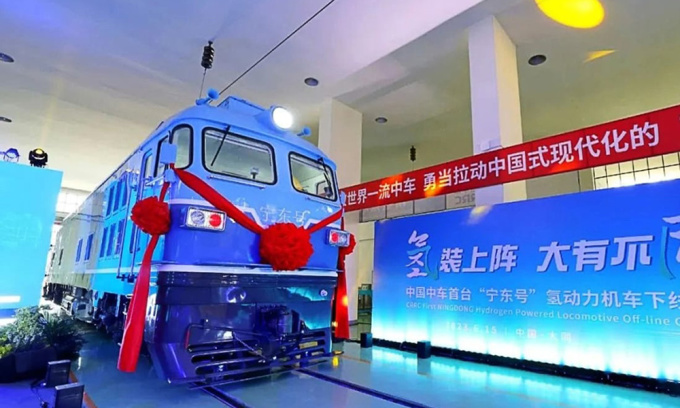
The hydrogen-powered locomotive was converted from an internal combustion engine. Photo: Weibo/SCMP
Ningdong is touted as the world's most powerful hydrogen-powered locomotive, with the potential to replace most fossil fuel engines currently in use, according to SCMP . It can hold 270 kg of hydrogen and run continuously for up to 190 hours.
The new locomotives, equipped with a hydrogen storage system, can be refueled in two hours and operate more cheaply, according to Liang Zhenzhong, deputy general manager and chief engineer of CRRC Datong. "Hydrogen is a clean, renewable energy. The operating costs of hydrogen-powered locomotives are only about half those of internal combustion locomotives," he said.
China has over 7,800 internal combustion engines powered by fossil fuels, accounting for 36% of the country's total locomotive fleet. CRRC's technology could replace more than 90% of those engines.
Hydrogen has great potential for reducing emissions because, unlike fossil fuels, it does not produce pollutants or greenhouse gases. The only byproducts emitted by hydrogen-powered vehicles are heat and water.
Hydrogen engines operate when hydrogen interacts with oxygen in a fuel cell, a reaction that produces steam and electricity. Fuel cells and hydrogen storage tanks are typically located on the roof of the train.
Hydrogen can be produced from various sources such as natural gas, nuclear power, biomass, and renewable energy. If produced from renewable energy sources, the hydrogen is called "green hydrogen," and the entire process becomes clean and sustainable.
The world's first hydrogen-powered passenger train began commercial operation in Germany in 2018 and had traveled more than 220,000 km across eight European countries as of January, according to the train manufacturer, the French company Alstom.
China plans to boost the development of hydrogen-powered vehicles, aiming to have 50,000 fuel cell vehicles by 2025, according to a plan by the National Development and Reform Commission of China in March 2022. The country also aims to build hydrogen refueling stations and produce 100,000-200,000 tons of green hydrogen annually by 2025.
In December 2022, CRRC unveiled a hydrogen-powered train in Chengdu, the capital of Sichuan province in southwestern China. The local newspaper, Chengdu Daily, described it as the world's fastest train of its kind, reaching speeds of 160 km/h. The train's fuel cell provides a range of 600 km – enough for a full day of use without refueling.
Thu Thao (According to SCMP )
Source link
![[Photo] Closing Ceremony of the 10th Session of the 15th National Assembly](/_next/image?url=https%3A%2F%2Fvphoto.vietnam.vn%2Fthumb%2F1200x675%2Fvietnam%2Fresource%2FIMAGE%2F2025%2F12%2F11%2F1765448959967_image-1437-jpg.webp&w=3840&q=75)




![[Photo] Prime Minister Pham Minh Chinh holds a phone call with the CEO of Russia's Rosatom Corporation.](/_next/image?url=https%3A%2F%2Fvphoto.vietnam.vn%2Fthumb%2F1200x675%2Fvietnam%2Fresource%2FIMAGE%2F2025%2F12%2F11%2F1765464552365_dsc-5295-jpg.webp&w=3840&q=75)

![Oil and Gas Industry - Clean Fuels for Green Transportation: [Part 2] Solid Foundation](https://vphoto.vietnam.vn/thumb/402x226/vietnam/resource/IMAGE/2025/11/11/1762841724562_h3-tau-maran-gas-achilles-tien-vao-kho-cang-lng-thi-vai-danh-dau-su-kien-dau-tien-va-quan-trong-nhat-trong-lo-trinh-chuyen-doi-nang-luong-xanh-cua-pv-gas-141854_697-160831-200134_900-131226.jpeg)







































![[OFFICIAL] MISA GROUP ANNOUNCES ITS PIONEERING BRAND POSITIONING IN BUILDING AGENTIC AI FOR BUSINESSES, HOUSEHOLDS, AND THE GOVERNMENT](https://vphoto.vietnam.vn/thumb/402x226/vietnam/resource/IMAGE/2025/12/11/1765444754256_agentic-ai_postfb-scaled.png)
















































Comment (0)