

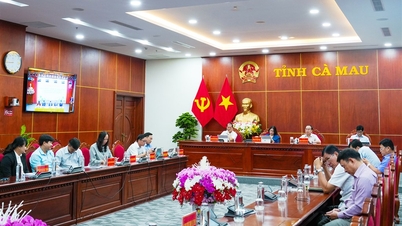
This information was presented at the conference "Current Status of Supply of Seedlings, Feed, and Materials for Marine Aquaculture; Product Traceability and Solutions for Sustainable Development of Marine Aquaculture in Vietnam," organized by the Ministry of Agriculture and Rural Development in coordination with the People's Committee of Khanh Hoa Province, held in both in-person and online formats on the morning of November 25th.
China is the main market for Vietnamese lobster.
According to Mr. Tran Cong Khoi, Head of the Aquatic Animal Breeding and Feed Department of the Fisheries Department (Ministry of Agriculture and Rural Development), the export value of lobsters in Vietnam in the first six months of 2023 reached nearly 130 million USD, 30 times higher than the same period last year.
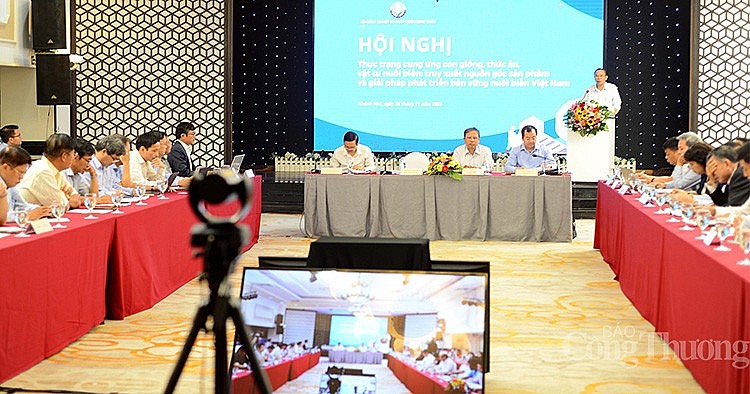 |
| Overview of the Conference |
At one point, prices doubled, reaching 1.7 million VND/kg for spiny lobster and 1.3 million VND/kg for green lobster. The main reason was the increased demand for seafood in various countries, especially in China, Vietnam's largest lobster import market, which reopened after a long period of closure to prevent the spread of Covid-19.
Regarding information on the export of spiny lobsters to the Chinese market, Mr. Le Ba Anh – Deputy Director of the Department of Quality, Processing and Market Development (Ministry of Agriculture and Rural Development) – stated that currently, green lobsters and spiny lobsters are the main lobster species exported. In Vietnam's lobster export markets, China accounts for 98-99%; other markets such as Thailand, Singapore, Hong Kong (China), and Taiwan account for 1-2%.
Specifically for the Chinese market, Vietnam currently has 46 packaging facilities exporting lobster to this market (out of a total of 57 facilities packaging live seafood exported to China). In the first nine months of 2023, lobster exports to the Chinese market reached over 95 million USD (a decrease of more than 46% compared to the same period in 2022).
To allow lobster to enter the Chinese market, Mr. Le Ba Anh said that businesses need to ensure that the requirements of the national Food Safety Management System are assessed and recognized as equivalent by the General Administration of Customs of China. The exported product must be on the list recognized by China (128 species/product types and 48 species of live aquatic animals).
In addition, aquaculture facilities are inspected and certified by local aquaculture/veterinary authorities for food safety and veterinary hygiene conditions, assigned identification numbers, and subject to disease monitoring during the farming process. Export shipments are issued certificates; a daily list of certificates is sent to Chinese Customs (Nanning) for verification…
China has introduced several new regulations regarding the export of spiny lobster.
Notably, from February 1, 2021, the Chinese market classified spiny lobster as a Group II endangered species. In May 2023, China amended its Wildlife Protection Law, prohibiting the harvesting of animals on the 2021 endangered list. This includes a ban on the harvesting, use, and trading of wild spiny lobsters. The General Administration of Customs of China has instructed its customs system at border crossings to strictly control the import of wild-harvested spiny lobsters. “Not only in the Chinese market, but spiny lobsters are also in Group II of Vietnam’s List of Endangered and Rare Aquatic Species (according to Appendix II, Decree 26/2019/ND-CP),” Mr. Le Ba Anh added.
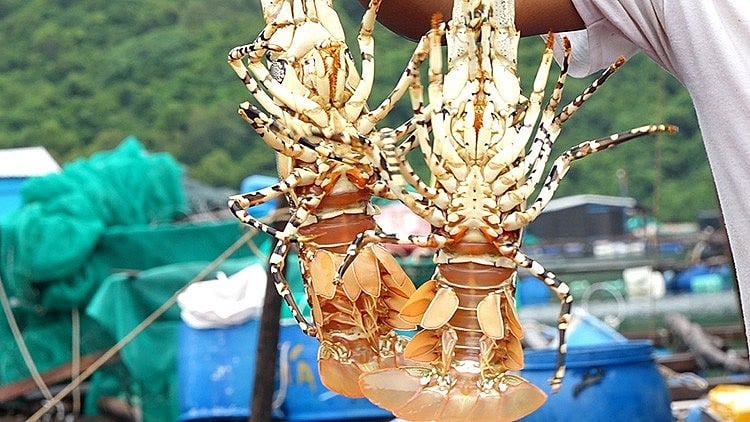 |
| Lobster exports |
To determine whether lobsters are farmed, they must have undergone a farming process, not direct fishing. If the juveniles are harvested from the wild, they are also considered wild-harvested lobsters. Chinese importers wishing to import them must obtain a permit from the Fisheries Administration (Ministry of Agriculture of China).
In addition, exporting countries must compile statistics on farming facilities and production volume; register spiny lobster farming facilities; and register export packaging facilities with the General Administration of Customs of China for approval (the Department of Quality, Processing and Market Development has issued Documents No. 1388 and 1389/CCPT-ATTP dated November 23, 2023, to guide the statistical compilation and registration). The forms and registration information will be sent through the Vietnamese Trade Office in China. After receiving the information, Chinese Customs will conduct both in-person and online inspections before approval.
Regarding this issue, Mr. Phan Quang Minh - Deputy Director of the Department of Animal Health (Ministry of Agriculture and Rural Development) - said that China changed its lobster management measures in 2023, defining farmed lobsters as those originating from F2 broodstock.
In addition to market difficulties, experts say that lobster larvae are heavily dependent on imports from Indonesia, the Philippines, Myanmar, Sri Lanka, and Singapore. In 2022, the number of imported larvae was 81 million; in the first six months of 2023, this figure was 59 million.
However, the lobster industry faces several challenges, such as export bans by some countries, leading to unstable supply; in July 2023, authorities discovered five batches of lobster larvae imported from Malaysia infected with white spot disease caused by the WSSV virus.
The lobsters are fed entirely live food, including various types of fish, golden apple snails, mollusks, crabs, etc., in the cages used for farming, which causes environmental pollution and disease outbreaks.
Furthermore, the supply of feed for lobsters is unstable and difficult to control. Meanwhile, industrial feed is only suitable for lobster farming in tanks; it is not yet suitable for sea cage farming. Although industrial feed helps control diseases and the environment, it can only be implemented on a small scale.
Referring to the upcoming requirements of the Chinese market for lobster larvae, Mr. Phung Duc Tien – Deputy Minister of Agriculture and Rural Development – suggested that relevant units should focus on research and solutions.
Reiterating the Marine Economic Development Strategy, the leaders of the Ministry of Agriculture and Rural Development emphasized the need to shift from traditional methods of aquaculture and fisheries to industrial-scale, high-tech applications. Promoting sustainable aquaculture and fisheries activities aims to make the fisheries sector sustainable, modern in production, elevated in integration, and accelerated in exports.
Source link






















































































Comment (0)