


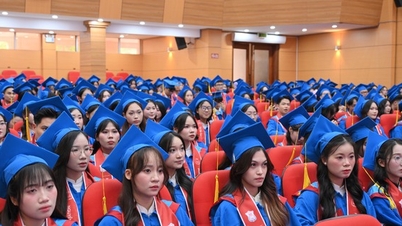
Dr. Pham Van Thai, Deputy Director of the Center for Nuclear Medicine and Oncology (Bach Mai Hospital) - seventh from the right in the photo - and several resident doctors who chose nuclear medicine as their specialty during the matching day on September 9th - Photo: Hospital provided.
According to Hanoi Medical University, this is the 50th residency program of the university. The residency training program is considered "elite training" by the medical community due to its difficulty and stringent requirements, although the opportunity to become a resident doctor is now much higher than in the past.
When the teacher uses "PR" to attract students.
For several days before the matching day, many professors and lecturers promoted their programs on social media, inviting talented doctors to register for their specialties. Associate Professor Do Gia Tuyen, head of the Internal Medicine Department at Hanoi Medical University, "encouraged" them: "General internal medicine residency is not just a specialty; it's the foundation of clinical medicine, the heart of the hospital. Choosing general internal medicine, you'll have the opportunity to comprehensively access all fields, from cardiovascular, respiratory, nephrology, and urology..."
Dr. Nguyen Quang Bay, an endocrinology specialist at Bach Mai Hospital and a lecturer at Hanoi Medical University, shared that as September 9th (the day the university organizes matching day) approaches, departments are actively inviting talented doctors to register for residency training.
Although Dr. Bay believes that choosing any specialty is noble, he still added a note on his personal page: "Wishing the 50th cohort of residents wise choices in their general internal medicine specialization."
This year, a total of 426 doctors chose their residency specialty, and the act of doctors calling out their names and chosen residency specialty caused a sensation on social media.
Why is Matching Day so important?
Associate Professor Pham Cam Phuong, director of the Center for Nuclear Medicine and Oncology (Bach Mai Hospital) and lecturer at Hanoi Medical University, who was part of the 26th residency program, said that during her residency, only 50 doctors from each graduating class were accepted into the residency program.
Those are the top-scoring students. To get into residency, doctors may have studied day and night since entering school.
"Back then, each doctor eligible for residency would register for a specialty first, taking the exam with others who had registered for that specialty. Then the professors realized that some highly skilled doctors had registered for specialty A, but specialty A only accepted two residents. That doctor, despite being very good, ranked third and failed the exam. That's why there was 'matching day,' where doctors with higher scores got to choose their specialty first," Dr. Phuong shared.
Because the selection process starts from the highest-scoring candidates, there are cases where a doctor only finds that there are no vacancies in a popular specialty or the field of medicine the doctor has chosen.
That's why some doctors hesitate and feel confused when deciding on a specialty after their names are called out. "There are cases where, six months after starting their studies, they want to change specialties because it's not a good fit. Residency is just one path," one doctor wrote.

The resident doctor with the highest score in this year's matching day (left in the photo) - Photo: NGUYEN BAO
Training elite doctors?
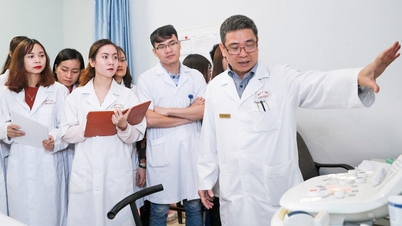
Although the number of resident doctors selected in recent years is significantly higher than before, this is still the training system that produces the best in the medical profession. After 6 years of general medicine, doctors will have an additional 3 years of "training" at the hospital. This is the time when doctors accumulate clinical experience, and upon graduating from residency, they can work independently.
According to Hanoi Medical University, as of 2024, the university has trained nearly 5,200 resident doctors, with over 3,300 doctors trained in the last nine years alone. Many resident doctors have become leaders in the Ministry of Health , hospital leaders, highly skilled professionals, leading doctors in their fields, and their "resident doctor" degree is always highly valued by hospitals, patients, and colleagues.
"In the past, we received a salary sufficient to cover our tuition while studying. Now, resident doctors don't receive a salary and also have to pay tuition fees (except for doctors with contracts at hospitals after graduation), so the cost of medical education is even higher. If resident doctors were paid, it would be more reasonable and allow them to fully dedicate themselves to their profession," shared Dr. Cam Phuong.
Source: https://tuoitre.vn/vi-sao-ngay-matching-day-chon-bac-si-noi-tru-hot-ran-ran-tren-mang-xa-hoi-20250911193417914.htm





























![[Image] Close-up of the newly discovered "sacred road" at My Son Sanctuary](/_next/image?url=https%3A%2F%2Fvphoto.vietnam.vn%2Fthumb%2F1200x675%2Fvietnam%2Fresource%2FIMAGE%2F2025%2F12%2F13%2F1765587881240_ndo_br_ms5-jpg.webp&w=3840&q=75)




























































Comment (0)