

According to information from the Import-Export Department ( Ministry of Industry and Trade ), exports of cassava and cassava products rebounded in March 2024. Statistics from the General Department of Customs show that in March 2024, Vietnam exported 314,860 tons of cassava and cassava products, worth US$142.09 million, an increase of 45.1% in volume and 47.6% in value compared to February 2024.
In the first three months of 2024, exports of cassava and cassava products reached 944,930 tons, valued at US$430.44 million, a decrease of 3.3% in volume but an increase of 15.6% in value compared to the same period in 2023.
Specifically for cassava, in March 2024, cassava exports reached 88,060 tons, worth 23.02 million USD, an increase of 35.9% in volume and 39.4% in value compared to February 2024.
The average export price was $261.5/ton, up 2.6% compared to February 2024, but down 10.9% compared to March 2023. For the first three months of 2024, cassava exports reached 220,440 tons, valued at $56.59 million, a decrease of 41.8% in volume and 45.7% in value compared to the same period in 2023.
Regarding export prices, in the first three months of 2024, the average export price of cassava and cassava products reached US$455.5 per ton, an increase of 19.5% compared to the same period in 2023.
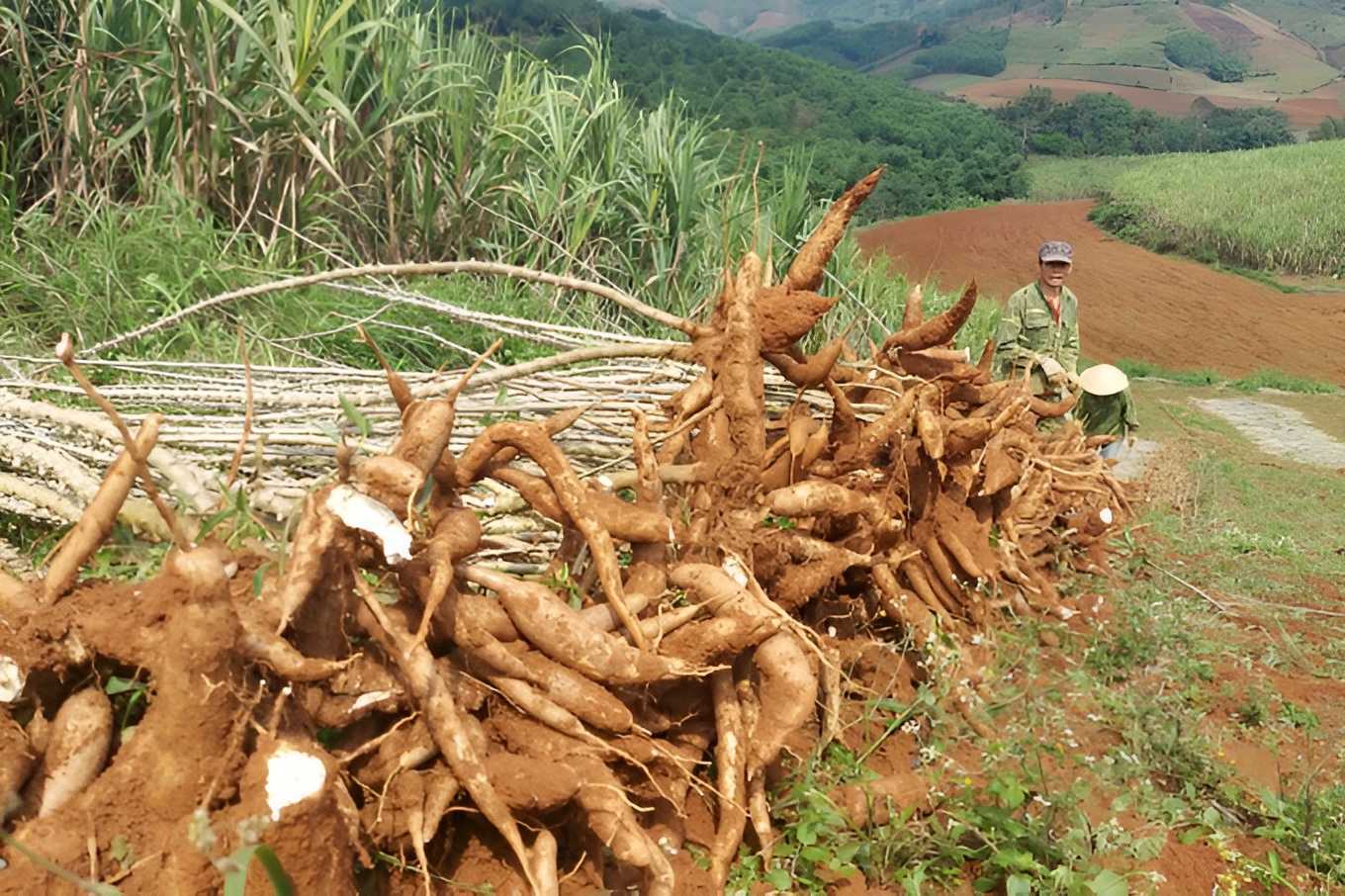
Vietnam has surpassed Thailand to become the largest supplier of cassava starch to China. (In the photo: Farmers in Thua Thien Hue province harvesting cassava. Photo: Thua Thien Hue Newspaper.)
Meanwhile, Vietnamese factories are offering exported cassava starch at 535-555 USD/ton, FOB Ho Chi Minh City port. Prices for cassava starch delivered to Mong Cai and Lang Son fluctuate between 4,000-4,180 CNY/ton.
The export price of iron bars to the Chinese market is 275 USD/ton, FOB Quy Nhon; the export price to the South Korean market is approximately 315 USD/ton, FOB Quy Nhon.
According to the Import-Export Department, in March 2024, China remained Vietnam's largest export market for cassava and cassava products, accounting for 94.24% of the country's total cassava exports, reaching 299,610 tons, worth US$133.56 million, an increase of 50.7% in volume and 55.1% in value compared to February 2024; and an increase of 33.2% in volume and 59.6% in value compared to March 2023.
In the first three months of 2024, Vietnam exported 890,550 tons of cassava and cassava products to China, worth US$400.12 million, an increase of 0.7% in volume and 20.7% in value compared to the same period in 2023.
As can be seen, China is currently the world's largest importer of cassava and cassava starch. According to statistics from the Chinese Customs Administration, in the first two months of 2024, China imported 371,930 tons of cassava chips, worth US$99.43 million, a decrease of 69.1% in volume and 69.2% in value compared to the same period in 2023. Thailand, Vietnam, Laos, and Cambodia are the four main suppliers of cassava chips to China.
Notably, China's imports of cassava chips from Thailand and Vietnam decreased sharply, while imports from Laos and Cambodia increased.
In the first two months of 2024, Vietnam was the second largest supplier of cassava chips to China, with 101,340 tons, valued at US$26.63 million, a decrease of 39.3% in volume and 39.8% in value compared to the same period in 2023. Vietnam's market share of cassava chips accounted for 27.25% of China's total cassava chip imports, higher than the 13.87% recorded in the first two months of 2023.
Regarding cassava starch, in the first two months of 2024, China imported 584,540 tons of cassava starch, worth US$309.26 million, a decrease of 11.5% in volume but an increase of 3.2% in value compared to the same period in 2023, mainly imported from Thailand, Vietnam, Laos, Cambodia, and Indonesia.
In the first two months of 2024, Vietnam surpassed Thailand to become the largest supplier of cassava starch to China, with 267,930 tons worth US$137.94 million, a decrease of 6.1% in volume but an increase of 10.6% in value compared to the same period in 2023. Vietnam's market share of cassava starch accounted for 45.84% of China's total cassava starch imports, higher than the 43.19% recorded in the first two months of 2023.
Although demand from the Chinese market remains strong, according to the Vietnam Cassava Association, many factories have ceased production due to inconsistent raw material supply. Forecasting that summer 2024 will arrive earlier than 2023, the demand for cassava products in the processed food industry is showing signs of gradually decreasing as hot weather begins in early April 2024.
Export businesses are still purchasing and storing cassava chips in small quantities due to forecasts of decreased consumption in 2024 (estimated to be over 10% lower than in 2023). Therefore, some businesses trading in this product are considering expanding into other agricultural products to ensure their business targets are met.
Source








![[Video] Hue and Quang Ninh mark strong tourism growth](https://vphoto.vietnam.vn/thumb/402x226/vietnam/resource/IMAGE/2025/12/12/1765555481742_dung00-22-16-02still007-jpg.webp)






























































Comment (0)