

According to VNA, many Russian logistics companies have opened rail and sea routes to boost Vietnam-Russia trade, with FESCO Group playing a key role in the project to develop Ho Chi Minh City's seaport into a transshipment hub for goods to Southeast Asian countries.
According to German Maslov, Deputy General Director of Logistics at FESCO based in Vladivostok, after two years of operation, the sea route connecting Vladivostok with Vietnamese ports has proven highly effective, attracting significant interest from customers in both countries. From an initial single vessel, FESCO has now expanded to three regularly operating ships. The volume of goods transported between Vietnam and Russia by FESCO is projected to increase by 16% in 2025 compared to 2024. Goods from ASEAN countries to Russia are also transshipped through Vietnamese ports by FESCO.
 |
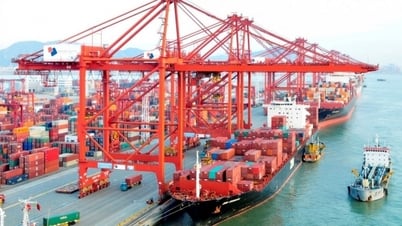
| The seaport planning will prioritize the development of international gateway ports combined with international transshipment hubs in Hai Phong and Ba Ria - Vung Tau. (Photo: Government Newspaper). |
Based on that success, two months ago FESCO opened additional shipping routes from Vietnam to the port of Saint Petersburg in the northwest and to the port of Novorosiysk in the south, meaning that goods can now be transported from Vietnam to all three of Russia's largest ports. Mr. Maslov affirmed that Vietnam has become an indispensable location for the development of logistics activities in this region.
Besides routes to Russia, Vietnam is also an important hub in regional routes. FESCO operates routes between Vietnam and Malaysia, Vietnam and Indonesia, and Vietnam and Thailand. Thanks to the Vietnamese gateway, FESCO's cargo volume with Malaysia has increased by 66%, and with Indonesia by 2 times, equivalent to thousands of containers of goods.
Mr. Maslov stated that Vietnam can be considered a key port hub for the transportation map with ASEAN, a factor in increasing cargo transport between Russia and ASEAN. Currently, FESCO has opened a representative office in Vietnam, and in the near future, FESCO is considering plans to build warehouses, port facilities, and establish joint ventures.
The Vietnamese Consul General in Vladivostok, Nguyen Viet Kien, stated that Vladivostok should first be viewed as a gateway, not just a market. If this gateway is exploited and seized in a timely manner, it will create even more favorable opportunities to further access the Russian market and the broader Eurasian market in general. Furthermore, the Far East will receive significantly more investment in the future, as Russian President Vladimir Putin announced at the recent Eastern Economic Forum that Russia will focus on energy development, road transport infrastructure development, and urban development in the Far East region.
This is a favorable time and opportunity for Vietnamese businesses to invest abroad, leveraging their role as pioneers and early adopters to capture initial market share. Mr. Nguyen Viet Kien emphasized that the Consulate General and the Trade Representative Office of Vietnam in Vladivostok are ready to act as a bridge and provide advice to domestic businesses in establishing and expanding investments.
Vietnam has currently established 32 maritime transport routes, including 25 international and 7 domestic routes. In addition to intra-Asia routes, the northern region has developed two routes to North America; the southern region has established 16 long-haul routes to North America and Europe, surpassing other Southeast Asian countries (only behind Malaysia and Singapore). Thanks to the government's open investment policies, Vietnam's port system has attracted many professional port operators and major international shipping companies to invest in the construction and operation of seaports. |
Source: https://thoidai.com.vn/viet-nam-la-cang-bien-dau-moi-voi-asean-216185.html


![[Photo] Prime Minister Pham Minh Chinh holds a phone call with the CEO of Russia's Rosatom Corporation.](/_next/image?url=https%3A%2F%2Fvphoto.vietnam.vn%2Fthumb%2F1200x675%2Fvietnam%2Fresource%2FIMAGE%2F2025%2F12%2F11%2F1765464552365_dsc-5295-jpg.webp&w=3840&q=75)















![[Photo] Na Ngoi Border Guard Station distributes 484 gifts to students and households before the cold season.](https://vphoto.vietnam.vn/thumb/402x226/vietnam/resource/IMAGE/2025/12/11/1765453782566_anh-don-bien-phong-na-ngoi-trao-484-suat-qua-cho-hoc-sinh-va-ho-dan-truoc-mua-gia-ret-20251211152111.jpeg)








































Comment (0)