

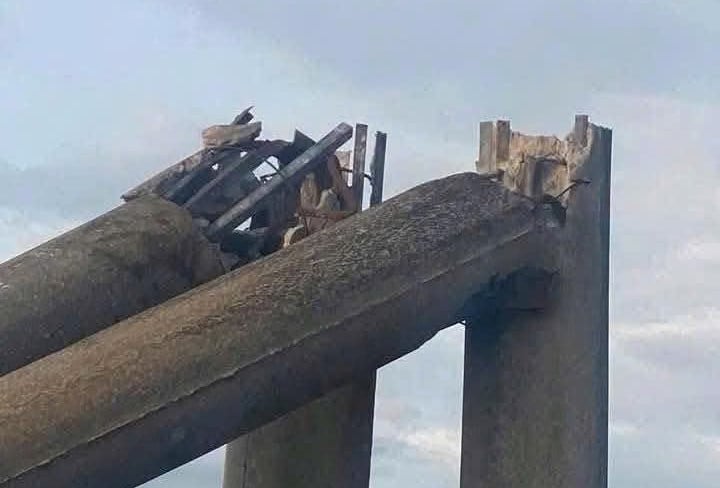
In recent days, the quality of some centrifugal concrete utility poles in Ha Tinh has become the focus of public attention, after many poles collapsed due to Typhoon Bualoi, exposing the internal structure and sparking much debate.
According to the Ha Tinh Power Company, these power poles belong to the project to upgrade the 35kV power line and 35/0.4kV transformer station at the Dong Loc Crossroads historical site. The project, implemented since 2013, underwent technical acceptance in April 2014, and was energized and put into operation in July 2014 to ensure a safe and stable power supply for the historical site and its residents.
In the project, the construction unit used centrifugal concrete columns manufactured by Khanh Vinh Co., Ltd.
In the document "Design of Centrifugal Reinforced Concrete Power Poles" dated January 2, 2013, this company provided an explanation and application of new technology in the production of steel-reinforced concrete poles.
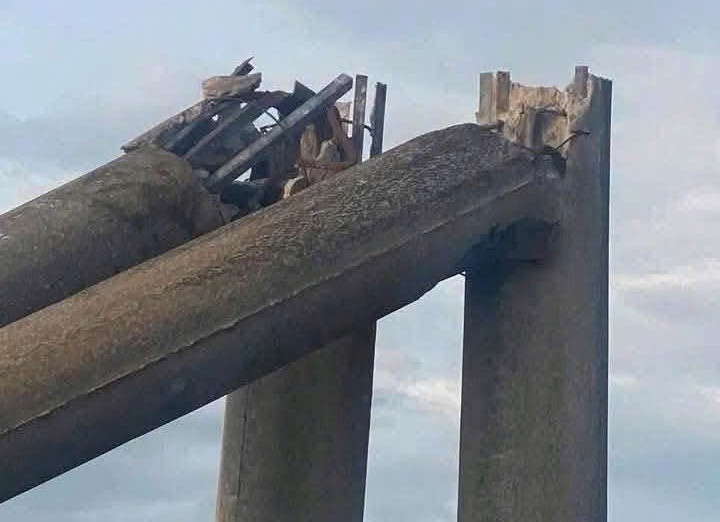
According to documents from Khanh Vinh Co., Ltd., Vietnam is gradually modernizing its national power grid system, especially in rural areas and remote regions with many rivers and high mountains. Therefore, transportation and construction are extremely difficult, and the lack of specialized transport vehicles significantly impacts the quality of the power poles.
To overcome these factors, the company has adopted structural reinforced concrete technology (rigid reinforced concrete).
The company cited research and experimental results showing that, with proper arrangement of structural steel, a rigid reinforced concrete column structure can withstand significant loads and remain safe even if the concrete is damaged.
After numerous trials, structural steel has been applied to the production of centrifugal concrete poles and square concrete columns, demonstrating high load-bearing capacity and reliability. As a result, this structure increases lateral stiffness and enhances the overall stability of the component.
According to the company's documents, structural steel profiles have previously been used effectively in constructions in many earthquake-prone countries because of their high stability and reliability when subjected to earthquake loads. This has been proven in practice, especially during the Kobe earthquake in Japan.
Khanh Vinh Company also revealed at the time that in early 2014, the company would produce a new type of lightweight concrete reinforcement with the same dimensions and cross-section but a weight reduction of 20-25%.
In the structural calculations for rigid steel columns subjected to compression and bending according to ACI318 (American Concrete Institute) and ASIC-LRFD standards, Khanh Vinh Co., Ltd. clearly states the column construction regulations: The arrangement of rigid reinforcement aims to create load-bearing capacity of the structure even when the concrete fails, while also improving the ductility of the structure when designing structures subjected to heavy loads.
It is possible to design the structure so that the concrete absorbs most of the load, especially earthquake loads, and is therefore susceptible to failure. The reinforcing steel will withstand the structural dead load and provide a certain degree of stiffness, reducing the risk of structural collapse.
According to documents from Khanh Vinh Co., Ltd., the calculation regulations of ACI318 for rigid concrete columns are similar to those for ordinary steel-reinforced concrete column structures. Significantly, repeated testing has shown that, with the same cross-sectional area of reinforcement in a structural element, if the structural reinforcement is designed and arranged appropriately, the column head load is greatly increased.
Source: https://vietnamnet.vn/vu-cot-dien-gay-do-o-ha-tinh-he-lo-ban-thiet-ke-chiu-duoc-ca-dong-dat-2448344.html


![[Image] Close-up of the newly discovered "sacred road" at My Son Sanctuary](/_next/image?url=https%3A%2F%2Fvphoto.vietnam.vn%2Fthumb%2F1200x675%2Fvietnam%2Fresource%2FIMAGE%2F2025%2F12%2F13%2F1765587881240_ndo_br_ms5-jpg.webp&w=3840&q=75)







































































Comment (0)