

On the afternoon of November 23, the National Assembly discussed the draft Law on Credit Institutions (amended) in the plenary session.
Representative Pham Van Hoa ( Dong Thap delegation) agreed with the need to revise regulations related to ending cross-ownership, manipulation, and control of banks, as this is a very important issue.
In fact, some of our banks have encountered this issue recently. According to the representative, it is important for banks to monitor and pay attention to cases where the bank owner is also a large business owner. For this case, the percentage of shareholders owned by the owners needs to be examined specifically.
In those banks, people's deposits don't reach borrowers or businesses that need them. Those who need to borrow face difficulties, while shareholders and owners of these banks borrow very easily.
"If we don't take timely preventive measures, the possibility of a SCB-like situation happening is very real," Mr. Hoa said, suggesting that the State Bank of Vietnam needs to pay more attention because, according to the information he has, there are currently banks owned by business owners, and they need to be carefully examined to ensure their safety.
"Don't talk about reducing the credit limit to 10% or 15%. For example, if you allow 10% but dozens of shareholders borrow 10%, how much money would that add up to? It's very dangerous if they all withdraw their money at the same time. I suggest that this area needs careful attention," Mr. Hoa emphasized.

Delegate Pham Van Hoa, from Dong Thap province (Photo: Quochoi.vn).
Also addressing this issue, delegate Trinh Xuan An ( Dong Nai delegation) emphasized that, according to the Central Committee's resolution and the National Assembly's resolution, we must not only deal with but also put an end to cross-ownership.
In fact, based on the SCB case and assessments of some current banks, delegates believe there are three issues: cross-ownership, control and manipulation of the credit system and banking system, creating risks—issues that urgently need to be addressed in order to build strong and thriving banks.
Mr. An emphasized that cross-ownership, control, and manipulation of banks are very sophisticated and often invisible tactics.
"However, with this intangible and constantly changing entity, we are using tools like the laws currently being designed, such as reducing shareholding ratios, lowering credit limits, and expanding the categories of individuals who are not allowed to hold positions... in other words, we are using the tangible to control the intangible. In my opinion, this is ineffective," Mr. An said.
According to Mr. An, it is crucial to identify the individuals or organizations that are the true owners of the bank. Therefore, the law needs to establish regulations to determine which individuals or organizations hold controlling power and influence over decision-making in banking operations.

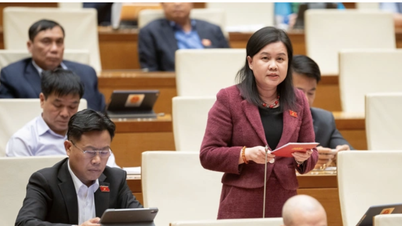
Delegate Trinh Xuan An, from Dong Nai province (Photo: Quochoi.vn).
To achieve this, Representative An proposed regulating two specific issues: Firstly, there needs to be transparency regarding the personal information of individuals and organizations that are shareholders of commercial banks, instead of reducing their ownership stake. Secondly, the obligation to disclose information to both institutional and individual shareholders, or groups of related parties, who own shares in credit institutions, needs to be defined above a specific threshold.
In addition, delegates argued that it is necessary to control the flow of money and capital contributions through cashless payment mechanisms and to implement controls on personal data.
"This regulation is very specific regarding cash flow because cash flow doesn't just appear out of nowhere. It has to come from somewhere, from an individual. The Van Thinh Phat case shows us such a lesson," Mr. An stated.
Regarding the frequently discussed issue of using nominees, Mr. An believes that the draft law's provision stating that shareholders "are not allowed to contribute capital or purchase shares of credit institutions under the name of other individuals or legal entities in any form, except in cases of entrustment as prescribed by law" is still too general.
The issue of using nominees to register accounts was clearly demonstrated in the recent SCB case. However, the regulations as drafted will be very difficult to enforce.
"What constitutes contributing capital or purchasing shares of a credit institution under the name of another individual or legal entity? How will this regulation be implemented in practice? I propose very specific regulations to provide a basis and methods for prevention, especially against the 'matrix' that we often euphemistically call the ecosystem created by the 'patrons' or 'madams' behind the banks," Mr. An suggested .
Source
































































































Comment (0)