

On the morning of November 26th, the trial of the case involving Xuyen Viet Oil Trading, Transportation and Tourism Company Limited continued with the defense arguments presented by the lawyers.
In his defense of former Deputy Minister of Industry and Trade Do Thang Hai, the lawyer argued that during his tenure, the defendant had repeatedly reminded the Domestic Market Department to fully implement the legally mandated assessment steps when granting licenses, and also requested prompt resolution to support domestic businesses.
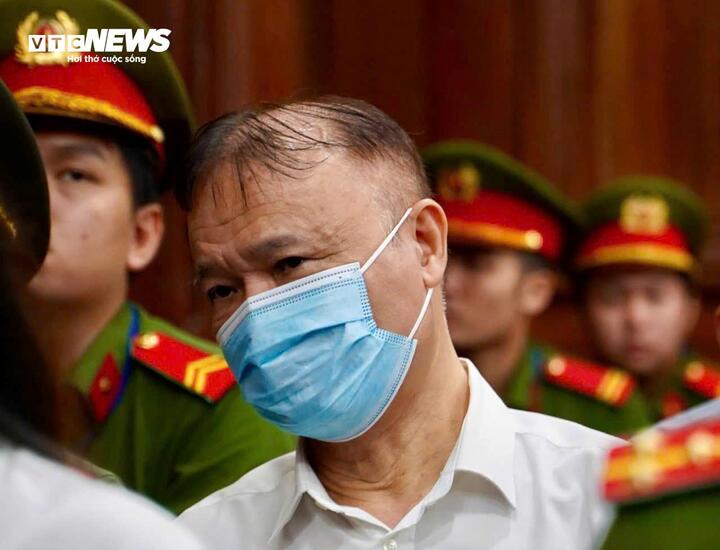
Former Deputy Minister of Industry and Trade Do Thang Hai at the court.
Regarding the alleged receipt of $50,000 from defendant Mai Thi Hong Hanh, the lawyer argued that when Ms. Hanh met with Mr. Hai to ask for assistance and mentioned "thank you," it was merely a polite formality.
The lawyer asserted that defendant Hai had no ulterior motive, and did not request or coerce defendant Hanh into paying a bribe to obtain the license. If there had been a demand, given his position as Deputy Minister of Industry and Trade and the importance of the license, the amount of bribe received could not have been limited to just 50,000 USD.
Furthermore, the lawyer emphasized that the defendant Hai did not place much importance on money. After the license was granted, Ms. Hanh repeatedly requested to meet with Mr. Hai again but was refused. When he received the gift from Ms. Hanh, due to being busy with work, Mr. Hai had to attend an urgent meeting and only opened the gift after a month, at which point he discovered that it contained $50,000.
Regarding mitigating circumstances, the lawyer stated that the defendant Hai had returned all the bribe money, had many outstanding achievements during his work, his family had contributed to the revolution, and many organizations and individuals had submitted petitions requesting leniency for Mr. Hai.
Regarding his family circumstances, the defendant's wife and sister are both suffering from cancer, and his younger brother has a mental illness. The lawyer requested the court to consider applying a special leniency policy, exempting the defendant Hai from punishment.
If a pardon is not possible, the lawyer hopes the court will consider mitigating the sentence so that the defendant receives the lowest possible sentence, below the prosecutor's recommendation.
In his supplementary defense, defendant Do Thang Hai admitted to the charges as stated in the prosecution's indictment. He stated that he had recognized his wrongdoing, did not deny guilt or blame his subordinates, and affirmed that he also bore responsibility when his subordinates made mistakes.
The defendant expressed his hope for leniency from the panel of judges, in a humane spirit. "I ask for leniency, because in this wrongdoing, I have clearly recognized my mistake and am not evading responsibility," defendant Hai said.
Also at the trial, the defense lawyer for defendant Hoang Anh Tuan (former Deputy Director of the Domestic Market Department, Ministry of Industry and Trade) agreed with the prosecution's view that the defendant was being tried for the right crime. However, the lawyer argued that a sentence of 7-8 years in prison was too high and harsh compared to the nature, extent, and context of the crime. The lawyer requested the panel of judges to consider mitigating circumstances and apply a lower sentence, from 4-5 years in prison.
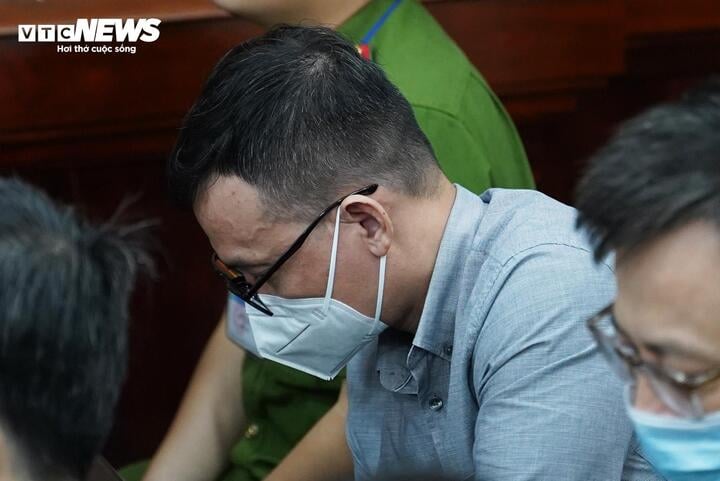
Defendant Hoang Anh Tuan at the trial. (Photo: Hoang Tho)
According to the lawyer, the giving and receiving of bribes stemmed from the initiative of the person giving the money; the defendant did not make any requests or demands.
Specifically, the defendant Hanh proactively sought introductions, approached, and gave money to the defendant Tuan. This is consistent with Hanh's testimony in court. The first time, Hanh gave $10,000 through an intermediary, Mr. Nguyen Van Thang (Deputy Director of the Hanoi Branch, Xuyen Viet Oil), but Thang only transferred $5,000 to Tuan. The second time, the amount given was also arbitrarily reduced by Thang without notification. If there had been a prior agreement, the defendant Tuan would have had to respond when the amount was not as expected.
Regarding the licensing of Xuyen Viet Oil Company, the lawyer argued that the defendant only conducted probabilistic inspections of certain points instead of inspecting the entire company. This stemmed from both subjective and objective reasons.
Subjectively, the defendant was influenced by and deferential to superiors, and was pressured to process the documents quickly. Objectively, the Ministry of Industry and Trade's management system had regular supervision from the provincial Departments of Industry and Trade, so the inspection team's observation instead of a full document check was reasonable.
The lawyer also pointed out the special context: the COVID-19 pandemic had just ended, travel was restricted, and the 49 Xuyen Viet Oil dealerships were distributed across 7 provinces and cities, making inspections difficult. The accused had to rely on video footage from the stores to replace direct inspections.
Furthermore, at this time, the Ministry of Industry and Trade must ensure national energy security. Revoking the licenses of violating stores would disrupt the supply chain and seriously affect the market.
The lawyer also argued that Xuyen Viet Oil accounts for 12% of the total national gasoline supply, 20% in the South, and 40% in Ho Chi Minh City. If the re-licensing is delayed, the market risks a sudden decrease in supply, causing serious disruption.
Furthermore, the lawyer emphasized that the defendant Tuan did not conceal any wrongdoing. In the licensing document, the defendant clearly stated that the inspection was only a probabilistic check, not a cover-up of any shortcomings in the inspection. Upon discovering irregularities in the management of Xuyen Viet Oil's price stabilization fund, the defendant resolutely proposed corrective measures, even revoking the license just four days after receiving the information.
The lawyer also requested the court to consider the defendant's work history, achievements, numerous commendations and certificates, and a petition for leniency from a union member.
In his self-defense, defendant Hoang Anh Tuan agreed with his lawyer's opinion, acknowledged his wrongdoing, and hoped the court would consider mitigating circumstances. The defendant expressed his wish for the court to weigh his merits and demerits, and for the lowest possible sentence so that he could return to his family and society as soon as possible.
Source: https://vtcnews.vn/vu-xuyen-viet-oil-luat-su-de-nghi-mien-hinh-phat-cho-cuu-thu-truong-cong-thuong-ar909673.html



















































































Comment (0)