

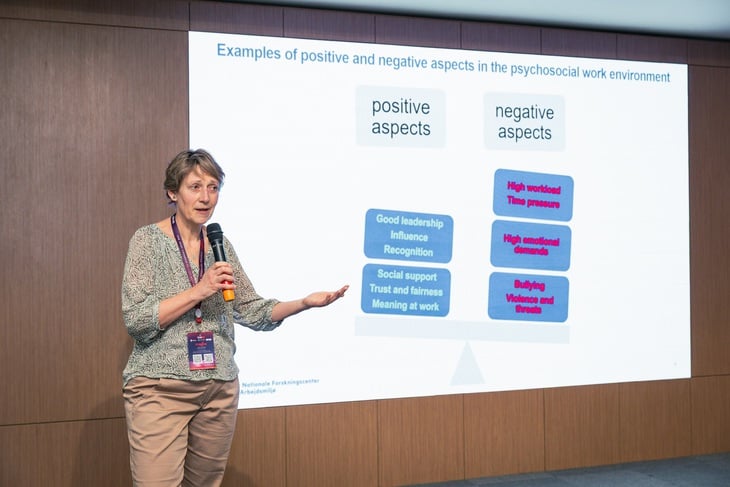
Dr. Birgit Aust, from the Danish National Centre for Workplace Research, shared several new studies related to workplace mental health - Photo: UEH.ISB
On December 10th, the international scientific conference "IMAGINE! Imagining the Future: Work and Mental Health" was organized by the World Occupational Health Commission on Work Organization and Psychosocial Factors at the UEH.ISB Talent School (University of Economics Ho Chi Minh City).
Numerous health and mental health risks
Professor Michael Quinlan, emeritus professor of labor relations at the University of New South Wales (Australia), shared historical data showing that psychosocial risks in the workplace have existed since the 19th century.
He cited records of poor laborers from the "sweat labor" era and compared the fundamental differences between today's ride-hailing, platform-based driver, and temporary labor models.
According to Professor Quinlan, modern forms of precarious employment, such as unstable income, lack of voice, technological surveillance, and high risk of job loss, are creating a vicious cycle of stress from which individuals cannot escape.
The studies he cited at the conference showed that migrant workers, women, and short-term contract workers are the groups most severely affected by mental health issues.
From a biological perspective, Professor Frida Marina Fischer, School of Public Health , University of São Paulo (Brazil), presented a series of evidence showing that the human body is being forced to work against its natural biological rhythm.
She stated that working night shifts, rotating shifts, or sleeping less than six hours for extended periods is associated with a higher risk of heart attack, stroke, type 2 diabetes, obesity, and some forms of cancer.
A study of half a million people in the UK also showed that night shift workers have almost twice the risk of contracting COVID-19 compared to those working regular hours. "This is a biological limit, not a matter of willpower," said Fischer.
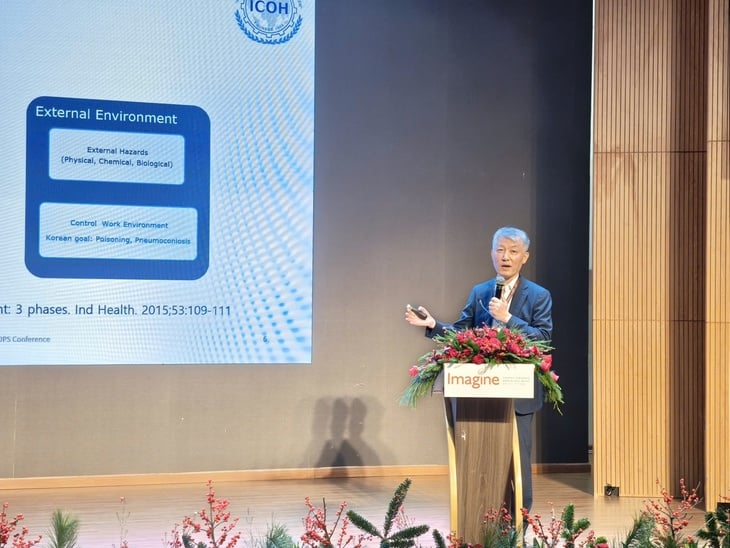
Mr. Seong-Kyu Kang from the International Occupational Health Commission speaks at the opening ceremony on the evening of December 10th - Photo: TRONG NHAN
Scientific approach to mental management.
Associate Professor Michelle Tuckey from the University of South Australia (Australia) analyzes the causes of negative behaviors such as rudeness, insults, isolation, or bullying in the workplace.
According to her, these behaviors are not due to "personality," but rather stem from substandard job design and operation, such as ambiguous role assignments, excessive workload, poor management skills, and illogical processes.
A field experiment conducted by her team across 327 departments of a supermarket chain showed that when the organization improved transparency, increased respect, and fostered internal coordination, bullying decreased significantly.
This, she argues, demonstrates that preventing abuse must begin at the systemic level, not with advice to change individual attitudes.
From an intervention perspective, Dr. Birgit Aust, from the Danish National Centre for Work Environment Research, argues that individual-centered solutions such as meditation, coping skills, and psychological counseling only offer short-term benefits.
Conversely, measures such as job redesign, adjusting working hours, streamlining staffing, increasing employee control, improving communication, and enhancing management capabilities are what truly bring about substantive change.
She also warned that many organizational interventions fail due to a lack of resources, insufficient leadership support, or improper implementation, leading to an even worse work environment.
Taking place from December 10th to 12th, the international conference "IMAGINE! Visualizing the Future: Work and Mental Health" brought together over 300 international delegates from 25 countries across 6 continents, building on the success of the first event in 2023 in Tokyo.
Associate Professor Bui Quang Hung, head of the Ho Chi Minh City University of Economics, said the world of work is undergoing profound transformation under the impact of technology, digital transformation, climate change, and the post-pandemic consequences. The pressure on mental health is increasing, especially for the younger generation of workers.
"The workshop also reflects a deep concern for mental health, occupational well-being, and human dignity within modern organizations," he said.
Source: https://tuoitre.vn/300-chuyen-gia-nha-khoa-hoc-den-tp-hcm-trao-doi-ve-suc-khoe-tinh-than-khi-lam-viec-20251210182459712.htm

![[Photo] Closing Ceremony of the 10th Session of the 15th National Assembly](/_next/image?url=https%3A%2F%2Fvphoto.vietnam.vn%2Fthumb%2F1200x675%2Fvietnam%2Fresource%2FIMAGE%2F2025%2F12%2F11%2F1765448959967_image-1437-jpg.webp&w=3840&q=75)
![[Photo] Prime Minister Pham Minh Chinh holds a phone call with the CEO of Russia's Rosatom Corporation.](/_next/image?url=https%3A%2F%2Fvphoto.vietnam.vn%2Fthumb%2F1200x675%2Fvietnam%2Fresource%2FIMAGE%2F2025%2F12%2F11%2F1765464552365_dsc-5295-jpg.webp&w=3840&q=75)














































![[OFFICIAL] MISA GROUP ANNOUNCES ITS PIONEERING BRAND POSITIONING IN BUILDING AGENTIC AI FOR BUSINESSES, HOUSEHOLDS, AND THE GOVERNMENT](https://vphoto.vietnam.vn/thumb/402x226/vietnam/resource/IMAGE/2025/12/11/1765444754256_agentic-ai_postfb-scaled.png)



































Comment (0)