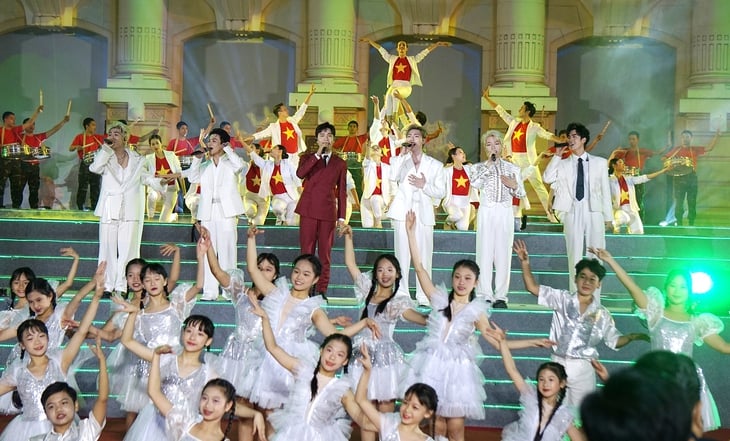
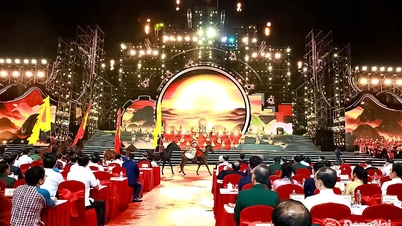
The "Brothers Say Hi" perform in a special art program celebrating the Party and the Lunar New Year on the evening of February 3, 2025 in Hanoi - Photo: T. ĐIỂU
This morning (August 23), the Ministry of Culture, Sports and Tourism held a ceremony to celebrate the 80th anniversary of the Traditional Day of the cultural sector (August 28, 1945 - August 28, 2025).
Eighty years ago, along with the establishment of the Provisional Government of the Democratic Republic of Vietnam, on August 28, 1945, the Ministry of Information and Propaganda (renamed the Ministry of Propaganda and Agitation from January 1, 1946) - the predecessor of the Ministry of Culture, Sports and Tourism - was founded. Since then, August 28 has become the traditional day of the culture, sports and tourism sector.
A fascinating history of mergers and transformations.
Historically, the Ministry of Culture, Sports and Tourism has undergone several mergers and separations under interesting historical circumstances.
After the first National Assembly convened on March 2, 1946, the coalition government was officially established, and the Ministry of Propaganda and Agitation ceased to exist. Two months later, on May 13, 1946, the Directorate General of Information and Propaganda (under the Ministry of Interior) was established. On November 27, 1946, it was renamed the Information Department.
On July 10, 1951, President Ho Chi Minh issued a decree merging the Information Department into the Prime Minister's Office and consolidating this Information Department with the Department of Literature and Arts under the Ministry of Education to form the Propaganda and Arts Department, headed by the poet To Huu.
The name continued to change during the period of socialist construction in the North and the struggle for national reunification (1954-1975). The Ministry of Propaganda was established by the Government Council in mid-August 1954. Subsequently, the 5th National Assembly approved it on May 20, 1955, renaming it the Ministry of Culture; Professor Hoang Minh Giam served as minister.
In the South, when the Provisional Government of the Republic of South Vietnam was established on June 6, 1969, musician Luu Huu Phuoc was entrusted with the responsibility of Minister of Information and Culture. Thus, from 1969 to 1975, the North had a Ministry of Culture, while the South had a Ministry of Information and Culture.
In 1976, the Socialist Republic of Vietnam was established with a Ministry of Culture for the entire country.
In 1977, the General Department of Information merged with the Ministry of Culture to form the Ministry of Culture and Information, and on July 4, 1981, it was renamed the Ministry of Culture.
In February 1986, the Ministry of Information was re-established by separating the publishing, press, information, propaganda, and exhibition management departments from the Ministry of Culture. On March 31, 1990, a new organization was formed, merging four agencies: the Ministry of Culture, the Ministry of Information, the General Department of Physical Education and Sports, and the General Department of Tourism into the Ministry of Culture - Information - Sports and Tourism. Musician Tran Hoan was appointed minister. However, shortly afterward, it was separated into two departments: Tourism and Sports. In 1993, it reverted to its old name, the Ministry of Culture - Information.
July 31, 2007 marked another major turning point when the Ministry of Culture, Sports and Tourism was established, undertaking the functions and tasks of managing multiple sectors and fields. From March 1, 2025, the ministry will also take over the functions and tasks of state management of press, publishing, and media from the Ministry of Information and Communications.
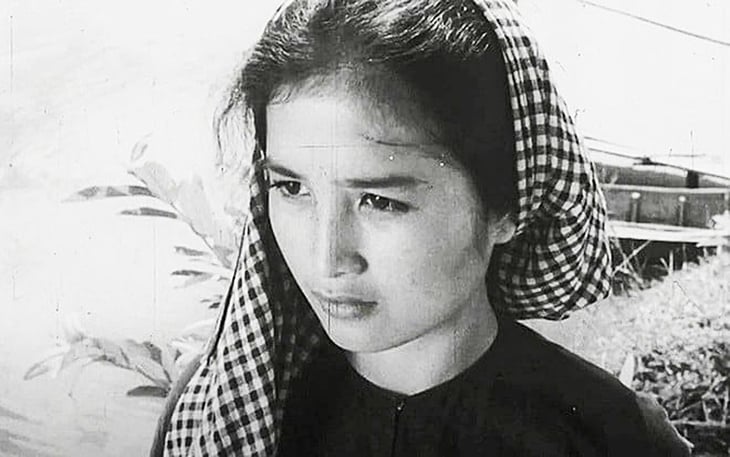
Revolutionary cinema accompanied the nation through the great resistance war against the US. In the photo: actress Tra Giang in the film "Sister Tu Hau" - Photo: archival material.
80 years of "culture guiding the nation's path"
On November 24, 1946, the first National Cultural Conference was convened in Hanoi. President Ho Chi Minh, opening the conference, clearly stated: Culture must guide the nation in achieving independence, self-reliance, and self-determination. This has also been the guiding principle throughout all activities of the cultural and information sector for the past 80 years.
It can be said that, during the two wars of resistance against French colonialism and American imperialism, culture and information were truly sharp spiritual weapons, contributing to arousing fervent patriotism, fostering unwavering fighting spirit, and building strong faith in the ultimate victory of the revolution.
Revolutionary artists, writers, and journalists immersed themselves in the realities of combat, "using pens as swords" and "art as weapons." Many artists, writers, journalists, and filmmakers fell on the battlefields, leaving us invaluable written works, literary pieces, and documentary films.
Vietnamese culture has made a tremendous contribution, together with the entire Party, people, and army, to writing the great epics of the nation in the 20th century. The Fourth National Party Congress affirmed: "Our literature and art deserve to stand among the pioneers of anti-imperialist literatures and arts in the present era."
In the 10 years following reunification, despite numerous challenges, Vietnam's cultural sector shifted from a culture of resistance to a culture of nation-building, achieving new levels of development and making significant contributions to the cause of building socialism and strengthening the country's spiritual foundation.
A crucial turning point in the development of Vietnamese culture occurred in 1986, when the Party initiated and led the comprehensive Doi Moi (Renovation) process of the country. Vietnamese culture continued to play an important role, always pioneering and guiding public opinion for bold economic and social reforms; always accompanying the glorious revolutionary cause of the Party and the nation.
With its immense achievements and contributions throughout its 80-year journey of construction and development, the industry has been honored by the Party and the State with prestigious awards such as the Gold Star Order, the Ho Chi Minh Order, and many other honorary titles and awards bestowed by various levels and sectors from the central to local levels to thousands of collectives and individuals.
**********
*This article is based on material provided by the Ministry of Culture, Sports and Tourism.
BIRD OF HEAVEN
Source: https://tuoitre.vn/80-nam-van-hoa-phung-su-dat-nuoc-20250823094406807.htm




![[Photo] General Secretary and President To Lam presides over a meeting on assessing national development resources.](https://vphoto.vietnam.vn/thumb/1200x675/vietnam/resource/IMAGE/2026/05/20/1779253785852_a1-bnd-2943-8519-jpg.webp)






















































Comment (0)