

Over the years, in accordance with the Party and State's guidelines and policies supporting the socio-economic development of ethnic minority groups with very small populations, Kon Tum province has implemented many mechanisms and policies to support, develop, and improve the material and spiritual lives of the Brâu and Rơ Măm ethnic minority groups; contributing to consolidating national unity and strengthening the trust of ethnic minorities in the Party and the State.
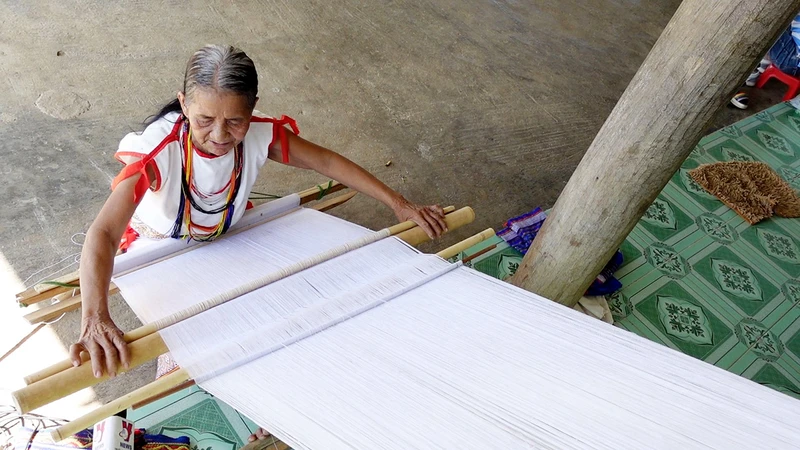
Rơ Măm women in Le village, Mô Rai commune, Sa Thầy district weave brocade.
Kon Tum is a mountainous border province located in the northern part of the Central Highlands. The province is home to 43 ethnic groups, notably including two very small minority groups, the Brau and the Ro Mam, who live in the border region with Laos. This is the only province in the Central Highlands with such small minority ethnic groups.
Helping ethnic minority groups with very small populations escape poverty.
The Rơ Măm ethnic minority comprises 192 households with 625 people, residing in Le village, Mô Rai border commune, Sa Thầy district. Previously, the people faced many difficulties, with poor transportation and a predominantly agricultural economy based on outdated methods. However, in recent years, thanks to the attention and investment from the Party, the State, and local authorities, the Rơ Măm people are now focusing on economic development and sustainable poverty alleviation.
Visiting Le village today, one can notice significant changes such as: basic infrastructure investment, forming a main transportation axis along the border crossing Le village; the national power grid has reached every household; the water supply system and irrigation canals serving production have been invested in... Children of the Rơ Măm ethnic group can attend school and receive adequate healthcare.
The lives of the people here have improved; many families have bought televisions, radios to listen to the news, telephones for communication, motorbikes for transportation, and some households have even been able to buy tractors and trucks to serve production, striving to become wealthy.
Every year, the local people receive support in terms of seedlings and livestock; they are also directly guided by agricultural and forestry extension officers on applying scientific and technical methods to production. Thanks to the continuous efforts of the people and the local government, the productivity of various crops and livestock has improved. Currently, the people here focus on cultivating nearly 110 hectares of cashew trees, about 60 hectares of wet and upland rice, 5 hectares of fruit trees, and over 90 hectares of rubber trees; the total livestock and poultry population reaches nearly 1,200 animals.
Le A Thai, Party Secretary and Village Head, said: “Previously, the people of Rơ Măm had a hard life. Now, thanks to the Party and State's investment in concreting the roads, trade has become easier. As a result, the people have more motivation and confidence to strive to become legitimately wealthy on their homeland.”
Mr. A Nhat, a Rơ Măm ethnic minority member from Le village, shared that with the support and guidance from the local government on livestock farming and crop cultivation, he boldly changed the land use and production model. From an unproductive plot of land, he planted 4 hectares of rubber trees, 2 hectares of cashew trees, nearly 1 hectare of cassava and rice; combined with livestock and poultry farming, he earns about 200 to 300 million VND per year.
As the material and spiritual lives of the Rơ Măm people improve, village elders, community leaders, and influential figures within the Rơ Măm ethnic community have the opportunity to preserve and exploit the advantages, cultural identity, and traditional crafts. To revive the traditional craft of brocade weaving, the Ethnic Affairs Committee of Kon Tum province is making efforts to open classes to teach brocade weaving to Rơ Măm women in Le village.
Now, under the communal house roof, whenever they have free time, the women weave brocade together and share their experiences. Many households have improved the designs, creating many beautiful products to exchange goods and sell to earn extra income.
Comrade Duong Quang Phuc, Chairman of the People's Committee of Sa Thay District, said: "In recent times, thanks to the special attention of the Party and the State, the lives of the Ro Mam ethnic people have changed significantly, improving day by day, with increased income, and the preservation and development of their culture. Outdated customs are gradually being eliminated; the cultural and spiritual lives of the people have changed noticeably."
Many practical and specific mechanisms and policies.
Over the past period, Kon Tum province has paid close attention to and promptly directed ethnic affairs and ethnic policies in the province, considering investment in socio-economic development as an important task for sustainable development and improving the material and spiritual lives of people in ethnic minority and mountainous areas.
This work has contributed to gradually narrowing the gap in living standards and income between ethnic minorities and the provincial average, and is linked to the task of building a strong political system at the grassroots level, consolidating and promoting national unity. Kon Tum province focuses on preserving and promoting the cultural values of ethnic minorities, safeguarding them for future generations.
The Brâu ethnic group comprises 174 households with 546 people, a very small ethnic community currently residing in Dak Me village, Po Y commune, Ngoc Hoi district, Kon Tum province. In order to preserve and promote the unique traditional culture of the Brâu people, the Kon Tum Provincial Museum and Library conducted surveys and held discussions with village heads, elders, and influential individuals to agree on the restoration of typical festivals that no longer exist within the community.
According to Nguyen Van Quang, Deputy Director of the Kon Tum Provincial Museum and Library, surveys have been conducted and it has been agreed to fully reconstruct all the activities of the Brâu people's rice planting festival. This is a prominent festival deeply rooted in the ethnic group's cultural identity, reflecting the people's aspirations for a bountiful harvest.
“Thanks to the restoration work, the Kon Tum Provincial Museum and Library has stored and digitized data on the Brâu people's rice planting festival to serve in promoting the festival's value. Every year, if conditions permit, we will invite artisans to perform and recreate the festival at the Museum so that a large number of tourists and people can enjoy it,” Mr. Quang said.
Kon Tum province has issued many specific mechanisms and policies for the Brau and Ro Mam ethnic minorities, aiming to maintain, develop, and enhance the status of these two ethnic groups. These include decisions such as: Decision No. 941b/QD-UBND approving the Project to support socio-economic development of the very small Brau ethnic minority in Kon Tum province until 2025 and Decision No. 941c/QD-UBND approving the Project to support socio-economic development of the very small Ro Mam ethnic minority in Kon Tum province until 2025..., with a total budget of nearly 160 billion VND for the implementation of these projects.
Comrade U Huan, Alternate Member of the Central Committee of the Party, Deputy Secretary of the Provincial Party Committee, and Head of the National Assembly Delegation of Kon Tum province, stated that the ethnic minority people of Kon Tum province in general, and the Brau and Ro Mam ethnic groups in particular, have undergone significant changes in their awareness, actively engaged in production, and boldly borrowed capital from the Social Policy Bank to invest in converting to high-economic-value crops and livestock, thereby contributing to reducing the poverty rate by an average of 3-4% per year; while also actively preserving and promoting the fine traditional and cultural values of their ethnic groups.
Ethnic minority communities in general, and very small ethnic minority groups in particular, although only accounting for a small percentage of the population, have demonstrated through changes in their socio-economic lives that the policies of the Party and State have gradually been implemented. This has helped ethnic minority communities strive to reduce poverty, gradually narrow the development gap with other ethnic groups, and contribute to strengthening national unity.
According to Anh Quân/nhandan.vn
Source: https://baophutho.vn/am-no-o-nhung-ban-lang-nguoi-brau-ro-mam-223271.htm




















































































Comment (0)