

F-35A fighters have moved one step closer to being able to carry Europe's Meteor long-range, beyond-visual-range air-to-air missile, after completing a series of ground integration tests in the US recently.
“Ground vibration testing and installation testing conducted at Edwards Air Force Base (USA) validated key hardware components of the 5th generation fighter and missile,” the website of the Lockheed-led industry group on the F-35 announced on Wednesday.

The European Meteor beyond-visual-range air-to-air missile has its own targeting radar with a range of 200km.
Engineers meticulously evaluated data collected from the tests to confirm the safe carry and deployment of missiles from the F-35A's internal weapons bay while preserving stealth, Ho said.
There is only one final ground test left for the missile, produced by European defense group MBDA and expected to be equipped for European F-35 customers, before it is licensed to enter the flight testing phase.
METEOR is a new generation of long-range air-to-air missiles from Europe, featuring a solid-fuel ramjet engine. It is integrated on many modern fighters such as Eurofighter Typhoon, Rafale, Gripen by external pylons.
However, fifth-generation stealth fighters such as the F-22 and F-35 still cannot carry this powerful weapon. These missiles cost up to 2 million dollars and are manufactured in very small quantities because of their complex components, so they are called "golden missiles".
This is a missile with a range of up to 200km, which means it is beyond the detection range of radar on modern fighter jets. On the other hand, this missile is equipped with its own radar and is networked so that it can be assigned a target after being fired.

The F-35 stealth fighter will become extremely dangerous when the Meteor is integrated into the weapon bay.
This means that the pilot can launch a missile at an enemy fighter before the radar on the aircraft can detect it. The missile will then travel at 4 times the speed of sound towards the enemy and then use the integrated radar to accurately aim and destroy the enemy.
“As a networked capability, through the weapon data link, integrating METEOR onto a fifth-generation platform like the F-35 allows aircrews to have the most flexible weapons system and maximize the capabilities of both the weapon system and the platform,” MBDA said in a supporting statement today.
Italy is funding the integration of this ramjet weapon onto the F-35A, while the UK leads the integration for the F-35B short take-off and vertical landing (STOVL) model.
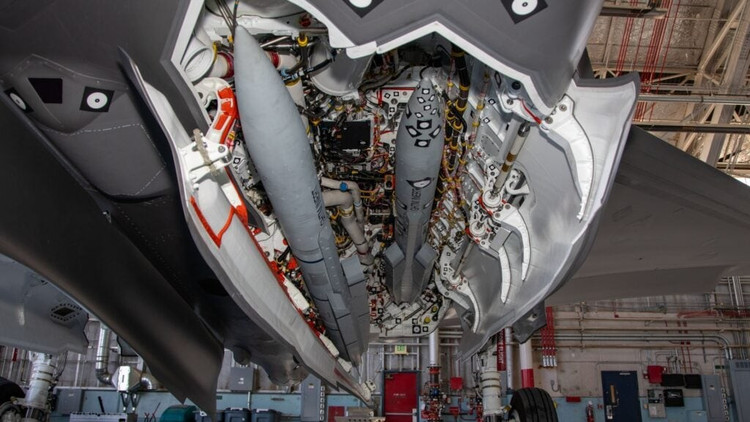
Britain and Italy are pioneers in integrating Meteor into F-35s purchased from the US.
In March, building on collaboration between the UK and US governments and support from industrial partners, a US Marine Corps F-35B began its first test flights with Meteor at Naval Air Station Patuxent River.
Maria Eagle, then the UK defence procurement minister, said in a statement to Parliament in June that “the current expected timeline for Meteor to reach operational capability is the early 2030s,” a delay from the previous target of entering service in 2027. Eagle did not specify the reason for the delay at the time.
“With the F-35 Lightning, the [Royal Air Force] already has one of the most advanced fighters in the world, and the integration of METEOR will continue to enhance the aircraft's capabilities in the years to come,” the UK Ministry of Defense said in a statement.
Source: https://khoahocdoisong.vn/anh-y-bat-tay-phat-trien-vu-khi-co-kha-nang-tan-cong-dang-gom-cho-f-35-post2149073885.html


![[Photo] 60th Anniversary of the Founding of the Vietnam Association of Photographic Artists](/_next/image?url=https%3A%2F%2Fvphoto.vietnam.vn%2Fthumb%2F1200x675%2Fvietnam%2Fresource%2FIMAGE%2F2025%2F12%2F05%2F1764935864512_a1-bnd-0841-9740-jpg.webp&w=3840&q=75)


![[Photo] Cat Ba - Green island paradise](/_next/image?url=https%3A%2F%2Fvphoto.vietnam.vn%2Fthumb%2F1200x675%2Fvietnam%2Fresource%2FIMAGE%2F2025%2F12%2F04%2F1764821844074_ndo_br_1-dcbthienduongxanh638-jpg.webp&w=3840&q=75)
























































































Comment (0)