

The warm, salty waters of the Atlantic Ocean are mixing with the colder, fresher waters of the Arctic Ocean, and Atlantic species are also migrating to the area.
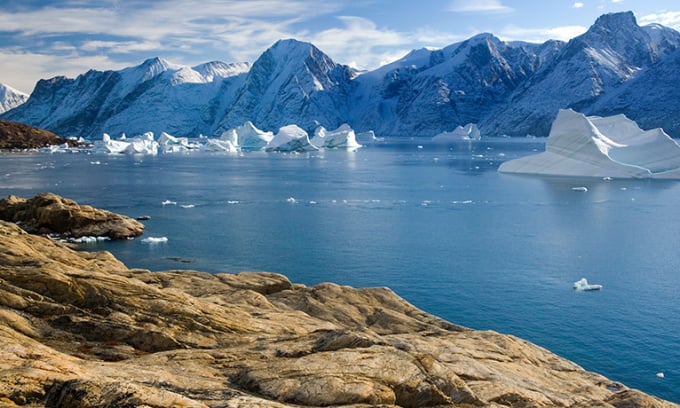
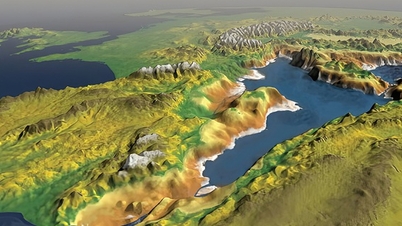
Greenland lies between the Atlantic and Arctic Oceans. Photo: Steveallen photo/iStock
Véronique Merten, a marine ecologist at the GEOMAR Helmholtz Centre for Ocean Research in Kiel, Germany, observed an "invasion" in the Fram Strait, off the west coast of Greenland, the Smithsonian reported on June 23.
While studying the biodiversity of the area using environmental DNA, she discovered capelin fish. These tiny creatures typically live in the North Atlantic and Pacific Oceans . However, they have now appeared in the Fram Strait in the Arctic Ocean, about 400 km from their usual habitat.
According to Merten, capelin fish are aggressive invaders. When ocean conditions change, they can easily expand their range.
It is difficult to estimate the population of an animal species based solely on the amount of its DNA in the water. However, in Merten's research samples, capelin were the most abundant species, overwhelming even typical Arctic fish like the Greenland halibut and the Arctic stingray. For Merten, the large number of capelin appearing in the north was a clear sign of a worrying phenomenon in the Arctic: Atlanticization.
The Arctic Ocean is warming rapidly – the Fram Strait is nearly 2 degrees Celsius warmer than it was in 1900. But Atlanticization is not just about the increase in temperature; it's a process of changing the physical and chemical conditions of the Arctic Ocean.
According to the oceanic cycle, water regularly flows from the Atlantic to the Arctic. This exchange occurs primarily in deeper waters, with ocean currents carrying warm, relatively salty Atlantic water northward. This warm Atlantic water does not mix well with the Arctic's surface water, which is relatively cool and fresh. Freshwater is less dense than saltwater, so Arctic water tends to rise to the surface, while the saltier Atlantic water sinks.
However, as the sea ice melts, the surface of the Arctic Ocean becomes warmer. The barrier between the layers of water gradually disappears, and Atlantic water mixes with the upper layer more easily. The warmer surface water continues to melt more sea ice, exposing more sea surface area to sunlight and further warming the water. This is the process of Atlantic-Arctic transformation.
Not only did Merten discover large quantities of capelin in the Fram Strait, but he also found DNA from other Atlantic species such as tuna and Histioteuthis squid. This is evidence that Atlanticization is occurring rapidly and could have very significant consequences.
A long-term study in the Barents Sea off the coast of Russia once painted a bleak picture of how Atlanticization could disrupt Arctic ecosystems. According to lead researcher Maria Fossheim, an ecologist at the Norwegian Institute for Marine Research, as the Barents Sea warmed and saltier, Atlantic species invaded. Fish populations in the Barents Sea migrated 160 km north in just nine years. In 2012, at the end of the study, Fossheim found that Atlantic species had spread throughout the Barents Sea, overwhelming Arctic species.
Thu Thao (According to Smithsonian )
Source link


![[Image] Vietnam's colorful journey of innovation](/_next/image?url=https%3A%2F%2Fvphoto.vietnam.vn%2Fthumb%2F1200x675%2Fvietnam%2Fresource%2FIMAGE%2F2025%2F12%2F14%2F1765703036409_image-1.jpeg&w=3840&q=75)

























































![[Image] Vietnam's colorful journey of innovation](https://vphoto.vietnam.vn/thumb/402x226/vietnam/resource/IMAGE/2025/12/14/1765703036409_image-1.jpeg)
































Comment (0)