

The Doksuri River, which made landfall in Fujian province Friday morning with winds reaching 175 km/h, was felt further north, according to Chinese meteorological services. Due to fears of flooding, Beijing issued an orange alert, the second highest level in the four-tier system.
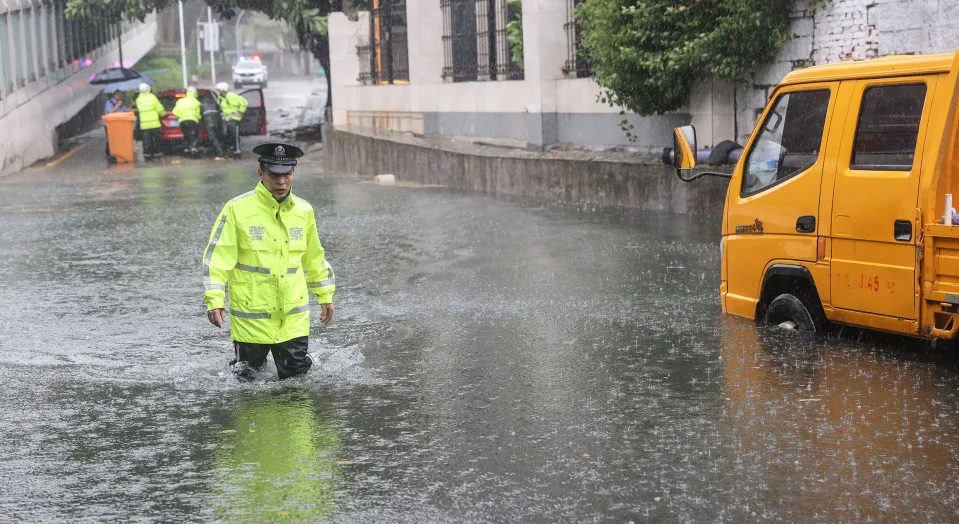
An area flooded by Typhoon Doksuri in Xiamen, Fujian, China. Photo: AFP
Several of the city's parks, lakes, and riverside promenades have been closed as a precaution. City authorities warned on Saturday that the torrential rains could cause flooding worse than in July 2012, when 79 people died and tens of thousands were evacuated.
Heavy rain was reported in the capital Beijing on Saturday afternoon and is expected to continue through Tuesday. Neighboring Hebei province, where heavy rain and strong winds are anticipated, has issued the highest level of alert in some areas. The weather service warned that rainfall could exceed 60 mm.
In Fuzhou, the capital of Fujian province, authorities ordered residents to stay home unless absolutely necessary on Saturday. The coastal province of Shandong and the megacity of Tianjin also felt the effects of the flooding.
More than 724,600 people in 84 counties of Fujian have been affected, with 124,400 residents evacuated. Approximately 262 hectares of crops have been damaged, according to Xinhua News Agency on Friday.
Super Typhoon Doksuri had previously swept across the Pacific earlier this week, but weakened as it approached the Philippines. The storm killed at least 13 people in the Philippines and capsized a ferry, killing at least 26.
The storm moved northwest toward China. Although it was forecast to have weakened somewhat, it still brought giant waves and violent gales to the southeastern part of the country.
China has experienced extreme weather conditions this summer. Besides heavy rains and floods, in early July, Beijing and surrounding areas broke temperature records, with localized temperatures exceeding 40 degrees Celsius.
Bui Huy (based on Xinhua, AFP, SCMP)
Source































![[Video] The craft of making Dong Ho folk paintings has been inscribed by UNESCO on the List of Crafts in Need of Urgent Safeguarding.](https://vphoto.vietnam.vn/thumb/402x226/vietnam/resource/IMAGE/2025/12/10/1765350246533_tranh-dong-ho-734-jpg.webp)





















































Comment (0)