

Smudge
That is the affirmation of Distinguished Professor Nguyen Van Tuan, Director of the Center for Medical Technology, University of Technology Sydney (UTS).
According to Mr. Tuan, in science , the retraction of a scientific article is a black mark. It is not simply a retraction due to a minor technical error, but an official statement by the journal that the article has serious violations. There are many violations, including falsification of data (figures, images), author issues, plagiarism, undeclared conflicts of interest, etc.
A retracted article is permanently marked in scientific databases (Web of Science, Scopus, PubMed, and Retraction Watch). It is no longer scientifically valid, cannot be properly cited, and becomes a black mark on the research records of all involved authors.

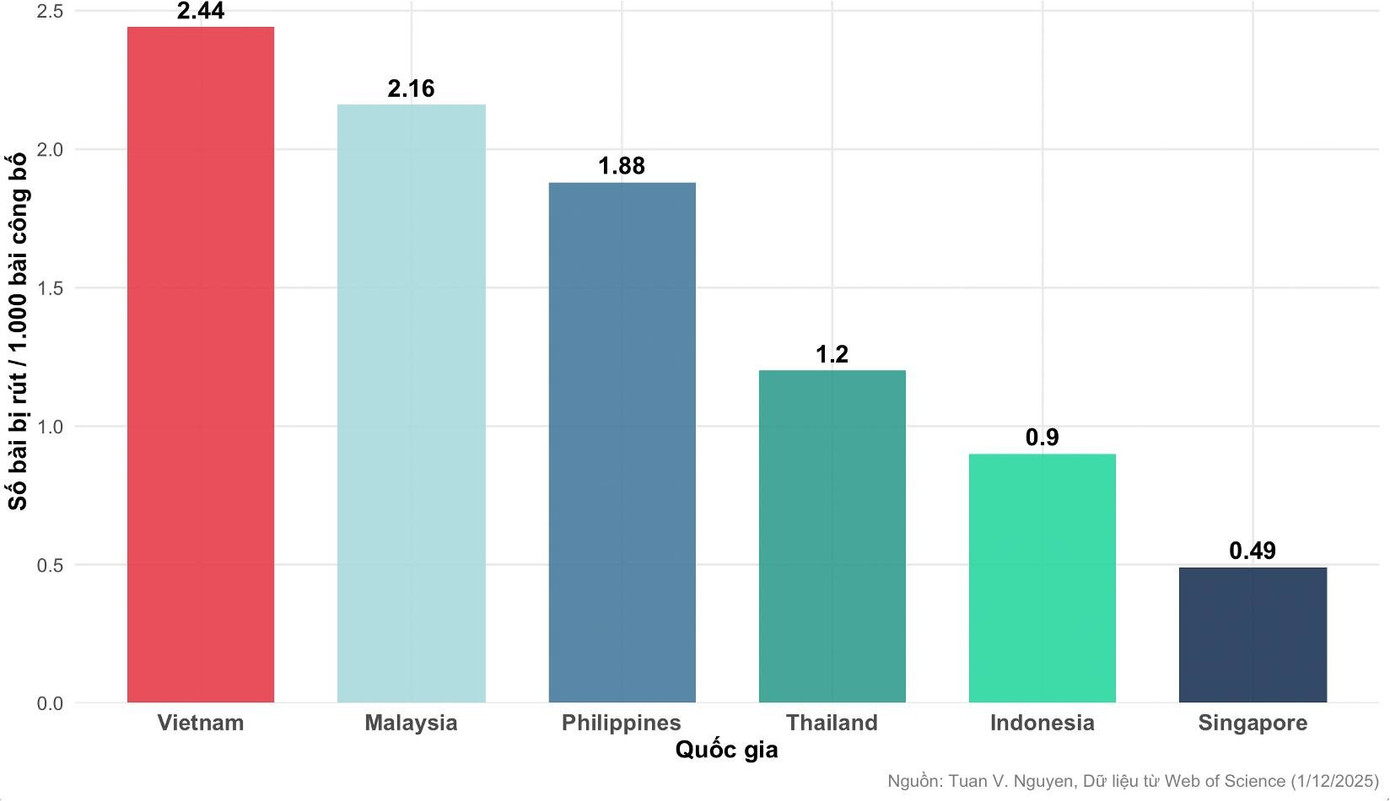
Data collected by Professor Nguyen Van Tuan shows that Vietnam ranks number 1 in the number of retracted articles in Southeast Asia. Of which, the crude retraction rate is 2.55/1,000 articles; the official retraction rate is 2.44/1,000 articles.
Vietnam far surpasses Malaysia (ranked second in the region) and is nearly 5 times more than Singapore - the country with the most highly rated research system in Southeast Asia.
The current global average recall rate is about 0.2-0.5 articles/1000 articles. Thus, Vietnam's rate is 5-10 times higher than the average.
Countries in the Middle East (Egypt, Saudi Arabia, Iraq, Iran), India, Pakistan, China and Bangladesh have the highest rates in the world, ranging from 2.5 to 6.0/1,000 publications.
“Currently, Vietnam has entered the top 10 countries with the highest recovery rate in the world. No one dares to be proud (if not ashamed) of this position,” said Professor Tuan.
The speed of increase is so fast
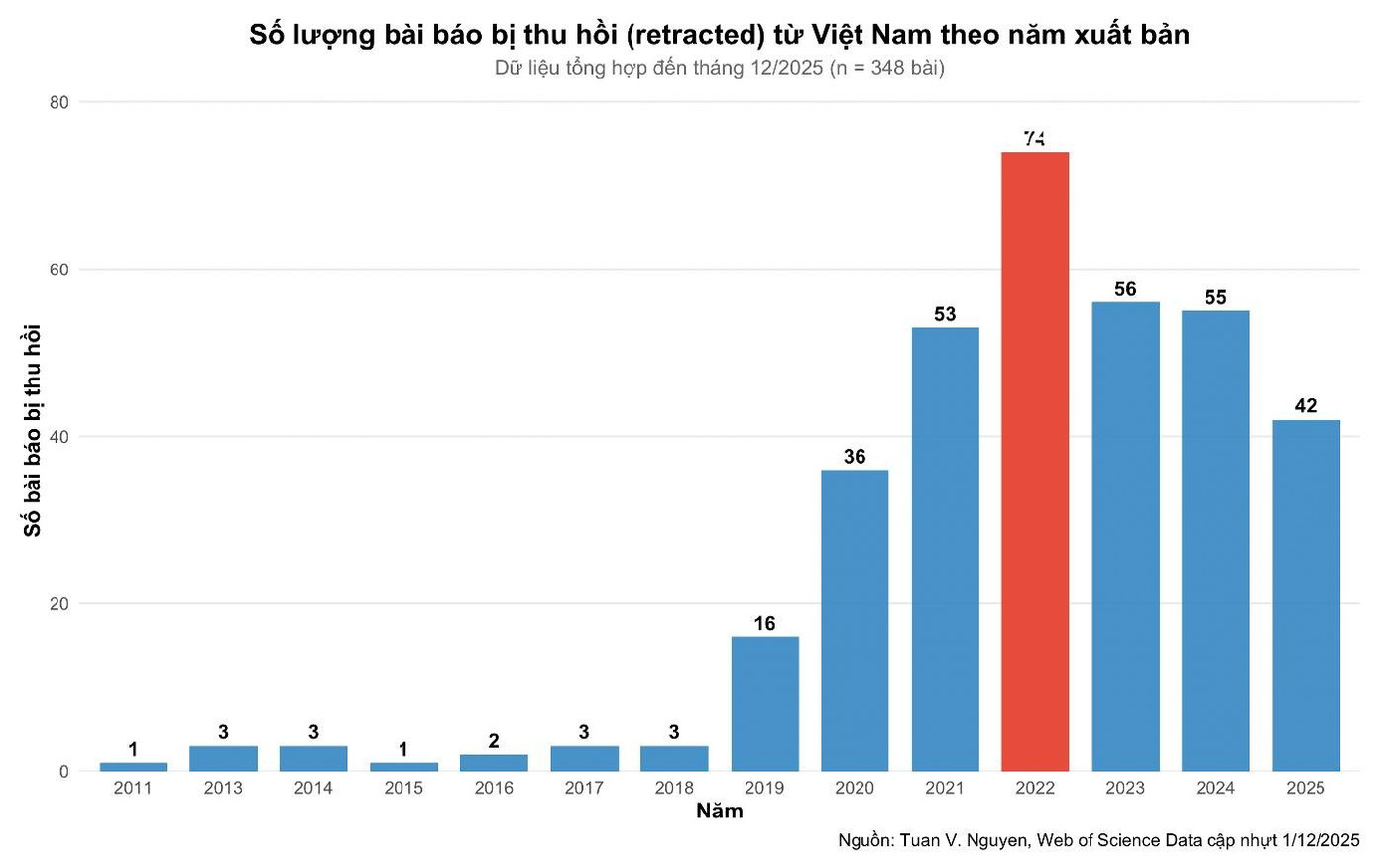
From 2011 to the end of 2025, Vietnam had at least 364 scientific articles officially withdrawn or with warnings.
But what is more frightening is not the absolute number, but the dizzying speed of increase and the trend that has not stopped. From 2011 to 2018, the number of Vietnamese articles withdrawn fluctuated from 1 to 3. In 2019, the number reached 16. In 2020, it jumped to 36, in 2021 it jumped again to 53, then peaked in 2022 with 74 articles.
Professor Nguyen Van Tuan commented that the retraction of the article has a huge impact. The international community has lost confidence in scientific research from Vietnam. Genuine scientists are “collateral damage” when applying for funding and international cooperation. Students and researchers are affected when citing retracted articles. There is a risk of being blacklisted or requested to check articles from Vietnam by major journals (this has happened).
Cannot stand idly by
Professor Tuan shared that, having "rolled around" in the scientific world in Vietnam and the world, he realized that there are many reasons why articles are withdrawn. Among them, the reasons that he said are "pre-existing" include: the pressure of international publication targets is too great (especially in the period 2017-2023).
It is also due to the mechanism of monetary rewards and academic titles based on the number of Scopus/WoS articles. In particular, the reward mechanism according to Q1-Q4 journals is a serious mistake. The existence of “writing factories” and “article publishing services”. Lack of serious training in research ethics and publication ethics at the postgraduate level. The internal quality control system at many universities is still very weak.
“I have worked on many long-term research and collaboration programs in Vietnam and found that the domestic scientific system has many big “loopholes”. I have mentioned these loopholes”, Professor Nguyen Van Tuan shared.
He proposed solutions to “patch the loopholes” such as publicizing regulations on scientific research, regulations on scientific ethics and publication ethics. It is possible to refer to regulations and rules in the US and Australia to rewrite them to suit Vietnam. All doctoral and master students are required to complete a formal course on research ethics and publication ethics before embarking on research.
Professor Nguyen Van Tuan proposed to immediately stop the monetary reward mechanism and consider the title of professor and associate professor based on the number of Scopus/WoS articles, and switch to assessing the real quality (citations, influence, applied products). Establish an independent National Research Ethics Committee (according to the COPE model) with the right to investigate and publicly handle violations.
Universities must publish a list of all withdrawn papers by lecturers and researchers on their websites. Increase the use of plagiarism and image manipulation detection technology in all domestic journals and encourage universities to apply it before submitting papers. Strictly handle cases of intentional data falsification, not just “learning from experience”.
He warned that if drastic action is not taken in 2025-2030, Vietnam risks becoming the “second Saudi Arabia” (the country with the most revoked articles in the world) in terms of the rate of revoked articles - a black mark for decades.
“Science is not just about the number of publications, but also about national honor. Science today is not like the 1970s-1980s. What is called the old way or tradition of the previous generation no longer applies to scientific publications today. Do not rely on personal experience anymore,” Professor Nguyen Van Tuan advised.
Source: https://tienphong.vn/bao-dong-viet-nam-dung-dau-khu-vuc-ve-so-luong-bai-bao-khoa-hoc-bi-thu-hoi-post1801405.tpo
![[Photo] Cat Ba - Green island paradise](/_next/image?url=https%3A%2F%2Fvphoto.vietnam.vn%2Fthumb%2F1200x675%2Fvietnam%2Fresource%2FIMAGE%2F2025%2F12%2F04%2F1764821844074_ndo_br_1-dcbthienduongxanh638-jpg.webp&w=3840&q=75)





































![[VIMC 40 days of lightning speed] Hai Phong Port determined to break through, reaching the target of 2 million TEUs by 2025](https://vphoto.vietnam.vn/thumb/402x226/vietnam/resource/IMAGE/2025/12/04/1764816441820_chp_4-12-25.jpeg)









































Comment (0)