


The commune is strategically located on the dynamic economic axis along the Red River, with a diverse transportation system (road, waterway, railway, and soon air and high-speed rail), converging favorable conditions for socio-economic development.
However, the large area, fragmented mountainous terrain, underdeveloped infrastructure, and uneven levels of education among the population pose significant challenges and limitations to sustainable poverty reduction efforts in the locality.
Comrade Nguyen Anh Dung, Secretary of the Party Committee and Chairman of the People's Council of Bao Ha commune, said: In order to implement the sustainable poverty reduction work in the area in a comprehensive and effective manner, the commune Party Committee issued Decision No. 106-QD/DU dated July 7, 2025, establishing the Steering Committee for National Target Programs in Bao Ha commune, with the Secretary of the Party Committee as the Head of the Steering Committee, the Standing Deputy Secretary and the Chairman of the People's Committee of the commune as Deputy Heads of the Steering Committee, and assigning the Economic Department as the permanent agency for the New Rural Development Program and Sustainable Poverty Reduction Program…
Based on the provincial plan targets for 2025, the People's Council of Bao Ha commune issued Resolution No. 17/NQ-HĐND dated July 18, 2025, on assigning socio-economic development plan targets for 2025, accordingly setting the poverty reduction rate target for 2025 at 0.78%.
Besides issuing directives and guidelines to agencies and units on implementing key goals and tasks, the Party Committee and People's Committee of Bao Ha commune always pay attention to directing and regularly checking the progress of implementing the goals and tasks of poverty reduction and the National Target Program for Sustainable Poverty Reduction (the Program) of departments and units, thereby promptly resolving difficulties and shortcomings in the implementation process.
Thanks to smooth implementation guidance from top to bottom, Bao Ha has achieved outstanding and comprehensive results in its sustainable poverty reduction policy. Specifically:
In 2024, the entire commune had 426 out of 7,806 poor households (5.46%), and 366 out of 7,806 near-poor households (4.69%). By 2025, the goal is to achieve an average multidimensional poverty reduction rate of 0.78% or higher across the commune, equivalent to a reduction of 61 or more poor households; a poverty reduction rate of 2% among ethnic minorities; a reduction in the near-poor household rate of 0.89%, equivalent to a reduction of 70 or more near-poor households; and a re-poverty rate below 1%. The target is to create 395 new jobs; achieve a trained workforce rate of 72%; an average per capita income of 51.6 million VND in 2025; and ensure 100% of the rural population has access to safe drinking water.
The allocated capital for implementation in 2025 is 7.025 billion VND. Of this: 7.025 billion VND is for operational expenses (2.751 billion VND allocated in 2025; 4.273 billion VND carried over from the previous year). Regarding capital allocation: Bao Ha commune is currently developing a plan to allocate funds to relevant departments and units for the implementation of the program's component projects.
Firstly, to achieve the goal of innovation, development, and comprehensive improvement of education quality, Bao Ha commune focuses on improving the quality of education; planning and building school facilities to meet the learning needs of the people; a total of 273 rooms/273 classes, including: 244 permanent rooms, 29 semi-permanent rooms (ensuring the continuation of teaching and learning), and 23 computer classrooms/23 schools.
In accordance with Government Decree No. 81/2021/ND-CP dated August 27, 2021, regulating the mechanism for collecting and managing tuition fees for educational institutions within the national education system and policies on tuition fee exemption and reduction, support for learning costs, and service prices in the field of education and training: 100% of students are entitled to the benefits as prescribed.
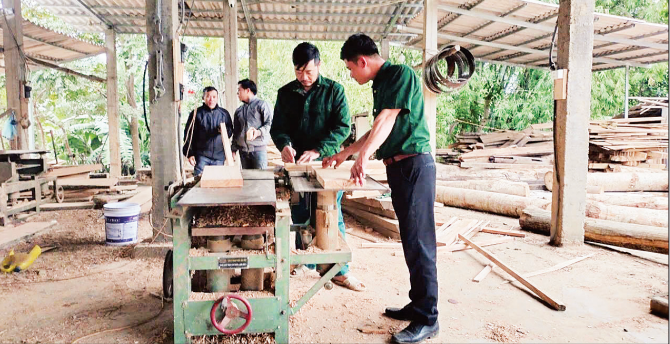
Secondly, in 2025, the focus will be on vocational training for laborers from poor and near-poor households, newly-escaped-from-poverty households, ethnic minorities, people with disabilities, laborers who are beneficiaries of revolutionary merit programs, and households that have lost their agricultural land... linked to the needs of the labor market and key economic development sectors of the commune, specifically: Opening 5 vocational training classes for rural laborers with approximately 170 trainees; the rate of trained laborers reaching 72%.
The People's Committee of the commune, in coordination with vocational training centers inside and outside the province, reviewed needs and recruited students in the area, opening 5 classes in the fourth quarter of 2025. The number of newly employed workers by September 2025 is 318 people, equivalent to 80.51% of the annual plan; the rate of trained workers is 66.24%, equivalent to 92% of the annual plan.
In particular, the preferential credit policy for poor and near-poor households has yielded outstanding results: In the first nine months of 2025 alone, the total loan volume of the Social Policy Bank to people in the commune reached over 223.810 billion VND, with more than 14,000 customers.
Some effective lending policies include: preferential loans for poor households - Decree 78/2002, loans for near-poor households, loans for newly escaped-from-poverty households, loans for households engaged in production and business in disadvantaged areas, loans for clean water and rural sanitation, loans for job creation, loans for production forestry, and livestock development…
Simultaneously, support has been provided to poor and near-poor households to access basic social services. To date, the Social Insurance agency has issued 24,882 health insurance cards to eligible individuals in the commune, with a total support budget of 15,420 million VND, including: 1,100 health insurance cards for people in poor households; 13,929 health insurance cards for ethnic minorities; and 6,285 health insurance cards for people living in areas with particularly difficult socio-economic conditions; the health insurance coverage rate has reached 92.7%.
In accordance with Circular No. 190/2014/TT-BTC dated December 11, 2014, of the Ministry of Finance on the implementation of the policy of electricity subsidy for poor households and social policy households: Bao Ha commune has prepared a budget estimate for electricity subsidy in 2025 for 426 poor households and 16 social policy households, with an estimated budget of 335.738 million VND.
Housing support for poor, near-poor, and disadvantaged households in Bao Ha is also a highlight. Following the principle of primarily leveraging local resources, the district mobilizes people to reinforce, repair, and rebuild houses, especially for households with temporary or dilapidated houses, and to upgrade residential housing. The district effectively implements housing support and repair policies for poor households from various sources such as the "Fund for the Poor," "Humanitarian Fund," and "Shelter of Love," as well as from the support of individuals, units, and organizations.
Since the beginning of the year, the Vietnam Fatherland Front Committee of the commune has supported the construction of new houses for 8 households and the repair of houses for 5 poor and near-poor households with a budget of 440 million VND from funds raised through donations to the Fund for the Poor...
Source: https://nhandan.vn/bao-ha-day-manh-cong-tac-giam-ngheo-ben-vung-post929155.html

![[Photo] Prime Minister Pham Minh Chinh holds a phone call with the CEO of Russia's Rosatom Corporation.](/_next/image?url=https%3A%2F%2Fvphoto.vietnam.vn%2Fthumb%2F1200x675%2Fvietnam%2Fresource%2FIMAGE%2F2025%2F12%2F11%2F1765464552365_dsc-5295-jpg.webp&w=3840&q=75)



![[Photo] Closing Ceremony of the 10th Session of the 15th National Assembly](/_next/image?url=https%3A%2F%2Fvphoto.vietnam.vn%2Fthumb%2F1200x675%2Fvietnam%2Fresource%2FIMAGE%2F2025%2F12%2F11%2F1765448959967_image-1437-jpg.webp&w=3840&q=75)




























![[OFFICIAL] MISA GROUP ANNOUNCES ITS PIONEERING BRAND POSITIONING IN BUILDING AGENTIC AI FOR BUSINESSES, HOUSEHOLDS, AND THE GOVERNMENT](https://vphoto.vietnam.vn/thumb/402x226/vietnam/resource/IMAGE/2025/12/11/1765444754256_agentic-ai_postfb-scaled.png)









































Comment (0)