

Vocational training, aimed at changing production mindsets and improving productivity and product quality, not only helps workers in traditional craft villages "make a good living" from their trade, but it is also a way to preserve, restore, and promote the cultural essence of the craft village to friends in other provinces and around the world . This is the approach that many localities have been striving to implement for many years.
The mat weaving craft in Bong Hai has a history spanning hundreds of years. According to documents in the history book of the Khanh Thien Commune Party Committee, the Bong Hai mat weaving craft (Bong Hai Township, now Khanh Thien Commune, Yen Khanh District) produced products strong enough to travel across the sea on merchant ships to foreign countries. Furthermore, skilled mat weavers in Bong Hai participated in weaving patterned mats for the National Assembly , with some mats measuring 2 meters wide featuring dragon motifs, to serve international guests and high-ranking officials of the Party and State…
Mr. Hoang Cao Cu, a renowned mat weaver in Khanh Thien, shared: "My wife and I are both nearly 80 years old, and our health isn't what it used to be. But for so many years, we've still tried to make a living and waited. We waited to pass on the 'passion' to the younger generation, to entrust our faith and responsibility to future generations. But nowadays, no one in the younger generation wants to learn and practice mat weaving anymore."
In an effort to preserve this centuries-old craft, Khanh Thien commune has made many efforts to revive, preserve, and develop mat weaving. The commune has also actively promoted and provided support policies to attract young people to mat weaving training classes. However, all efforts have been unsuccessful. The market economy has opened up many opportunities for the people of Khanh Thien to find other jobs with higher incomes.
Thus, from a profession that provided food and clothing for many generations, today in Khanh Thien there is only… 1 household still practicing it. Mr. Pham Hong Quang, Chairman of the People's Committee of Khanh Thien commune, regretfully stated: In the rural tourism project associated with the construction of new rural areas in the period 2023-2030, with a vision to 2040, it is regrettable that the locality cannot turn this centuries-old craft into a key tourism product to attract tourists because currently, the entire commune only has 1 household still practicing it. This is a great regret for the locality and for the weavers…
In reality, the decline of traditional crafts like in Khanh Thien is not an isolated case. Many craft villages are facing the risk of extinction due to the indifference of the younger generation. Faced with this situation, many localities have implemented solutions to keep the flame of these crafts burning, through efforts to teach and pass on skills to young artisans.
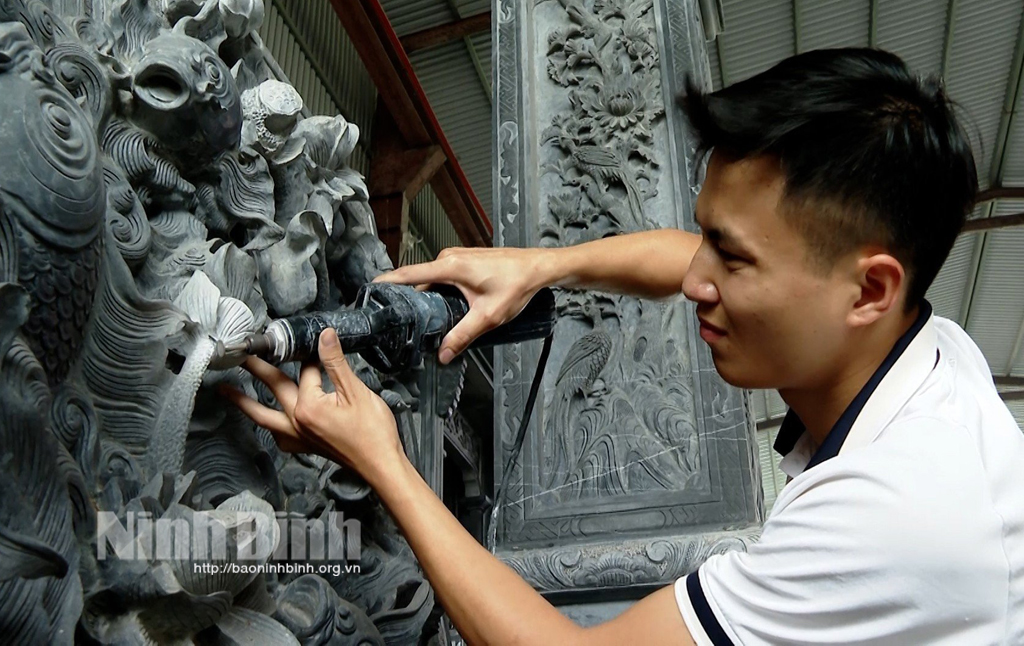
As a locality with two famous craft villages, namely Van Lam embroidery village and Ninh Van stone carving village, in recent years, along with promoting vocational training for rural laborers, the Hoa Lu District People's Committee has also paid great attention to vocational training for the laborers in these craft villages themselves.
After receiving training and acquiring high-level skills that are in line with current trends, workers will achieve better incomes for the same unit of production. Furthermore, a truly skilled workforce contributes to the preservation and development of traditional crafts, safeguarding the cultural essence of their homeland.
From 2010 to the present, Hoa Lu district has coordinated and implemented vocational training for over 13,000 rural workers, contributing to raising the percentage of trained workers in the district from 48.47% (in 2012) to over 60% currently. This includes focusing on vocational training linked to businesses and traditional craft villages; and vocational training for rural workers linked to tourism development…
Workers who have completed traditional vocational training are either employed by local businesses or create their own jobs, providing them with stable and high incomes, contributing to poverty reduction and ensuring social security in the area.
Mr. Pham Van Hoan, Head of the Labor, War Invalids and Social Affairs Department of Hoa Lu District, affirmed: In reality, socio-economic development based on exploiting the value of agriculture and rural areas; developing tourism associated with the preservation and development of traditional craft villages, connecting craft villages with festivals and historical relics, forming eco-tourism and experiential tourism tours… has made a significant contribution to preserving and promoting traditional cultural values, while simultaneously increasing income and improving the lives of the people in Hoa Lu District.
Currently, the province has 245 craft villages, of which 54 have been recognized as provincial-level craft villages. Many particularly famous and typical traditional crafts in Ninh Binh province include: sedge mat weaving in Kim Son district; stone carving in Ninh Van; embroidery in Ninh Hai commune (Hoa Lu district); rattan and bamboo weaving in Gia Tan commune (Gia Vien district); pottery in Gia Thuy commune (Nho Quan district); Phuc Loc carpentry village, Ninh Phong ward (Ninh Binh city)...
The entire province has over 24,000 households participating in the production and processing of products, including 65 joint-stock companies, 126 limited liability companies, 198 enterprises, 86 cooperatives and production groups... providing employment for a significant portion of the rural workforce, contributing to the positive shift in economic and labor structure.
The formation and development of craft villages not only create new breakthroughs in economic and social development and poverty reduction, but also make a significant contribution to preserving and promoting the traditional cultural values of the nation in local areas.
Most traditional craft villages in Ninh Binh have been recognized as provincial or district-level cultural villages. In particular, Ninh Binh's traditional craft villages are also becoming popular tourist destinations.
However, the current reality is that many traditional craft villages are at risk of disappearing due to a lack of young people continuing the tradition. Mr. Vu Manh Duong, Deputy Head of the Employment and Vocational Education Department of the Department of Labor, War Invalids and Social Affairs, stated: In the coming time, the Department of Labor, War Invalids and Social Affairs will actively coordinate with localities to further strengthen vocational training activities for craft village workers, especially attracting young workers to participate in vocational training.
Young workers always play a crucial role in maintaining and developing traditional crafts. They possess the necessary skills, the ability to absorb and apply advanced techniques in production, diversify products, and find markets for their products. Retaining young workers in particular, and the workforce in general, is vital for the survival and development of craft villages.
Dao Hang - Minh Quang
Source





















































































Comment (0)