

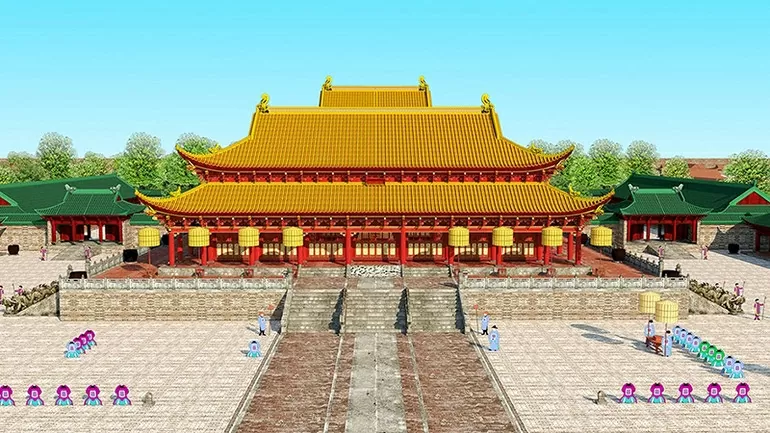
 |
| The Thang Long - Hanoi Heritage Conservation Center coordinated with units to recreate the space of Kinh Thien Palace on a 3D perspective. (Source: Nhan Dan Newspaper) |
The fire that devastated Notre Dame Cathedral in 2019 was not just a French loss. But within days, the foundations for a plan to rebuild the iconic structure were being laid, thanks to laser scans and 3D models made years earlier.
Similar stories are playing out around the world , as war, rapid urbanization and climate change continue to threaten humanity's cultural heritage.
From the Zamani project in South Africa to CyArk's global Open Heritage initiative in partnership with Google, countries and organizations around the world are racing to digitize memories before they disappear.
In Italy, Pompeii has become the focus of several large-scale digitization projects, turning the fragile ruins into an interactive archive for both researchers and the public.
In Vietnam, the Ministry of Culture, Sports and Tourism has launched a program to digitize cultural heritage for the 2021-2030 period, opening up opportunities to keep up with global trends by focusing digital preservation efforts on education and creative initiatives from the community itself.
For the past three years, Dr. Surendheran Kaliyaperumal has been teaching Fundamentals of Creative 3D at RMIT University Vietnam with a different approach.
Instead of designing random objects or fantasy worlds, students were tasked with selecting heritage sites from temples, ancient architectural works, parks to popular eateries and reconstructing them in 3D modeling software Blender.
To date, students have simulated more than 100 locations in Vietnam, of which about 65 works are considered to have enough archival value. This collection ranges from symbols such as the Saigon Central Post Office and the Independence Palace, to everyday spaces such as Hoang Van Thu Park or a small pho lau restaurant on Nguyen Thanh Y Street (Ho Chi Minh City).
The impact of the subject goes beyond skills. “They learn about culture, develop storytelling skills, connect emotionally, and develop a sense of appreciation for their heritage,” says Dr. Surendheran Kaliyaperumal.
“Vietnam has a rich culture, a young creative force and increasingly open access to digital tools. With such strengths, Vietnam is well-positioned to turn digital preservation into a bridge between culture and innovation, turning each classroom into a creative laboratory and heritage into a living, shareable resource for the future,” Mr. Surendheran affirmed.
For Dr. Kaliyaperumal Surendheran, this is not simply a teaching activity, but a career ambition. He envisions an open national archive where students, artists and the community can continue to contribute to creating a living “digital map” of Vietnamese culture. In 10-20 years, this archive can become a source of learning materials and a cultural memory bank for the country.
“If this project can inspire students to become cultural guardians, I believe it will be a truly meaningful achievement,” he shared.
As Vietnam rapidly urbanizes, initiatives like these send a powerful message: Heritage can survive if we teach the younger generation not only how to design, but also how to remember.
Source: https://baoquocte.vn/bao-ton-ky-uc-van-hoa-trong-ky-nguyen-so-336158.html


![[Photo] Cat Ba - Green island paradise](/_next/image?url=https%3A%2F%2Fvphoto.vietnam.vn%2Fthumb%2F1200x675%2Fvietnam%2Fresource%2FIMAGE%2F2025%2F12%2F04%2F1764821844074_ndo_br_1-dcbthienduongxanh638-jpg.webp&w=3840&q=75)





























![[VIMC 40 days of lightning speed] Da Nang Port: Unity - Lightning speed - Breakthrough to the finish line](https://vphoto.vietnam.vn/thumb/402x226/vietnam/resource/IMAGE/2025/12/04/1764833540882_cdn_4-12-25.jpeg)

































Comment (0)