

Recently, Bai Chay Hospital received a 37-year-old male patient residing in Dong Trieu town ( Quang Ninh province) who was bitten by his pet cat while preparing it for meat approximately 50 days prior to admission. At the time of examination at Bai Chay Hospital, the patient had swelling and pain in the tip of his right third finger, and a swollen and painful lymph node measuring approximately 3x2cm in the armpit area of the same hand where the cat bit him.
Through clinical and paraclinical examinations, doctors diagnosed the patient with cat scratch disease and monitored for sepsis. The patient was treated with pain relievers, fever reducers, and antibiotics according to the prescribed protocol.

Dr. Pham Cong Duc, Head of the Department of Tropical Diseases at Bai Chay Hospital, examines a patient suffering from cat scratch disease.
Cat scratch disease is a globally recognized infectious disease commonly caused by the gram-negative bacterium Bartonella henselae. Cats serve as natural reservoirs of Bartonella henselae, causing septicemia in red blood cells and potentially surviving for a year or longer in some cats. Infection can occur through cat scratches or bites that cause abrasions on the patient's body, or through the cat licking open wounds with its saliva.
According to Dr. Pham Cong Duc, Head of the Department of Tropical Diseases at Bai Chay Hospital, "For cat scratch disease, the bacteria that commonly cause it in humans are the intracellular gram-negative bacilli Bartonella henselae. When these bacteria enter the human body from a cat through a scratch or bite, they attack the lymphatic system, causing localized lymphadenitis. Patients will experience swelling, pain, and black scabs at the site of the scratch, bite, or lick. After a while, the scabs fall off, but the wound does not heal like a normal wound; it remains swollen and edematous, and the lymph nodes near the bite area may become enlarged, causing fever, loss of appetite, and headaches lasting 2-5 months."
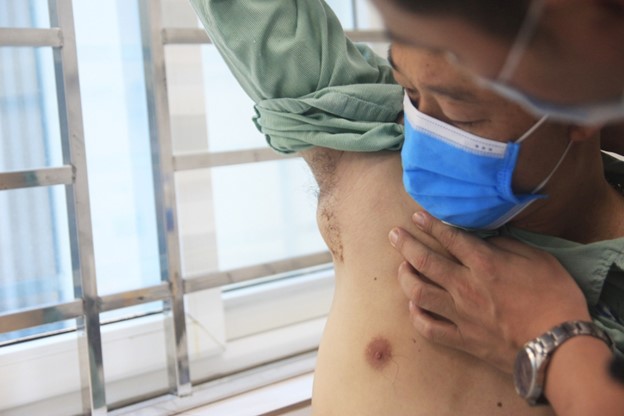
The patient experienced swelling of the fingertip at the site of the cat bite and swelling of the armpit lymph nodes.
"If diagnosed promptly by a doctor and treated with fever reducers, painkillers, and specific antibiotics, cat scratch disease can stabilize the patient's condition. However, if detected late, the disease can lead to serious complications affecting internal organs, causing liver and kidney damage; neurological complications such as encephalitis and epilepsy; and eye complications causing blindness... impacting the patient's health and threatening their life," Dr. Duc said.
Based on the case of the patient above, doctors at Bai Chay Hospital advise everyone to be careful when interacting with animals such as dogs and cats to avoid being scratched or bitten, and to limit close contact with dogs and cats when the skin is scratched or cut. In addition, if a cat scratches, bites, or licks an open wound, the wound should be washed under strong running water for 5-10 minutes with soap or antiseptic solution.
Although the incidence of rabies from cats is relatively low, doctors recommend monitoring sick or dead cats for about 15 days, seeking medical advice, and getting tetanus or rabies vaccinations. In addition, families who own dogs and cats should proactively vaccinate their pets against rabies, especially families with children, to know how to protect children from aggressive animals and prevent unfortunate incidents.
Le Trang
Source

![[Photo] Prime Minister Pham Minh Chinh attends the Conference summarizing and implementing tasks of the judicial sector.](/_next/image?url=https%3A%2F%2Fvphoto.vietnam.vn%2Fthumb%2F1200x675%2Fvietnam%2Fresource%2FIMAGE%2F2025%2F12%2F13%2F1765616082148_dsc-5565-jpg.webp&w=3840&q=75)


























































































Comment (0)