

Biden is revitalizing industry to compete with China, but this intervention could put the US economy and its allies at risk, according to the WSJ.
Jake Sullivan, President Joe Biden's national security adviser, is often preoccupied with foreign threats, such as the Ukraine conflict. But in April, in a speech at the Brookings Institute, he addressed an internal threat, echoing the long-held belief among Washington elites that "the market always allocates capital efficiently and productively."
Some in policy circles call this view neoliberalism, which prioritizes free trade and has been bipartisan for decades. But Sullivan argues that this doctrine has hollowed out American industrial bases, weakened the middle class, and made the country more vulnerable to climate change, Covid-19, and the weaponization of supply chains by hostile nations.
To address this, he argued that the US needed a new approach, a "modern industrial strategy." This would involve the government supporting stronger investment in industry and commerce to bolster the middle class and national security.
Since the 2020 election, Biden has attempted to formulate a unified theory for his economic policies. Sullivan's recent comments on the White House's domestic and foreign policy objectives toward China have further clarified what could be called "Bidenomics," with its three pillars. However, this economic policy also reveals several blind spots and contradictions, according to the WSJ .
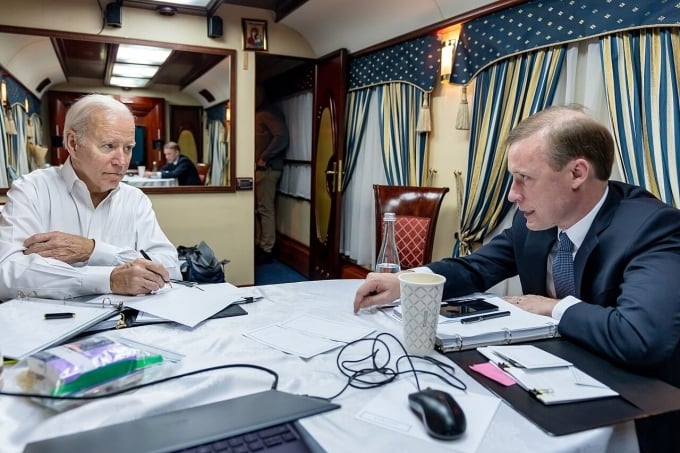
US President Joe Biden and National Security Advisor Jake Sullivan on a train to Kyiv, Ukraine from Przemsyl, Poland. Photo: White House .
First, the quality of economic growth is more important than the quantity. The old adage holds that "all growth is good growth." Bidenomics is not only concerned with higher GDP growth rates but also with whether that growth leads to higher average incomes, less inequality, and more domestic investment in areas critical to national security or the environment.
Secondly, free enterprise has disappeared, replaced by industrial policy. The market allocates capital to achieve the highest returns for private investors. But Bidenomics argues that this doesn't take into account issues like climate change, fragile supply chains, or geopolitical vulnerabilities. That's why Germany has become dangerously dependent on Russian gas, and China dominates the supply of many critical minerals and pharmaceutical ingredients.
To remedy these issues, Bidenomics aims to direct private capital into prioritized sectors through regulations, subsidies, and other interventions. "Supporting industrial policy, once seen as shameful, should now be seen as something almost self-evident," Sullivan and Jennifer Harris wrote in a 2020 essay for Foreign Policy magazine.
Third, trade policy should prioritize American workers, not consumers. Neoliberalism assumes that increasing access to global markets for American companies will boost competition, lower consumer costs, and provide better jobs for workers. But Sullivan argues that it benefits companies more than workers.
Conversely, under Bidenomics, U.S. foreign policy has focused on protecting a range of economic interests, from workers' rights to climate policy and tax compliance. Consumers and competition are not primary concerns.
Jake Sullivan, 46, has extensive experience in Democratic policymaking. He advised both Secretary of State Hillary Clinton and Vice President Biden in the Obama administration. He spent several years trying to understand how the Democratic Party had become detached from the working class. He wrote in 2018 in Democracy that the 2007-2009 recession demonstrated the government's "failure to protect citizens" from excessive free trade.
He was a harsh critic of free trade, arguing that both parties had accepted it without regard for the working class or China's rule-breaking. In his view, the clear economic model for competing with China was the same one the US used to confront the Soviet Union.
Post-World War II, investments in infrastructure such as interstate highways and semiconductor and satellite technology helped the U.S. fuel economic growth, widespread innovation, and gain an advantage in its competition with the Soviet Union. Sullivan recognized that this approach wasn't perfect, but that competing with China "would require the kind of domestic mobilization that the U.S. pursued in the 1950s and 1960s."
Sullivan's views on economics align with Biden's. He and colleagues like Brian Deese, who formerly headed the White House National Economic Council, view Biden's recent accomplishments—a $1 trillion infrastructure package, $1 trillion for electric vehicles and renewable energy, and $53 billion for semiconductors—as part of a modern industrial strategy.
However, Bidenomics has quite a few flaws. Economically, capital and labor are finite. Therefore, they need to be allocated in a way that maximizes productivity and growth. Experience has shown that governments do this far less effectively than the market. Of course, the market also has weaknesses regarding pollution or military security, but those are exceptions.
Bidenomics accepts the value of free markets but sees market failures everywhere, from regional, racial, and gender inequality to the lack of high-speed internet in rural areas and affordable childcare. When market economic failures are defined in this way, it is too broad to address.
Biden and Democrats' preferential treatment of certain products and industries has caused resentment. Congressman Ro Khanna, representing Silicon Valley, wants subsidies currently given to semiconductors to also be extended to aluminum, steel, paper, microelectronics, auto parts, and climate technology. "America needs to be able to manufacture these basic things here. I'm going to go from factory town to factory town and see what we can do to revitalize it," he said .
Semiconductors are crucial to both the civilian and defense industries, and even many neoliberals advocate for subsidies to reduce America's dependence on China, Taiwan, and South Korea.
However, to align with Bidenomics—that is, addressing the social failures of a free market economy—the U.S. Commerce Department stated that companies receiving subsidies must meet a series of governance conditions, such as providing childcare services, paying union-mandated wages, employing unionized workers, not repurchasing shares or investing in China, and sharing profits with the federal government. These restrictive requirements have diminished the policy's effectiveness.
According to the WSJ , Bidenomics' domestic and foreign policies are also contradictory. While seeking the support of allies, the Biden administration's policies discriminate against those partners. Biden argues that the "Inflation Reduction Act" helped boost battery and electric vehicle production in the US. But other countries complain that the most generous subsidies under the law are only for vehicles assembled in North America. "The US is our partner on shared values, but at the same time has a very protectionist economic policy," German Finance Minister Christian Lindner once said.
Recent complaints have subsided as the Biden administration opened negotiations with allies on common standards for key minerals used in batteries and interpreted legislation to subsidize more foreign electric vehicles. But another move has unsettled some Democrats in Congress.
Unlike Donald Trump, Biden doesn't seek to tear up existing free trade agreements or raise tariffs. But he's also not interested in new trade agreements or tariff reductions. His "Indo-Pacific Economic Framework" seeks cooperation with regional allies on labor conditions, climate policy, tax compliance, and corruption, but doesn't offer greater market access for the U.S. like the TPP.
For foreign trading partners, it was an unimpressive proposal. One Indonesian official remarked that instead of "carrot and stick," it was "stick and stick." So what is the alternative to Bidenomics?
The promise of greater access to the US market will not convince more Asian countries to side with the US in confronting China. But like the Cold War, the competition between the two superpowers is a long game.
According to Doug Irwin, a trade policy historian at Dartmouth University, without a proactive trade strategy with the region, the absence of the US will create a vacuum that allows China to take the lead and the US to gradually lose influence. When the US withdrew from the TPP, Singapore Prime Minister Lee Hsien Loong commented to the WSJ that "you've opened this door and now someone else will knock."
Even if the U.S. remains outside the TPP, there are still many other ways to strengthen trade relations. Rahm Emanuel, the U.S. Ambassador to Japan, has recommended increasing Alaskan natural gas exports to Japan, even though that runs counter to Biden's long-term climate goals. According to Emanuel, Asian countries still "want U.S. military, diplomatic, and economic leadership."
Until very recently, U.S. presidents believed that binding other nations on trade and investment helped maintain the international order led by the United States. "The maintenance of our Western political unity depends heavily on the degree of Western economic unity," President John F. Kennedy stated in 1962, when he asked Congress to expand its authority to negotiate trade agreements.
This approach has not been successful with China but has worked spectacularly with Western Europe, Japan, and South Korea. It explains why, despite dissatisfaction with aspects of Bidenomics, these countries have increased their engagement with Biden's coalition.
Phiên An ( according to WSJ )
Source link


![[Photo] Prime Minister Pham Minh Chinh holds a phone call with the CEO of Russia's Rosatom Corporation.](/_next/image?url=https%3A%2F%2Fvphoto.vietnam.vn%2Fthumb%2F1200x675%2Fvietnam%2Fresource%2FIMAGE%2F2025%2F12%2F11%2F1765464552365_dsc-5295-jpg.webp&w=3840&q=75)

![[Photo] Closing Ceremony of the 10th Session of the 15th National Assembly](/_next/image?url=https%3A%2F%2Fvphoto.vietnam.vn%2Fthumb%2F1200x675%2Fvietnam%2Fresource%2FIMAGE%2F2025%2F12%2F11%2F1765448959967_image-1437-jpg.webp&w=3840&q=75)












































![[OFFICIAL] MISA GROUP ANNOUNCES ITS PIONEERING BRAND POSITIONING IN BUILDING AGENTIC AI FOR BUSINESSES, HOUSEHOLDS, AND THE GOVERNMENT](https://vphoto.vietnam.vn/thumb/402x226/vietnam/resource/IMAGE/2025/12/11/1765444754256_agentic-ai_postfb-scaled.png)






































Comment (0)