

This is one of the five key tasks identified by the Ministry of Education and Training to be implemented in the new school year 2025-2026. Accordingly, the Ministry of Education and Training requires units to innovate teaching and assessment methods towards developing students' comprehensive qualities and abilities.
In parallel, localities promote educational programs such as STEM/STEAM, digital literacy, artificial intelligence (AI) and career education. In particular, improving the quality of English teaching is emphasized, with the goal of gradually making this subject a second language in schools.
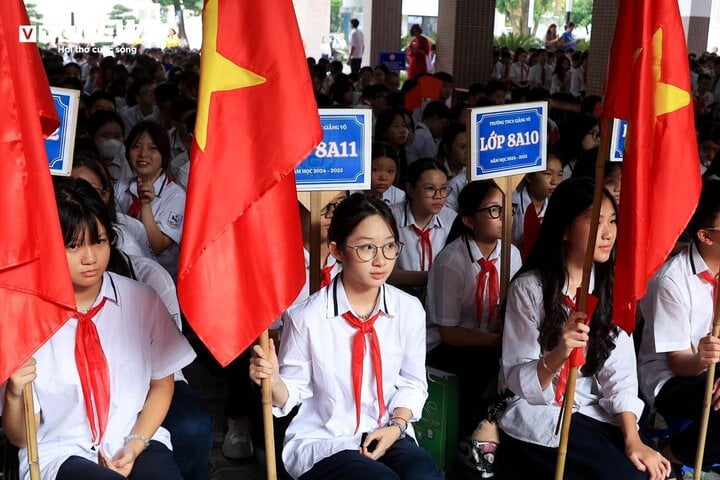
Students attend the opening ceremony of the new school year 2024. (Illustration photo)
The guidelines also require the Departments of Education and Training to continue reviewing, arranging and planning the school network, especially in areas where administrative boundaries are being merged. The goal is to ensure that all primary school students can attend school according to the provisions of the 2019 Education Law and their studies are not interrupted.
For border areas, islands, ethnic minority areas and areas with special economic difficulties, the Ministry proposes to build and consolidate boarding, semi-boarding and inter-level boarding schools for ethnic minorities. At the same time, there should be appropriate support policies so that students in border communes can enjoy the best benefits.
Regarding facilities, the Ministry requires overcoming the situation of "school equipment but not in class", while ensuring the full and timely supply of textbooks for students right from the beginning of the school year.
To address the teacher shortage, the Ministry of Education and Training requires localities to synchronously implement many solutions such as teaching contracts, mobilization, secondment, and inter-school teacher transfers. This is to avoid disruption and staff shortages after restructuring the apparatus.
A new point is to build a mechanism to mobilize highly specialized human resources, including artisans, artists, professional athletes and foreign volunteers to participate in educational activities on culture, arts, sports and life skills.
In the context of digital transformation, the Ministry directed to increase the application of artificial intelligence (AI) and big data in management and teaching. AI will be used to support career counseling, personalize learning, identify students in need of support and evaluate policies. The implementation of digital student records will also continue to be promoted, connecting with the National Population Database to modernize management.
The Ministry of Education and Training emphasizes the need to strengthen and improve the quality of universal education, ensuring equitable access. The guidelines also require educational institutions to effectively implement inclusive education for students with disabilities, and to develop appropriate individual education plans.
For ethnic minority students, it is necessary to continue implementing solutions to enhance Vietnamese, organize Vietnamese language teaching for children before entering first grade and pilot the enhancement of listening and speaking skills based on their mother tongue.
Finally, the Ministry requires the Departments of Education and Training to strengthen inspection and supervision of the implementation of general education programs, strictly manage extra teaching and learning activities and the use of textbooks and reference publications.
Nhu Loan
Source: https://vtcnews.vn/bo-gd-dt-quyet-giai-bai-toan-thieu-giao-vien-nam-hoc-moi-ar958095.html
![[Photo] 60th Anniversary of the Founding of the Vietnam Association of Photographic Artists](/_next/image?url=https%3A%2F%2Fvphoto.vietnam.vn%2Fthumb%2F1200x675%2Fvietnam%2Fresource%2FIMAGE%2F2025%2F12%2F05%2F1764935864512_a1-bnd-0841-9740-jpg.webp&w=3840&q=75)



![[Photo] National Assembly Chairman Tran Thanh Man attends the VinFuture 2025 Award Ceremony](/_next/image?url=https%3A%2F%2Fvphoto.vietnam.vn%2Fthumb%2F1200x675%2Fvietnam%2Fresource%2FIMAGE%2F2025%2F12%2F05%2F1764951162416_2628509768338816493-6995-jpg.webp&w=3840&q=75)











































































Comment (0)