

Also attending were Deputy Prime Ministers Tran Hong Ha, Le Thanh Long, and Ho Duc Phoc; representatives from central ministries and agencies; and leaders of 12 large private corporations and enterprises.
In his opening remarks at the conference, Prime Minister Pham Minh Chinh stated that since the beginning of his term, the Government has held numerous meetings with domestic and foreign businesses. Since the Covid-19 pandemic, the Government has held several separate meetings with businesses; however, this is the first time a thematic working session of its kind has been held. In the coming period, the Government will continue to hold thematic working sessions with businesses to discuss important issues in more detail.
The Prime Minister emphasized that this conference demonstrates the Party and State leaders' concern for private enterprises, in the spirit that the private economy is identified as an important driving force of the country's socio-economic development. This content was established in the 12th Party Congress, and the 13th Party Congress also continued to affirm that the private economy is a crucial driving force of our country's economy.
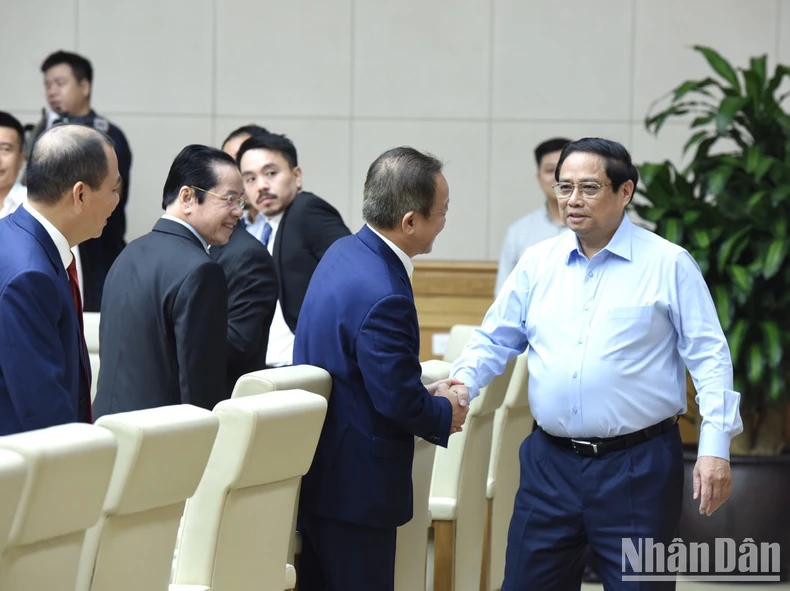 |
Prime Minister Pham Minh Chinh with leaders of private corporations and businesses. (Photo: TRAN HAI) |
The private sector contributes over 45% of GDP and 40% of total social investment; creates jobs for 85% of the total workforce; accounts for 35% of import turnover and 25% of export turnover. We are proud to have large private corporations that have affirmed their position and expanded globally. During the Covid-19 pandemic, businesses at the conference made many positive and effective contributions to help the entire nation overcome the pandemic. The government has repeatedly expressed its gratitude to business leaders in general, especially large enterprises, for their participation in combating the Covid-19 pandemic and quickly bringing the country back to normal. This effort is the result of the entire population, the leadership of the Party, the management of the State, and the contributions of businesses.
The Prime Minister shared that since the beginning of his term, the country has faced countless difficulties: strategic competition, conflicts in some areas, disruptions to supply chains and production chains affecting the entire global economy, including Vietnam. In this context, Vietnamese businesses, including private enterprises, have played a crucial role in restoring and developing the national economy. Businesses and entrepreneurs have strived, contributed, overcome the consequences, and propelled the Vietnamese economy to 34th place in the world according to the World Bank (WB) ranking.
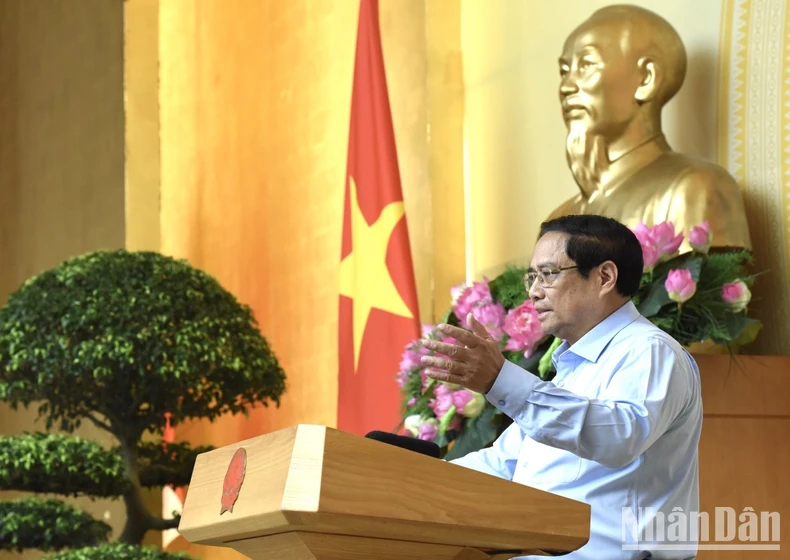 |
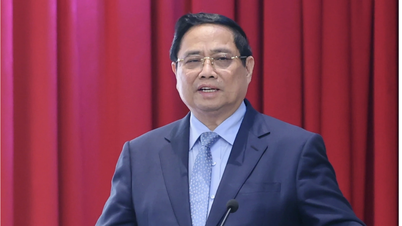
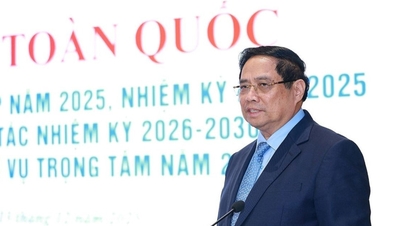
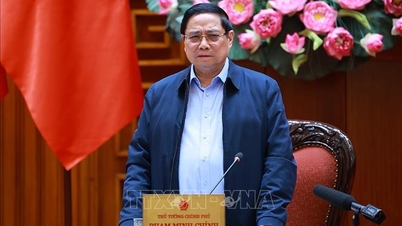
Prime Minister Pham Minh Chinh delivers a speech at the conference. (Photo: TRAN HAI) |
The Prime Minister expressed his deep appreciation for the contributions of businesses in overcoming the consequences of natural disasters, especially Typhoon No. 3 (Yagi) and other natural disasters, demonstrating a spirit of "mutual support and compassion," and "national solidarity and brotherhood."
The Prime Minister expressed his hope that, for businesses, especially those that have already achieved success, we are entering a period of national transformation, summarizing 40 years of the Doi Moi (Renovation) process. As the late General Secretary Nguyen Phu Trong once said: "Our country has never had such a foundation, potential, position, and international prestige as it does today." This is thanks to the efforts of the entire society and the entire people, in which the business community and entrepreneurs have made important contributions. Vietnam's current position is different; however, we still face many difficulties, the scale of the economy is still modest, and per capita income is not yet high. Therefore, the Prime Minister hopes that business leaders will continue to uphold the spirit of patriotism and love for the people, promoting the glorious historical and cultural traditions of the nation, which are cultural heritage and the foundation of the country, namely "national solidarity and brotherhood," "mutual support and compassion," so that we can continue to develop in the spirit of listening and understanding each other. Sharing a vision, understanding, and actions; working together, sharing the benefits, winning together, and developing together.
Prime Minister Pham Minh Chinh emphasized the spirit of national unity, which is also a heritage of the country; always united within the Party, united among the people, and united internationally. The Prime Minister stated, “Resources originate from thinking, motivation from innovation, strength from the people and businesses; the people make history. Therefore, businesses and entrepreneurs need to play their historical role, contribute to the country, and create breakthroughs in the current period, especially as the country has just gone through difficult times such as the Covid-19 pandemic and the devastating effects of Typhoon No. 3.”
The Prime Minister urged businesses to promote self-reliance and self-improvement to overcome difficulties together; we must achieve breakthroughs and advancements from now until the end of this term, with only a little over a year remaining; entering a new era in 2030, the country will celebrate 100 years of the Communist Party's leadership: the country must have major projects and national symbols to commemorate this significant event.
The 10th Central Committee Conference recently agreed to study investment in the development of high-speed rail, restart research on nuclear energy; complete the north-south and east-west expressway systems connecting airports and seaports, creating new impetus and reducing logistics costs; do a good job on social welfare issues such as eliminating temporary and dilapidated housing; strive to complete this by 2025, the 80th anniversary of the founding of the country; and by 2030, the 100th anniversary of the founding of the Party, we aim to eliminate poverty.
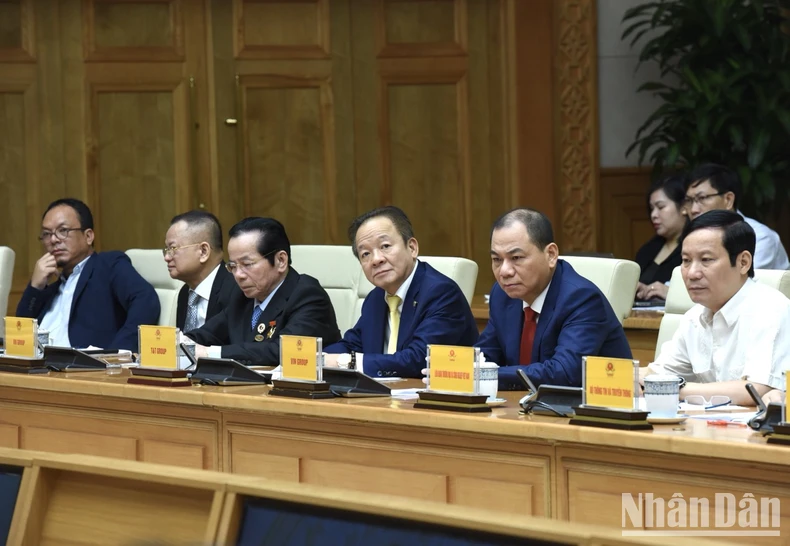 |
Leaders of major private corporations and businesses attended the conference. (Photo: TRAN HAI) |
The Prime Minister summarized the spirit of the recently concluded 10th Plenum of the 13th Central Committee, highlighting several breakthroughs: the introduction of groundbreaking developments, including the most significant institutional breakthrough – a resource and driving force for development; the creation of symbolic projects that serve as driving forces, guiding and inspiring the entire nation; the need to further improve social welfare; adapting to and aligning with nature in development; focusing on programs and projects to resettle residents in landslide-prone areas; combating drought, saltwater intrusion, subsidence, and landslides in the Mekong Delta; leveraging science and technology and innovation for national development; and renewing traditional growth drivers while promoting new ones.
The Prime Minister emphasized that private enterprises need to capitalize on this momentum to develop the country; continue to be pioneers in innovation, pioneers in strategic breakthroughs, especially in building and perfecting the legal system, particularly the socialist-oriented market economy institutions. We need to be understanding and supportive in the coming time; we need to discuss, listen, and reach consensus on issues so that the country can develop rapidly and sustainably.
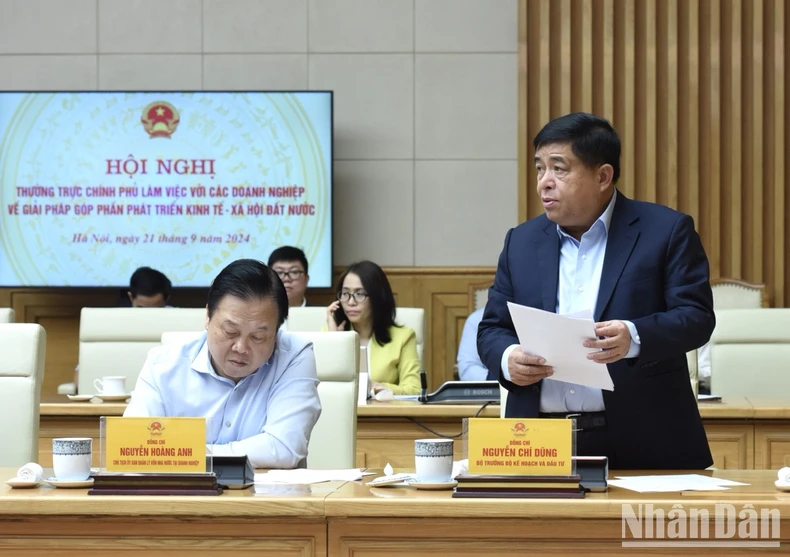 |
Minister of Planning and Investment Nguyen Chi Dung delivers a speech at the conference. (Photo: TRAN HAI) |
According to the Ministry of Planning and Investment, businesses and entrepreneurs always play a key role, being the main material production force of the economy, and are extremely important in the cause of national construction and development. In nearly 40 years of implementing the Doi Moi (Renovation) policy, with the correct guidelines and policies of the Party and State, Vietnam currently has more than 930,000 operating businesses, of which 98% are small and medium-sized enterprises; approximately 14,400 cooperatives and more than 5 million business households. Along with the strong growth in number, Vietnamese businesses have continuously developed and expanded in terms of capital, revenue, profits, and labor efficiency; demonstrating their role as the main force managing and organizing production resources, creating goods and services for society, and promoting the country's socio-economic growth and development.
In 2023, the private sector contributed approximately 46% of GDP, generated about 30% of state budget revenue, and employed about 85% of the workforce; its corporate income tax contribution accounted for about 34%. Notably, a large number of private enterprises have emerged, accumulating sufficient capacity in terms of capital scale, technology, and corporate governance, with brands expanding into regional and global markets, becoming important drivers of the economy, such as Vingroup, Thaco, Hoa Phat, TH, etc. Many enterprises have mastered technology, led in innovation, built strong brands, created ecosystems for other businesses to develop together, pioneered green transformation and digital transformation, participated in solving major national challenges, and contributed to building an independent and self-reliant economy.
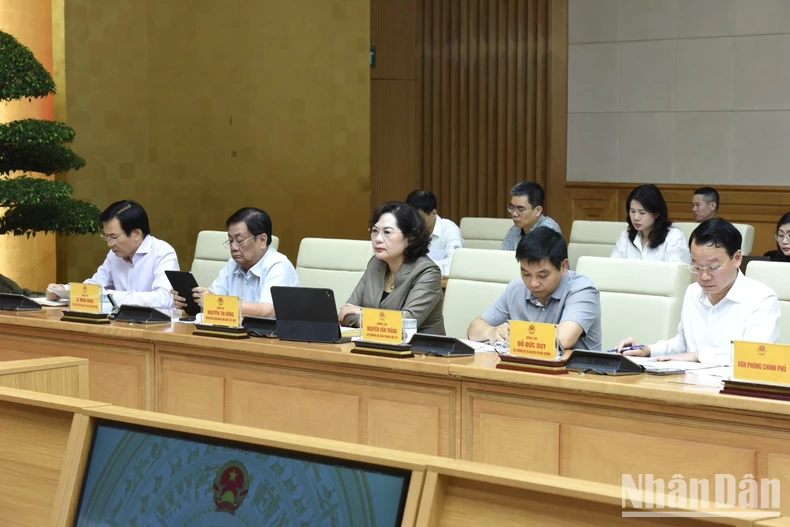 |
Representatives from central ministries and agencies attended the conference (Photo: Tran Hai). |
International experience shows that not only in developed countries but also in low- and middle-income countries, large corporations play a crucial role, making significant contributions to economic development in terms of growth, employment, exports, taxes, and value creation. According to World Bank estimates, 80% of global profits are generated by the top 10% of businesses, with large corporations contributing an average of one-third of export revenue and half of a nation's export growth rate. South Korea's miraculous economic development is linked to major national brands like Samsung, Hyundai, and SK. Similarly, Honda and Toyota are closely associated with Japan's national strength.
After nearly 40 years of implementing the Doi Moi (Renovation) policy, Vietnam, once a backward economy, has risen to become one of the top 40 economies, with a trade volume among the top 20 countries in the world. It is a crucial link in 16 free trade agreements connecting with 60 key economies in the region and globally. The size of the economy has increased from $26.3 billion in the early years of Doi Moi to over $430 billion in 2023. Vietnam is regarded by the United Nations and the international community as a success story, a shining example of poverty reduction and continuous improvement in the material and spiritual lives of its people.
However, the world is witnessing many major changes, the emergence of new industries, policy shifts in major economies leading to shifts in investment flows, and adjustments in the structure of trade and investment. This presents both risks and challenges, but at the same time also brings new opportunities and advantages to countries.
The new context is also placing new demands on the country's economic development. This means not only striving for growth targets, but also for green, sustainable growth, aiming for net zero growth by 2050. It means not only developing traditional businesses, but also focusing efforts on attracting investment and creating breakthroughs in pioneering industries such as semiconductors, AI, and green hydrogen. Growth is no longer based solely on capital and resource exploitation as before, but must also rely on science and technology and innovation. It means not only leveraging and renewing traditional growth drivers like investment, consumption, and exports, but also fostering new growth drivers stemming from the circular economy, the digital economy, and new economic models...
At this conference, the Standing Committee of the Government wishes to hear from businesses about their operational situation, difficulties and obstacles, proposed solutions, and shared thoughts and visions. Together with leading large enterprises, they aim to identify and jointly implement national-level projects, find solutions to major national challenges, and achieve the goal of transforming Vietnam into a developing country with modern industry and high middle income by 2030, and a developed country with high income by 2045, as set out in the 13th National Congress of the Party.
The Ministry of Planning and Investment also reported that the socio-economic situation in Vietnam during the first eight months continued to achieve many positive and important results: macroeconomic stability was basically maintained, inflation was controlled, and major balances were ensured; budget deficit, public debt, government debt, and foreign debt remained within permissible limits. The consumer price index (CPI) for the first eight months increased by 4.04% compared to the same period last year, within the control level set by the National Assembly. The exchange rate was managed proactively, flexibly, and promptly, in line with developments in the world market. State budget revenue for the first eight months is estimated to reach 78.5% of the projected amount, an increase of 17.8% compared to the same period last year. Export and import turnover for the first eight months increased by 16.7%, 15.8%, and 17.7% respectively compared to the same period last year; the trade surplus is estimated at 19.1 billion USD; and major balances were ensured.
Supply-side growth drivers continue to show positive developments. Agricultural production and services maintain a fairly strong growth momentum. Industrial production is recovering rapidly, once again becoming an important driver for overall economic growth; the Industrial Production Index (IIP) in August increased by 9.5% year-on-year, and by 8.6% over the first eight months, with manufacturing increasing by 9.7%. The Purchasing Managers' Index (PMI) in August reached 52.4 points, marking the fifth consecutive month above 50 points, indicating a clear recovery in industrial production.
In August, approximately 21,900 businesses entered or re-entered the market, bringing the total for the first eight months to around 168,100, exceeding the number of businesses withdrawing from the market (135,300). Demand-side growth drivers showed a more positive recovery. Foreign direct investment (FDI) continued to be a bright spot, with total registered FDI capital in the first eight months reaching approximately US$20.5 billion, a 7% increase compared to the same period last year. This included nearly US$12 billion in newly registered FDI, a 27% increase, and approximately US$14.15 billion in implemented FDI, an 8% increase. The work of improving institutions and laws was decisively directed, prioritizing both time and resources, with a spirit of reform, innovation, and breakthroughs in thinking, approach, and methods, and promoting decentralization and delegation of power.
The government has submitted to the National Assembly proposals to allow the Land Law, Housing Law, and Real Estate Business Law to take effect early from August 1, 2024, and has also issued and directed the issuance of 121 detailed regulations and guidelines for their implementation. The Prime Minister has established a Steering Committee to review obstacles in the legal system and to study and submit to the National Assembly at the 8th Session solutions to immediately address legal bottlenecks and obstacles.
In the first eight months, nearly 90 trillion VND of taxes, fees, and land rent were exempted, reduced, or extended, with an estimated total of 187 trillion VND for the whole year. The 120 trillion VND social housing loan package continues to be expedited; the 30 trillion VND loan package for forestry and fisheries products is being considered for expansion.
The Government and the Prime Minister continue to direct ministries, sectors, and localities to resolutely remove difficulties and obstacles, ensuring the progress of key projects. To date, more than 2,021 km of expressways have been put into operation, opening up many new development opportunities. The 500kV Circuit 3 power line project, with a scale of nearly 1 billion USD, was inaugurated after more than 6 months of construction, becoming a typical model, creating momentum and inspiring the implementation of important national projects with new approaches, new thinking, new management, and mobilizing combined strength.
Business and production activities in the first eight months of the year maintained their recovery momentum. Several large corporations and enterprises have proactively transformed and invested heavily in new industries such as artificial intelligence (AI), semiconductor chips, and hydrogen; pioneering innovation in business models towards a green and circular economy, making positive contributions to the realization of the sustainable development goals and the Government's Net Zero commitment by 2050.
Private enterprises have gradually developed into a leading force, spreading and driving the development of many important industries and sectors, contributing to macroeconomic stability and ensuring major economic balances with high intellectual content and innovative capabilities. Thousands of small and medium-sized enterprises and household businesses have benefited from business linkages with these leading enterprises.
Large-scale enterprises have transformed themselves by adopting technology and modern management models. Their investment activities have helped supplement resources and reduce reliance on state budget investments, contributing to accelerating the restructuring of the economy and the innovation of the growth model.
At the conference, corporations and private enterprises proposed numerous solutions to the Government, the Prime Minister, and relevant ministries and agencies to address difficulties and obstacles, particularly suggesting mechanisms and policies that create favorable conditions for businesses to develop strongly and make a worthy contribution to national development. Representatives from several ministries and agencies immediately addressed the proposals of the corporations and enterprises.
Concluding the conference, Prime Minister Pham Minh Chinh expressed his sympathy with businesses regarding the recent difficulties the country has faced; he thanked businesses for always standing alongside the Party, the State, and the people in contributing to overcoming difficulties and building a more prosperous and beautiful country, where the people enjoy increasingly comfortable and happy lives.
The Prime Minister stated that the Government has great confidence and pride in the growth and strength of Vietnamese businesses; is committed to accompanying and protecting the legitimate rights and interests of businesses; will not criminalize economic relations; will study the abolition of unnecessary permits that easily lead to harassment and inconvenience, increasing compliance costs for businesses; affirmed that the Government always listens, shares, and works together to resolve difficulties and obstacles, overcome challenges; and especially focuses on building and perfecting institutions so that businesses can invest with confidence and promote production and business.
The Prime Minister instructed the Deputy Prime Ministers, Ministers, and heads of agencies to directly listen to and definitively resolve the difficulties faced by businesses; emphasizing that removing obstacles for businesses is removing obstacles for the economy; business development leads to national development. The Prime Minister requested that ministries, agencies, and organizations actively address business difficulties with the spirit of "removing obstacles wherever they arise," without shirking responsibility, avoiding responsibility, or causing inconvenience or harassment. The Government will continue to decentralize power to ministries, agencies, and localities; and resolutely cut down on cumbersome and unnecessary administrative procedures.
The Prime Minister also requested that businesses comply with the law, contribute to improving institutions to strengthen management and promote business development; institutional building must be consistent, focusing on creating a development environment and formulating policies for development, especially the development of a socialist-oriented market economy and key national projects.
The Prime Minister emphasized the need to always place the people and businesses at the center and as the main actors in the process of improving institutions; he urged businesses to implement "six pioneering initiatives": Pioneering in innovation and the application of science and technology, focusing on traditional growth drivers, promoting new growth drivers such as the green economy, circular economy, knowledge economy, and combating climate change; Pioneering in participating in global value chains and supply chains, contributing to building corporate and national brands; Pioneering in creating jobs and livelihoods for the people, and doing a good job in social welfare; Pioneering in infrastructure development, especially digital infrastructure, transportation, socio-economic and cultural infrastructure, particularly transportation infrastructure including highways, railways, airports, seaports, and green infrastructure; Pioneering in contributing to training high-quality human resources, reforming administrative procedures, building smart governance, and contributing to improving the investment and business environment. Pioneering in solidarity, unity, mutual support, listening and understanding; sharing vision, awareness and action; working together, sharing benefits, winning together, and developing businesses and the country.
The Prime Minister requested the Government Office and ministries to listen to and incorporate the contributions of businesses, contributing to resolving issues with the spirit of "saying what you mean and doing what you commit to," harmonizing benefits, sharing risks, and balancing the interests of the State, the people, and businesses. The Government also thanked the businesses for proposing specific tasks such as participating in the construction of the North-South high-speed railway project, expressways, steel plants, ports, airports, social housing, and improving children's physical health...
The government will study and assign tasks and orders to businesses to work together, win together, and share the benefits. Ministries and agencies should handle work with high determination, great effort, and decisive action to resolve difficulties and obstacles together with businesses; implementation should be guided by the "5 clear principles": "clear person, clear task, clear time, clear responsibility, clear product". The Prime Minister also noted that ministries and agencies should organize more specialized conferences within their respective sectors with businesses on issues related to land, environment, finance, taxation, investment, etc.
According to the Ministry of Planning and Investment, Vietnam currently has over 930,000 active businesses, of which 98% are small and medium-sized enterprises (SMEs); approximately 14,400 cooperatives and over 5 million business households. Along with the strong growth in numbers, Vietnamese businesses have continuously developed and expanded in terms of capital, revenue, profits, and labor efficiency. In 2023, the private sector contributed approximately 46% of GDP, generated about 30% of state budget revenue, employed about 85% of the workforce, and accounted for about 34% of corporate income tax contributions. Notably, a large number of private enterprises have emerged, accumulating sufficient capacity in terms of capital scale, technology, and business management, with brands reaching regional and global markets, becoming an important driving force of the economy.
Source: https://nhandan.vn/cac-tap-doan-doanh-nghiep-tu-nhan-phat-huy-truyen-thong-yeu-nuoc-tao-buoc-phat-trien-dot-pha-nhanh-va-ben-vung-post832265.html




![[Photo] Prime Minister Pham Minh Chinh attends the Conference summarizing and implementing tasks of the judicial sector.](https://vphoto.vietnam.vn/thumb/402x226/vietnam/resource/IMAGE/2025/12/13/1765616082148_dsc-5565-jpg.webp)






![[Video] 24-hour News on December 13, 2025: Prime Minister: Eliminate the situation of "managing without knowing" and "banning if you can't manage"](https://vphoto.vietnam.vn/thumb/402x226/vietnam/resource/IMAGE/2025/12/13/1765631092985_z7323081777994-c31a9753c13724017adafe243bd77001-jpg.webp)






















































Comment (0)