

Avoid conflicts of law between different laws.
In a summary report on some major issues addressed and revised in the draft Law on Housing (amended), the Chairman of the National Assembly's Law Committee, Hoang Thanh Tung, stated: The policy issues in the draft Law on Housing (amended) need to be consistent with the draft Law on Land (amended) and the Law on Investment. Regarding consistency with the draft Law on Land (amended), the Chairman of the Law Committee noted that there are still two differing opinions on the form of land use for commercial housing projects (Clause 4, Article 36):
The majority of opinions suggest retaining the regulations on land types permitted for commercial housing projects as in the current Housing Law (land use rights for residential purposes, land use rights for both residential and other purposes, and land use rights for residential purposes acquired through agreements) to prevent loopholes and revenue losses due to land value differentials when allowing other land types to be used for commercial housing projects.
Some opinions support the provisions of the draft Law on Housing (amended) submitted by the Government at the 5th session regarding the addition of two other types of land for commercial housing projects to institutionalize the policy in Resolution No. 18-NQ/TW dated June 16, 2022, of the 5th Conference of the Central Committee of the 13th Party Congress.
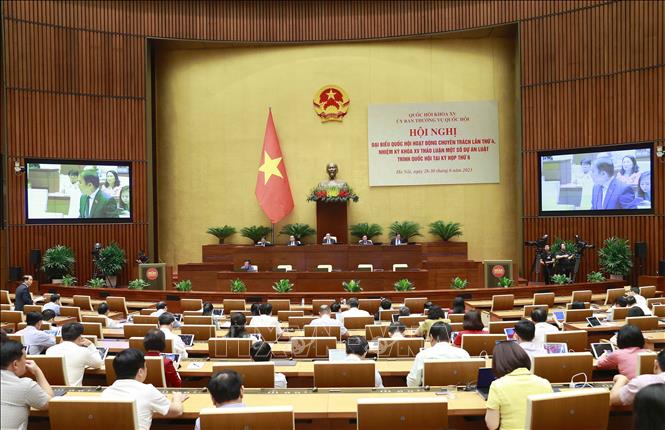
The National Assembly's specialized working group conference continued its discussion on the draft Law on Housing (amended). Photo: VNA.
During the discussion at the 25th session, the majority of the Standing Committee of the National Assembly agreed with the proposal of the Standing Committee of the Legal Affairs Committee to inherit the provisions of the current Housing Law.
Regarding the content related to the Investment Law, after research, the Standing Committee of the National Assembly agreed with the proposal of the Standing Committee of the Legal Affairs Committee as follows: To avoid conflicts of law between different laws, ensure the simplification of investment and business procedures, and reduce the legal compliance costs for citizens and businesses, Clause 4 of Article 35 of the draft Housing Law (amended) should be revised to connect the regulations on the order and procedures for investing in housing projects between the three laws on Investment, Construction, and Housing, remove the overlapping content on investment procedures as mentioned above, and expand the right of investors to choose the form of investment (authorization or establishment of a business) as shown in the draft Law.
Regarding the renovation and reconstruction of apartment buildings (Chapter V of the draft Law), the Standing Committee of the National Assembly's Legal Committee has incorporated the opinions of National Assembly deputies and revised Articles 68, 69, and 70 of the draft Law as follows: For old apartment buildings (built before 1994), the current housing law's provisions on the application of the K coefficient for apartment compensation will continue to apply; for new apartment buildings built after 1994 that are eligible for reconstruction due to their conformity with the planning, apartment owners are responsible for contributing funds for the reconstruction of the apartment building and can pay these funds according to the project's progress or after the handover of the apartment according to the approved compensation, support, and resettlement plan. If they do not contribute funds for the reconstruction of the apartment building, they will be compensated for the land use rights and the remaining value of the housing (if any) according to the Government's regulations.
Regarding the regulation that the Vietnam General Confederation of Labor is the investor in social housing and worker accommodation (Clause 3, Article 78), the Chairman of the Legal Committee stated that there are still two differing opinions on this matter:
Type 1 opinion: Supports the regulation that the Vietnam General Confederation of Labor is the managing agency for investing in social housing projects for workers to rent, as proposed by the Vietnam General Confederation of Labor in document No. 7177/TLĐ-BQLDA.
The second type of opinion suggests that the Vietnam General Confederation of Labor should not be included as the investor for social housing and worker accommodation projects in the draft amended Housing Law, as proposed by the Government. This is a new issue, and the pilot program implemented so far (according to the Prime Minister's Decision) has encountered many obstacles and is not yet mature enough to be included in the Law. Therefore, it is proposed that the Vietnam General Confederation of Labor develop a proposal to report to the National Assembly for consideration, allowing for a pilot implementation of the policy where the Vietnam General Confederation of Labor is the investor for social housing projects for a certain period. If it proves effective, then it should be included in the Law.
Regarding land for the construction of social housing (Article 81), the Standing Committee of the National Assembly's Legal Affairs Committee reported and proposed two options. After discussion at the 25th session, the Standing Committee of the National Assembly agreed with Option 1 as proposed by the Standing Committee of the Legal Affairs Committee.
Regarding the construction of worker accommodation in industrial zones (Articles 90 and 92), the Chairman of the Legal Committee stated that many opinions supported the construction of worker accommodation within the commercial and service land area of industrial zones as stipulated in the draft Law submitted by the Government.
Some opinions suggest that regulations on the construction of worker accommodation within industrial zones should not be implemented because it is inconsistent with Articles 19 and 77 of the Investment Law. The construction of worker accommodation within industrial zones should be limited to ensure labor safety and security within the zones.
Consider regulations regarding project developers and the conditions for becoming a project developer in housing construction projects.
Speaking during the discussion, National Assembly representative Le Thi Thanh Lam (from the Hau Giang Provincial Delegation) stated that Clause 2, Article 35 of the draft Law stipulates that in the case specified in point a, Clause 1 of this Article, the investor of a housing construction project must meet the following conditions: Have equity capital as prescribed by the law on real estate business to implement each project; have the right to use land to implement each type of housing construction investment project as prescribed by this Law, or be allocated or leased land as prescribed by the Land Law; and have the capacity and experience to implement the project as prescribed by law.
Representative Le Thi Thanh Lam argued that such a regulation is unnecessary and could cause overlap. Therefore, she suggested that this regulation should be removed from the draft Law on Housing (amended). In addition, to further improve the draft Law, Representative Le Thi Thanh Lam also suggested a review of the provisions in Clause 1, Article 35 and Clause 1, Article 58…
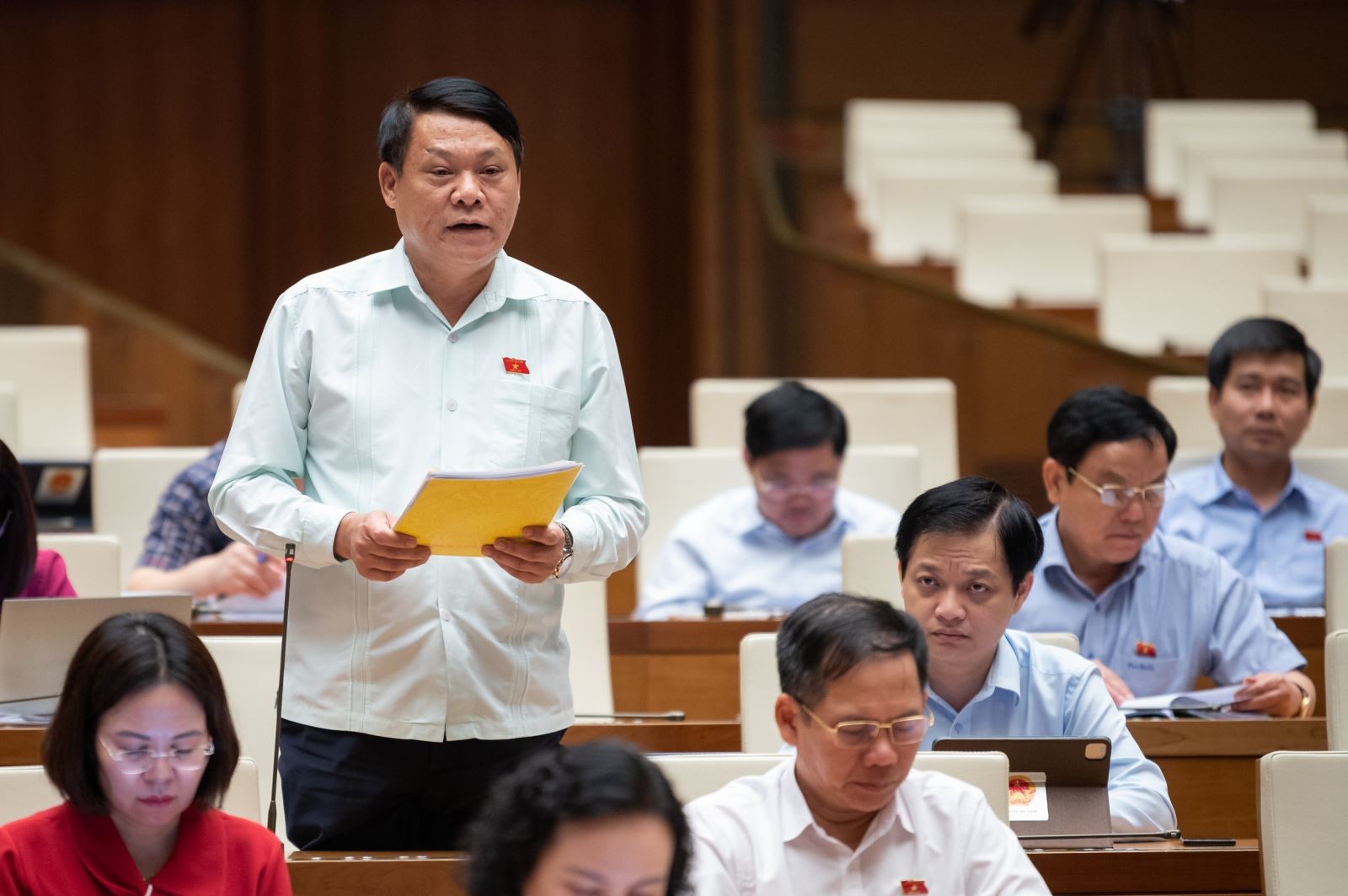
Representative Nguyen Thanh Nam - Member of the National Assembly delegation from Phu Tho province, delivered his remarks.
Commenting on the regulations regarding general requirements for the development, management, and use of housing, National Assembly delegate Nguyen Thanh Nam (Phu Tho province delegation) pointed out that Clause 5, Article 5 stipulates that "In Type I, Type II, and Type III urban areas, and in wards, districts, and cities belonging to special urban areas, the investor of a housing construction project must build housing for sale, rent, or lease-purchase." Delegate Nguyen Thanh Nam argued that this regulation is inappropriate, impractical, and creates difficulties for investors and people when buying houses in urban areas...
According to Representative Nguyen Thanh Nam, in reality, people in the midland and mountainous provinces often want to use land to build their own houses and design architecture that suits the customs, traditions, and living habits of their families and individuals, whether in rural areas or type II and type III urban areas. Therefore, if the above regulation is implemented, it will not be feasible in many localities.
Furthermore, when developers have to build houses on the land, it increases their costs, leading to higher house prices by the time they reach the buyers. Subsequently, buyers still have to spend a significant amount of money to renovate or improve parts of the house, making the final price far too high compared to their income and needs.
Concerned about administrative procedures, National Assembly delegate Pham Trong Nghia (Lang Son province delegation) stated that a website specializing in statistics on living standards worldwide shows that in 2023, Vietnam's house price-to-income ratio ranked 14th out of 107 countries surveyed, and 11th out of 38 countries in Asia. On average, the price of housing in Vietnam is 23.5 times the annual income of a household. Ideally, this ratio would be between 5-7 times. Investment procedures are one of the fundamental reasons for increased costs, leading to higher house prices, especially in urban areas and industrial zones, making housing in these areas unaffordable for the majority of the population...
Representative Pham Trong Nghia noted that the draft Law has reduced and shortened some procedures compared to the current law. However, some administrative procedures could still be further reduced. Specifically, Clause 4 of Article 37, which stipulates the notification of complete handover of housing by the central or provincial housing management agency as prescribed by the Government, points out that this is a new administrative procedure not included in the current Law and has many overlaps with the procedure for approving acceptance results under the Construction Law.
Furthermore, Clause 4 of Article 35 stipulates that, for projects where both investment policy approval and investor approval are required according to investment law, if multiple investors propose to undertake a housing construction project, after the investment policy approval, these investors may authorize a qualified investor or establish a company or cooperative to handle the procedures for recognizing the project owner. Thus, after both the investment policy approval and the investor approval, the investors still need to take one more step to become the project owner.
Therefore, Representative Pham Trong Nghia proposed reviewing and reassessing how many administrative procedures have been reduced and how many have been added to the draft Law, in order to provide a basis for National Assembly representatives to discuss at the upcoming 6th Session.
Concluding the discussion, Vice Chairman of the National Assembly Nguyen Khac Dinh stated that the opinions expressed by the National Assembly deputies were heartfelt, insightful, and highly responsible, focusing on the key contents of the draft law. The opinions generally agreed with many of the points that had been incorporated and revised; at the same time, they analyzed and deepened many points and contributed many practical and specific suggestions to improve the draft law.
Members of the National Assembly highly appreciated the responsible and proactive working spirit of the lead agency in reviewing and drafting the law. They coordinated with relevant agencies under the close guidance of the Standing Committee of the National Assembly to seriously incorporate the opinions expressed by National Assembly members at the 5th Session, revising and perfecting the draft law.
Following this conference, the Secretary General of the National Assembly will compile the discussion points and submit a report to the National Assembly deputies and relevant agencies for further study, explanation, and refinement of the draft law. The Standing Committee of the National Assembly will closely coordinate with the Government to direct the lead agency responsible for verification, the drafting agency, and relevant agencies to continue studying and thoroughly explaining the opinions of the National Assembly deputies discussed today, as well as the opinions of the National Assembly delegations, agencies, and relevant organizations, in order to further refine the draft; and seek the Government's opinion before submitting it to the National Assembly for discussion and approval at the 6th Session.
According to VNA/News Agency
Source


![[Image] Close-up of the newly discovered "sacred road" at My Son Sanctuary](/_next/image?url=https%3A%2F%2Fvphoto.vietnam.vn%2Fthumb%2F1200x675%2Fvietnam%2Fresource%2FIMAGE%2F2025%2F12%2F13%2F1765587881240_ndo_br_ms5-jpg.webp&w=3840&q=75)


































































Comment (0)