


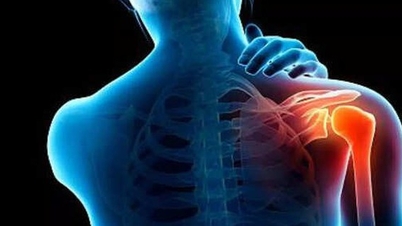
Many cases of complications and adverse events are related to the musculoskeletal system - Illustration.
Recently, Thai Binh Provincial General Hospital has received cases of severe complications due to patients with rheumatoid arthritis and chronic gout who self-medicated with powdered or pill-form medicines of unknown origin and composition.
Typically, the case of patient HTTB (Quynh Ngoc commune, Quynh Phu district) receiving treatment for adrenal insufficiency at the nephrology - musculoskeletal department.
According to the patient, who suffered from rheumatoid arthritis but did not follow the prescribed treatment at the hospital, instead bought medicine from a traditional healer and took it for four months. Initially, the symptoms improved, but later the pain worsened, the face became swollen, the legs atrophied, and all joints ached intensely.
At the hospital, doctors determined that the patient's condition had become complicated; in addition to rheumatoid arthritis, the patient also suffered from adrenal insufficiency, osteoporosis, diabetes, and impaired vision.
In another case, patient PVV (from Duyen Hai commune, Hung Ha district) was admitted to the hospital with hundreds of puncture wounds on his feet and lower legs, causing swelling, pain, and high fever.
The patient stated that someone had recommended a traditional healer who treated bone and joint problems by squeezing out "toxic blood," so they sought him out for treatment.
The traditional healer uses a sharp object resembling a piece of glass to make 0.5-1cm incisions from the knee down to the top of the foot, squeezing out blood as he makes the cuts. They claim that this bloodletting and detoxification process helps the body eliminate toxins, improve blood circulation, and alleviate bone and joint problems.
However, about a day after the procedure to drain the toxic blood, the patient's lower leg and knee joint became increasingly painful, making it impossible for her to walk. The incision site showed signs of inflammation, and she felt tired and had a high fever, so her family had to take her immediately to Thai Binh Provincial General Hospital for treatment.
Dr. Roãn Thị Thư Nghĩa - Department of Nephrology and Musculoskeletal Disorders, Thai Binh Provincial General Hospital - said that after conducting tests, patient V. was diagnosed with diffuse soft tissue inflammation of both lower legs and feet - an acute gout attack complicated by renal failure - elevated liver enzymes, with a serious prognosis and a high risk of developing sepsis/septic shock/multiple organ failure.
The patient was treated with broad-spectrum intravenous antibiotics, anti-inflammatory drugs, painkillers, and liver function support. After one week of treatment, the patient's health had basically stabilized, the swelling and pain in the lower leg and foot had decreased, the fever had subsided, the kidney failure had resolved, and liver enzymes had decreased.
Severe complications
On average, the Department of Nephrology and Musculoskeletal Disorders at Thai Binh Provincial General Hospital examines approximately 7,000 outpatients, treats nearly 4,000 inpatients, and receives hundreds of hospitalized cases due to complications and adverse events related to musculoskeletal disorders each year.
According to Ms. Bui Thi Lan Anh, head of the department, many patients who come to the specialized facility are already in the late stages of the disease and have suffered from complications such as systemic infection, osteoporosis, tophi infection, diabetes, vision loss, heart failure, kidney failure, joint deformities, etc.
In particular, patients who are unaware of their underlying medical conditions and who take medication without a prescription may experience gastrointestinal bleeding.
For techniques such as injections and joint fluid aspiration, if not performed in a sterile environment, it can cause joint infection, potentially leading to intra-articular bleeding, accelerated joint degeneration, and osteoporosis.
Doctors advise patients that joint fluid aspiration and injections must be prescribed by musculoskeletal specialists, performed in a sterile injection room; patients must strictly adhere to post-injection instructions, and return for timely follow-up appointments so that the doctor can adjust and provide an appropriate treatment plan.
Foods that are good for people with osteoarthritis.
Associate Professor Dr. Nguyen Dinh Hoa - Department of Spinal Surgery, Viet Duc Friendship Hospital - suggests the following recommended foods for people with osteoarthritis:
Omega-3 : Omega-3 fatty acids are metabolized into the active compound resolvin, which helps fight inflammation and reduce the activity of inflammatory enzymes – similar to aspirin.
Omega-3s are found in fatty fish such as salmon, mackerel, herring, and sardines (ideally 2-4 servings per week).
Eat the right kinds of fruits and vegetables : Dark green leafy vegetables (broccoli, spinach) provide carotenoid antioxidants, vitamin C, calcium, and magnesium, which are beneficial for joints.
Yellow/orange fruits and vegetables such as carrots, sweet potatoes, guavas, mangoes, and pumpkins are also rich sources of vitamin C and carotenoid antioxidants, which help reduce arthritis symptoms.
Curry spices such as star anise, chili peppers, cloves, cumin, ginger, rapeseed, and turmeric contain anti-inflammatory compounds that help reduce pain and soothe aches caused by arthritis.
Drinking tea : Especially green tea, which contains high levels of the antioxidant catechin, inhibits the expression of inflammatory chemicals in the joints and helps protect cartilage.
Source: https://tuoitre.vn/can-than-bien-chung-khi-chua-xuong-khop-bang-cac-phuong-phap-la-20240613183627143.htm











































































Comment (0)