

That statement needs to be put in a larger context: If Vietnam wants to enter a new stage of development, it must remove the barriers that are blocking the right to life, the right to education, and the right to work of more than 8 million people with disabilities - or 6 to 10% of the population.
Treatment of people with disabilities is a measure of national civilization, an institutional responsibility, not just a matter of community kindness.
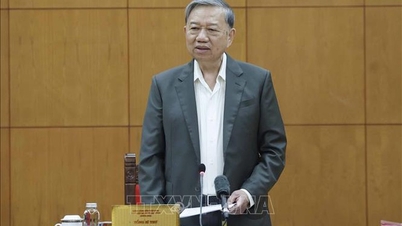
The General Secretary stressed the need to shift from a medical model to an inclusive social model, because disability is not just a health impairment; it is a combination of barriers that prevent people with disabilities from participating equally in life. When viewed in this way, policy cannot stop at care and protection; it must move to empowerment, opening up opportunities, removing barriers - that is, changing the structure of society, not just changing the subsidy regime.
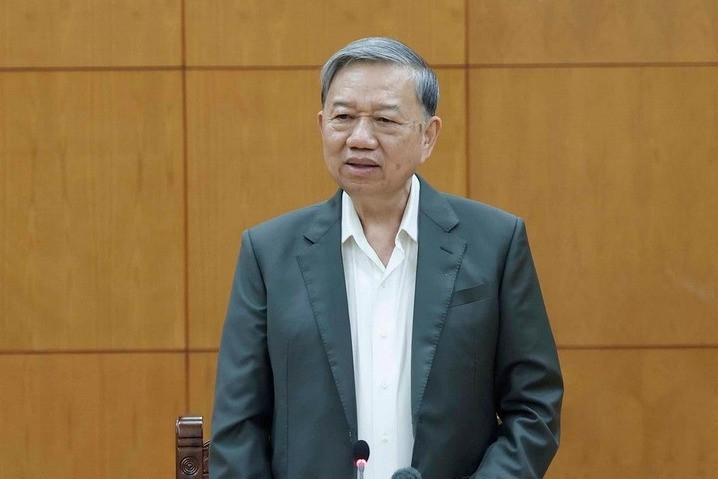
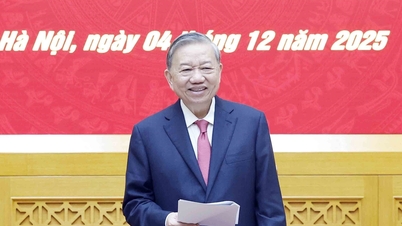
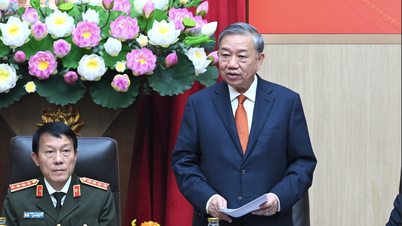
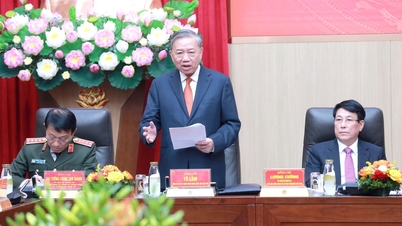
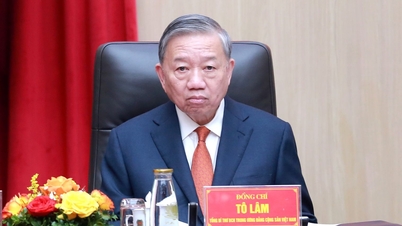
General Secretary To Lam speaks at the working session. Photo: VNA
Over the past 15 years, Vietnam has significantly increased social security coverage: about 1.7 million people are receiving social benefits due to disability, all people with severe disabilities are provided with free health insurance cards, the community-based disability determination system has been expanded, and the “family background check” condition has been eliminated since 2010.
There are 165 social assistance facilities nationwide caring for about 25,000 people with disabilities, and managing an additional 80,000 people in the community. Vietnam aims to screen 80% of children aged 0–6 by 2030, ensure 90% of children with disabilities have access to education , and require all new construction to ensure accessibility.
These figures represent a significant effort. But looking deeper into the data, we see that there are still huge gaps. Vietnam spends about 0.2% of GDP on disability-related social protection – a decent level for the middle-income group, but still far from the 0.5% spent by its predecessors and even further from the 1.5% spent by OECD countries.
The system covers people with severe disabilities relatively well, but people with mild disabilities receive little support, have little access to rehabilitation services, and are given few opportunities in the labor market, and still have to bear huge costs to integrate into society.
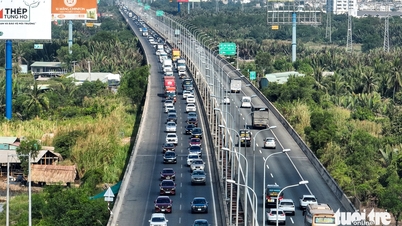
Looking at real life, the difficulties of people with disabilities appear much more clearly. Transport infrastructure is still “uncooperative”: many buses lack wheelchair spaces, overpasses only have stairs, sidewalks are bumpy, old public buildings lack ramps, cultural and sports spaces are not designed for people with limited mobility. Things that normal people only consider inconvenient, for people with disabilities, can be the boundary between integration and isolation.
In education, children with disabilities have the right to go to school, but the road to school is bumpy. Many schools lack support teachers, early intervention specialists, and appropriate facilities. Many children have to stay at home because the school is not qualified to accept them.
In the labor market, people with disabilities have difficulty accessing vocational training, finding jobs because businesses lack inclusive recruitment policies, maintaining jobs because workplaces are unfriendly, and competing because the cost of disability - assistive devices, transportation, personal support - is always higher than income.
Medical and rehabilitation services at the grassroots level also lack experts and equipment. Many people want to have regular health check-ups but do not have the means to travel. In cultural and social life, many cultural houses, stadiums, community centers, etc. do not take into account users with disabilities.
The biggest difficulty for people with disabilities is not in their legs or arms, but in social prejudice. The view of pity or that they “cannot do great things” still persists, creating invisible barriers from schools to businesses, from the government to the community. In particular, women and children with disabilities face a much higher risk of violence, abandonment, and isolation than the rest of society.
At the launch of the report “Towards an Inclusive Society”, ILO Director in Viet Nam, Ms. Sinwon Park, stressed that social security “is not just about protection – it is about empowerment”. When the social security system is strong enough to be a support, and the labor market is open enough to provide opportunities, people with disabilities can actively choose, challenge and contribute fully.
This perspective shows that policy should not only stop at subsidies, but also pave the way for vocational education, job opportunities, friendly cooperative models, digital economy, assistive technology and access to online public services.
The General Secretary also called for a strong improvement in transport infrastructure, public works, online services and the application of assistive technology. Digital transformation, if designed correctly, can remove many physical barriers that infrastructure investment takes years to overcome. But to do that, policies must be unified, procedures must be simple, and digital infrastructure must be designed with the principle of “access for all”.
A civilized society not only supports the disadvantaged when they are in trouble but also gives them the opportunity to live independently, study, work and contribute like any other citizen. And that can only come true when people with disabilities are seen as developing subjects, who can lead and not just wait for support.
Vietnam has come a long way: expanding social security coverage, improving the health system, building an inclusive legal framework, and developing support models. But to “leave no one behind”, we must go further: increasing investment in social security, promoting inclusive education, expanding employment opportunities, standardizing accessibility infrastructure, and vigorously exploiting disability-friendly digital transformation.
Vietnamnet.vn
Source: https://vietnamnet.vn/chinh-sach-cho-nguoi-khuet-tat-thuoc-do-cua-mot-xa-hoi-van-minh-2469272.html
![[Photo] Cat Ba - Green island paradise](/_next/image?url=https%3A%2F%2Fvphoto.vietnam.vn%2Fthumb%2F1200x675%2Fvietnam%2Fresource%2FIMAGE%2F2025%2F12%2F04%2F1764821844074_ndo_br_1-dcbthienduongxanh638-jpg.webp&w=3840&q=75)


































![[VIMC 40 days of lightning speed] Da Nang Port: Unity - Lightning speed - Breakthrough to the finish line](https://vphoto.vietnam.vn/thumb/402x226/vietnam/resource/IMAGE/2025/12/04/1764833540882_cdn_4-12-25.jpeg)
































Comment (0)