

Apartment prices surged, with localized increases of up to 40% quarterly; Hanoi adjusted land use plans for several projects in Quoc Oai; and procedures for converting agricultural land to residential land were discussed… These are some of the latest real estate news.
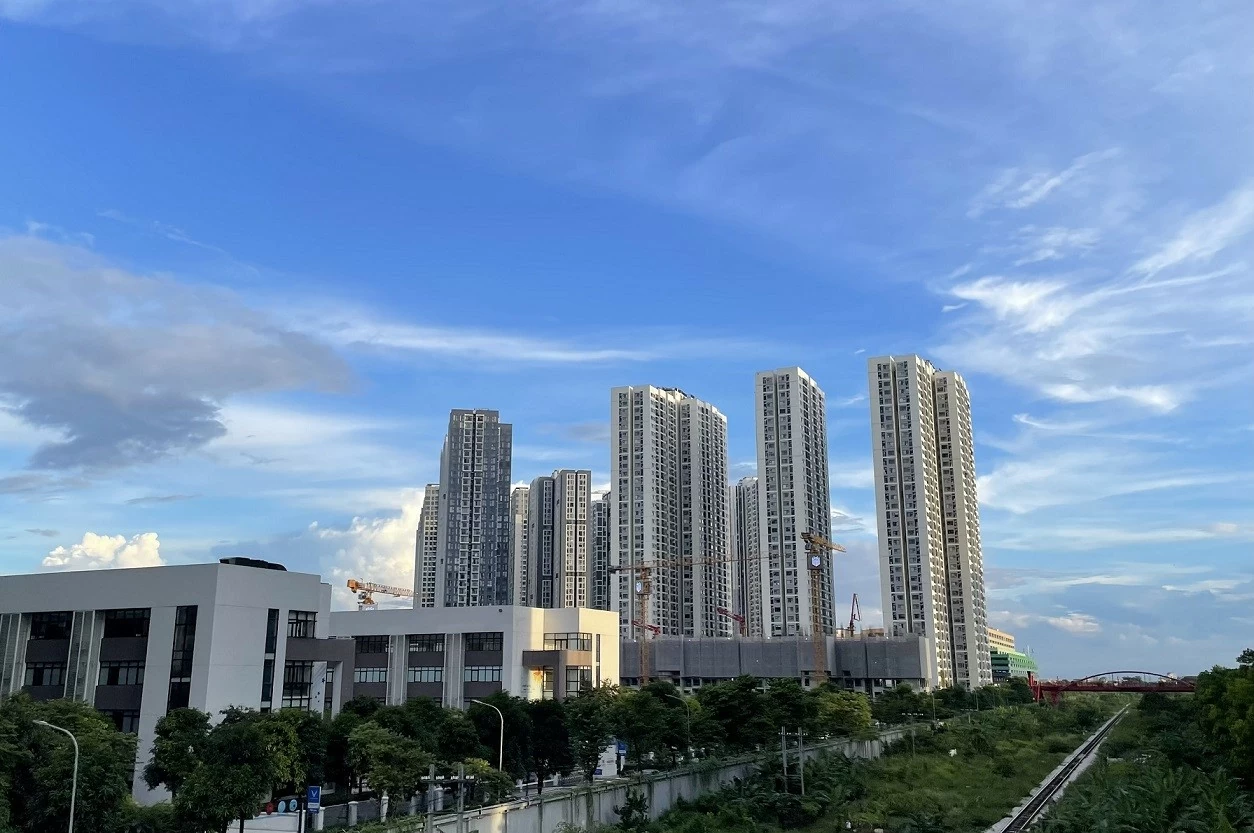 |
| The shortcomings in the structure of real estate products remain a major limitation of the current market and are also one of the reasons for the recent increase in real estate prices. (Illustrative image - Photo: Linh An) |
Apartments, both old and new, continue to rise in price.
Regarding the Hanoi apartment market, the Ministry of Construction stated that prices continue to rise in both new and old projects. To date, the market has established a price level for new projects, increasing by approximately 4-6% quarterly and 22-25% annually. Notably, some areas have seen localized increases of around 35-40%, depending on the location, compared to the previous quarter.
Surveys at several projects show that prices start from 69 million VND/m2 for Lumi Prestige (Nam Tu Liem district), apartments in Khai Son City (Long Bien district) are priced from 50-68 million VND/m2, and projects on Nguyen Tuan street (Thanh Xuan district) are priced at approximately 75-97.2 million VND/m2…
Not only in Hanoi, but overall data shows that in the third quarter, real estate prices in several localities continued to trend upwards, especially in Hanoi, Ho Chi Minh City, and other major cities.
"The price increase is localized, occurring in certain areas, certain types, and certain segments of real estate, leading to an overall price increase," the Ministry of Construction stated.
Shortcomings in the structure of real estate products remain a major limitation of the current market and are also one of the reasons for the recent increase in real estate prices.
The Ministry of Construction points out that the supply of affordable housing is insufficient to meet market demand. In the affordable apartment segment (priced below 25 million VND/m2), there are virtually no transactions or available units for sale.
Mid-range apartments (priced from 25 million VND/m2 to under 50 million VND/m2) still account for a high proportion of transactions and supply in the market. The remainder consists of high-end and ultra-high-end apartments (priced above 50 million VND/m2).
Explaining the shortage of housing supply to meet the needs of the majority of people, especially low- and middle-income earners in urban areas, particularly Hanoi and Ho Chi Minh City, the Ministry of Construction stated that there are many reasons.
This includes difficulties and obstacles faced by real estate businesses in legal procedures, especially in determining land prices, calculating land use fees, land clearance, and land allocation.
In addition, many projects that have been underway or are being implemented have had to be temporarily suspended, delayed, or experience delays in construction progress.
Authorities assess that the Land Law 2024, the Housing Law 2023, and the Real Estate Business Law 2023 have been enacted and are in effect. Institutional and legal obstacles (regarding land, housing, real estate business, credit, etc.) for businesses have been largely removed, and the real estate supply has shown improvement. However, some limitations remain, as it takes time for the newly enacted mechanisms, policies, and laws to be effectively implemented and "put into practice."
Many real estate experts point out that the increase in supply is in the affordable, reasonably priced segment. In fact, despite the increase in apartment supply, the average selling price in Hanoi has continued to rise in both the primary and secondary markets.
According to Savills Vietnam, in major cities like Ho Chi Minh City and Hanoi, the current housing market is experiencing a shortage of affordable housing supply, with the market share of this segment decreasing from 60% in 2016 to only 35% in 2024, and primary apartments priced under 2 billion VND disappearing completely.
According to the leader of a real estate company in Hanoi, most projects currently underway in the market are mid-range and high-end. When demand exceeds supply, real estate prices increase. It's not uncommon for selling prices to be pushed higher than their true value.
According to this expert, the problems of the real estate market cannot be solved until there is a supply of affordable, suitable housing.
Adjusting land use plans for several projects in Quoc Oai, Hanoi.
The Hanoi People's Committee has just issued Decision No. 5682/QD-UBND on adjusting and supplementing the 2024 land use plan for Quoc Oai district.
Accordingly, adjustments and additions to the list of land use plans for Quoc Oai district in 2024, which were approved by the Hanoi People's Committee in Decision No. 418/QD-UBND dated January 22, 2024, Decision No. 2015/QD-UBND dated April 16, 2024, and Decision No. 3848/QD-UBND dated July 25, 2024, have been made.
Specifically, the adjustment and supplementation (location, area) of projects identified in Decision 418/QD-UBND dated January 22, 2024, Decision 2015/QD-UBND dated April 19, 2024, and Decision 3848/QD-UBND dated July 25, 2024 constitutes one project.
The 2024 Land Use Plan for Quoc Oai District includes 9 projects: Construction of access roads to the Central Obstetrics and Gynecology Hospital, Branch 2; Central Pediatric Hospital, Branch 2; Construction of the Ngoc Liep Commune Cultural Center; Ngoc My A Kindergarten; construction of the Phu Hang village cultural house in Tan Phu commune; construction of a 220kV power line to supply electricity to the Hoa Lac 220/110kV substation and 110kV outgoing lines; Signaling Center; Construction of a general distribution and storage warehouse, the Northern fuel storage warehouse and Vehicle Fleet I under the Equipment and Logistics Department; Expansion of the Tay Ha Noi 500kV substation to serve the installation of 6 220kV bays in Dong Quang commune; Phuong Cach Primary School, with a total area of 74.18 hectares.
The number of projects and the area in Decision No. 3848/QD-UBND dated July 25, 2024 have been adjusted to 148 projects with a total area of 1,151.27 hectares.
Ho Chi Minh City issues new regulations on minimum land area for subdivision.
On October 31st, the Ho Chi Minh City People's Committee issued Decision No. 100/2024 stipulating the conditions for land subdivision, land consolidation, and the minimum area for land subdivision for each type of land in the city.
This decision replaces Decision No. 60/2017 on the previous minimum area for land subdivision.
Regarding the minimum area for land subdivision, according to the new regulations, residential land in the area is divided into 3 zones, with corresponding minimum areas of 36m2, 50m2, and 80m2.
Specifically, Zone 1 includes districts 1, 3, 4, 5, 6, 8, 10, 11, Go Vap, Binh Thanh, Phu Nhuan, Tan Binh, and Tan Phu. The minimum land area for subdivision in these districts is 36m2, with a frontage width and depth of no less than 3m.
Area 2 includes Districts 7, 12, Binh Tan, Thu Duc City, and the towns of the districts. The minimum land area for subdivision in these areas is 50m2. The regulations stipulate that the frontage width and depth of the plot must not be less than 4m.
Zone 3 includes areas excluding the towns of Binh Chanh, Cu Chi, Hoc Mon, Nha Be, and Can Gio districts. The minimum land area for subdivision in these areas is 80m2. The frontage width and depth of the plot must not be less than 5m.
Regarding agricultural land, Ho Chi Minh City stipulates that the minimum area for land subdivision for annual crop land and other agricultural land is 500m2.
Meanwhile, for land used for perennial crops, aquaculture, salt production, and concentrated livestock farming, the minimum area for subdivision is 1,000m2.
Compared to the previous decision, the minimum land area for residential and agricultural land subdivision in Ho Chi Minh City remains unchanged.
A new feature of the land subdivision regulations is the removal of previous regulations regarding planning and construction conditions.
Specifically, land subdivision and consolidation must meet requirements such as: having access roads, connecting to existing transportation routes, ensuring adequate water supply and drainage, and other necessary needs in a reasonable manner.
If a land user allocates a portion of a land parcel containing residential land, or a land parcel containing both residential and other land within the same parcel, for use as a pathway, then when subdividing or consolidating the land parcels, it is not necessary to change the land use purpose for the area used as a pathway.
In cases where land users allocate a portion of their land as an access road, this access road will be determined by mutual agreement between the parties, and the local authorities will assess the situation and provide approval before any land subdivision or consolidation takes place.
Regarding the land area designated as a pathway, if it is used by multiple plots of land, it will be converted to a shared use form on the land certificate.
Procedures for converting land used for growing crops to residential land.
When people convert land used for growing crops to residential land, they must prepare the necessary documents to submit to the competent State agency as stipulated in Article 227 of the 2024 Land Law.
When is it permissible to convert land used for growing crops into residential land?
Based on Article 116 and point b, clause 1, Article 121 of the 2024 Land Law, land users are only allowed to convert land used for crop cultivation to residential land if approved by the competent State agency. In other words, there must be a decision permitting the change of land use purpose as prescribed.
To make a decision allowing the change of land use purpose, the competent State agency must base its decision on the district-level land use plan, or the general plan, or the zoning plan as prescribed by the law on urban planning that has been approved by the competent authority.
Procedures for converting agricultural land to residential land.
According to Article 227 of the 2024 Land Law, the procedures for changing land use purposes are as follows:
Step 1. Submit the application for land use change in accordance with regulations.
Step 2. The competent authority checks the conditions for changing the land use purpose. If the application is incomplete, the land user must supplement the application and resubmit it to the land management agency.
Step 3. After submitting all the necessary documents, the land management agency will prepare a file and submit it to the District People's Committee for the issuance of a decision permitting the change of land use purpose.
Step 4. Pay the land use fee as prescribed, except in cases where exemption applies.
Step 5. Transfer the file to the Land Registration Office/branch to carry out the registration, issue the land title certificate, update and correct the land database and cadastral records, and return the certificate to the land user.
In cases where both the right to use and the purpose of use are transferred, the procedure for registering the transfer of land use rights will be carried out simultaneously with the procedure for changing the purpose of land use, as prescribed by law.
Source: https://baoquocte.vn/bat-dong-san-moi-nhat-chung-cu-tu-cu-den-moi-lien-tuc-tang-gia-thiet-lap-mat-bang-moi-tphcm-quy-dinh-ve-dien-tich-toi-thieu-duoc-tach-thua-292238.html
![[Photo] Closing Ceremony of the 10th Session of the 15th National Assembly](/_next/image?url=https%3A%2F%2Fvphoto.vietnam.vn%2Fthumb%2F1200x675%2Fvietnam%2Fresource%2FIMAGE%2F2025%2F12%2F11%2F1765448959967_image-1437-jpg.webp&w=3840&q=75)

![[Photo] Prime Minister Pham Minh Chinh holds a phone call with the CEO of Russia's Rosatom Corporation.](/_next/image?url=https%3A%2F%2Fvphoto.vietnam.vn%2Fthumb%2F1200x675%2Fvietnam%2Fresource%2FIMAGE%2F2025%2F12%2F11%2F1765464552365_dsc-5295-jpg.webp&w=3840&q=75)











































![[OFFICIAL] MISA GROUP ANNOUNCES ITS PIONEERING BRAND POSITIONING IN BUILDING AGENTIC AI FOR BUSINESSES, HOUSEHOLDS, AND THE GOVERNMENT](https://vphoto.vietnam.vn/thumb/402x226/vietnam/resource/IMAGE/2025/12/11/1765444754256_agentic-ai_postfb-scaled.png)












































Comment (0)