

On October 24th, the University of Banking Ho Chi Minh City organized a seminar on digital transformation in communication and admissions, with the participation of many admissions and career guidance experts and representatives from universities. Many opinions suggested that the application of technology and the development of flexible communication strategies are becoming key factors in helping universities enhance their competitiveness in the context of rapidly changing admissions policies.
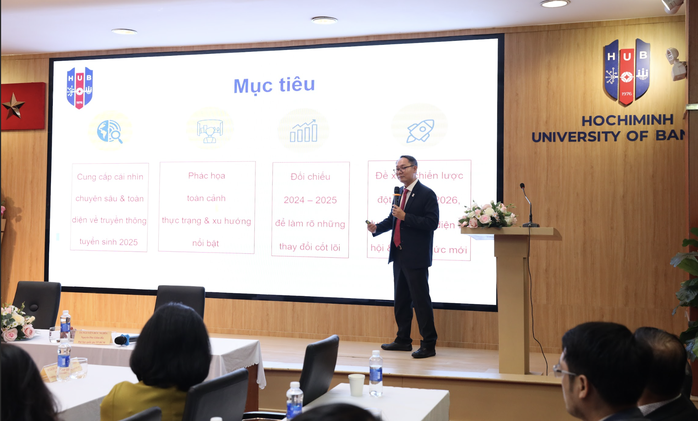
Associate Professor Dr. Nguyen Van Thuy
New requirements for admissions communications.
Associate Professor Nguyen Van Thuy, Head of Admissions and Communications at the Ho Chi Minh City University of Banking, stated that while admissions have been stable for many years, 2025 marks a turning point as the Ministry of Education and Training changes its policy. This directly impacts the admissions process and how universities approach and interact with prospective students.
A survey of 1,543 students revealed that 54% learned about the school through its fan page, demonstrating the increasing role of digital communication. However, schools are currently facing four major challenges: fierce competition among institutions; the need for long-term and systematic investment; diverse but fragmented communication channels; and a strong reliance on the digital behavior of prospective students.
Associate Professor Dr. Nguyen Van Thuy proposed a breakthrough communication strategy for 2026 centered around three key areas: early analysis and planning – enhanced presence and interaction – conversion optimization.
From an expert perspective, Dr. Le Thi Thanh Mai, former Head of the Student Affairs Department (Vietnam National University Ho Chi Minh City), warns that while students are increasingly searching for information through AI, the information from AI is not always accurate. According to her, effective student recruitment communication needs to be based on three pillars: a team of admissions counselors and career guidance experts; the application of digital technology and AI; and a communication strategy that reaches the right target audience.
However, she also pointed out a common limitation: the current admissions counseling force lacks in-depth professional training, leading to incomplete and easily misleading information.
Digital transformation is a strategy.
Dr. Nguyen Duc Nghia, former Vice Director of the Vietnam National University Ho Chi Minh City, emphasized that digital transformation in admissions and communication is no longer an option but has become a strategic tool for universities in the current context. This is a far-reaching journey, requiring comprehensive changes from leadership thinking, process restructuring, investment in foundational technologies to developing human capabilities and building an organizational culture ready for innovation.
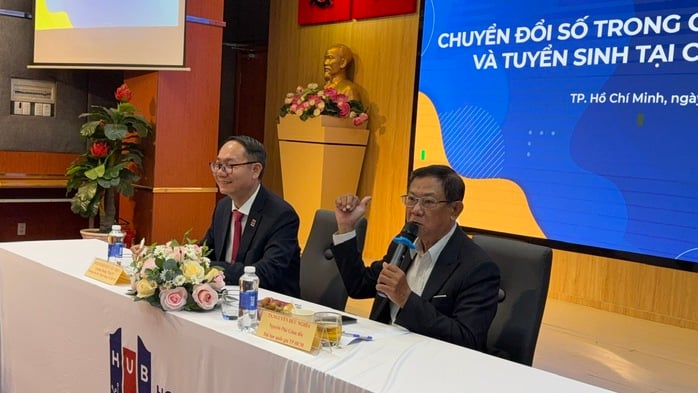
Dr. Nguyen Duc Nghia shared his insights on digital transformation in student recruitment and recruitment communication.
Successful digital transformation is not simply about digitizing existing manual processes. It requires a holistic approach:
In the admissions process , digital transformation means building a seamless, automated, and intelligent process, from online application submission and automated selection to online enrollment, providing a convenient and transparent experience for applicants and optimizing operational efficiency for the school.
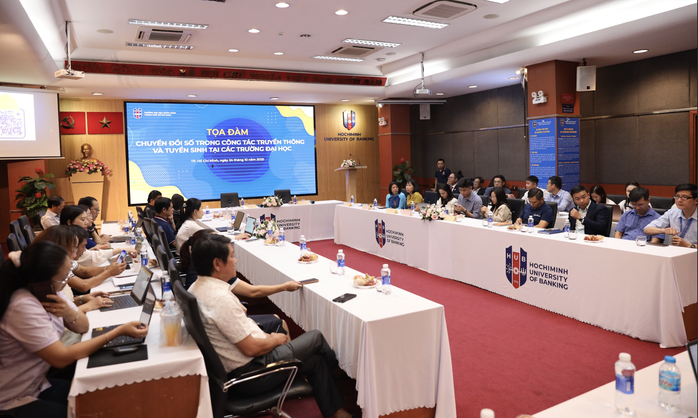
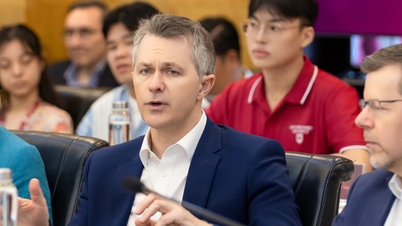
Guests at the show
In admissions communications, it's a revolution from one-way mass communication to large-scale, personalized dialogue, using data and marketing automation technology to understand and guide each applicant throughout their decision-making journey.
To realize this vision, universities need a well-structured implementation roadmap, focusing on three core elements: Technology - People - Processes.
According to Ms. Nguyen Thi Bich Ngoc, Head of Communications at the International University (Vietnam National University Ho Chi Minh City), in the context of Vietnam's higher education system undergoing a strong transformation towards autonomy, competitiveness, and international integration, student recruitment has become one of the top strategic tasks for each educational institution.
The explosion of digital media makes schools more vulnerable to media crises, especially during peak admission periods. When public attention is focused on the high school graduation exam and university entrance exams, misinformation can spread rapidly in a short time, creating a bandwagon effect.
The crisis not only affects the school's image, but also puts pressure on current staff, faculty, and students, and even impacts international partners that are collaborating with the school.
"Media crises in student recruitment are unavoidable in the context of a rapidly developing digital environment. The issue is not about avoiding crises, but about proactively managing and handling them effectively, turning risks into opportunities to affirm the school's brand value," shared Ms. Ngoc.
Source: https://nld.com.vn/khan-cap-lam-moi-truyen-thong-tuyen-sinh-19625102416264917.htm

![[Photo] Prime Minister Pham Minh Chinh holds a phone call with the CEO of Russia's Rosatom Corporation.](/_next/image?url=https%3A%2F%2Fvphoto.vietnam.vn%2Fthumb%2F1200x675%2Fvietnam%2Fresource%2FIMAGE%2F2025%2F12%2F11%2F1765464552365_dsc-5295-jpg.webp&w=3840&q=75)


![[Photo] Closing Ceremony of the 10th Session of the 15th National Assembly](/_next/image?url=https%3A%2F%2Fvphoto.vietnam.vn%2Fthumb%2F1200x675%2Fvietnam%2Fresource%2FIMAGE%2F2025%2F12%2F11%2F1765448959967_image-1437-jpg.webp&w=3840&q=75)













































![[OFFICIAL] MISA GROUP ANNOUNCES ITS PIONEERING BRAND POSITIONING IN BUILDING AGENTIC AI FOR BUSINESSES, HOUSEHOLDS, AND THE GOVERNMENT](https://vphoto.vietnam.vn/thumb/402x226/vietnam/resource/IMAGE/2025/12/11/1765444754256_agentic-ai_postfb-scaled.png)













































Comment (0)