

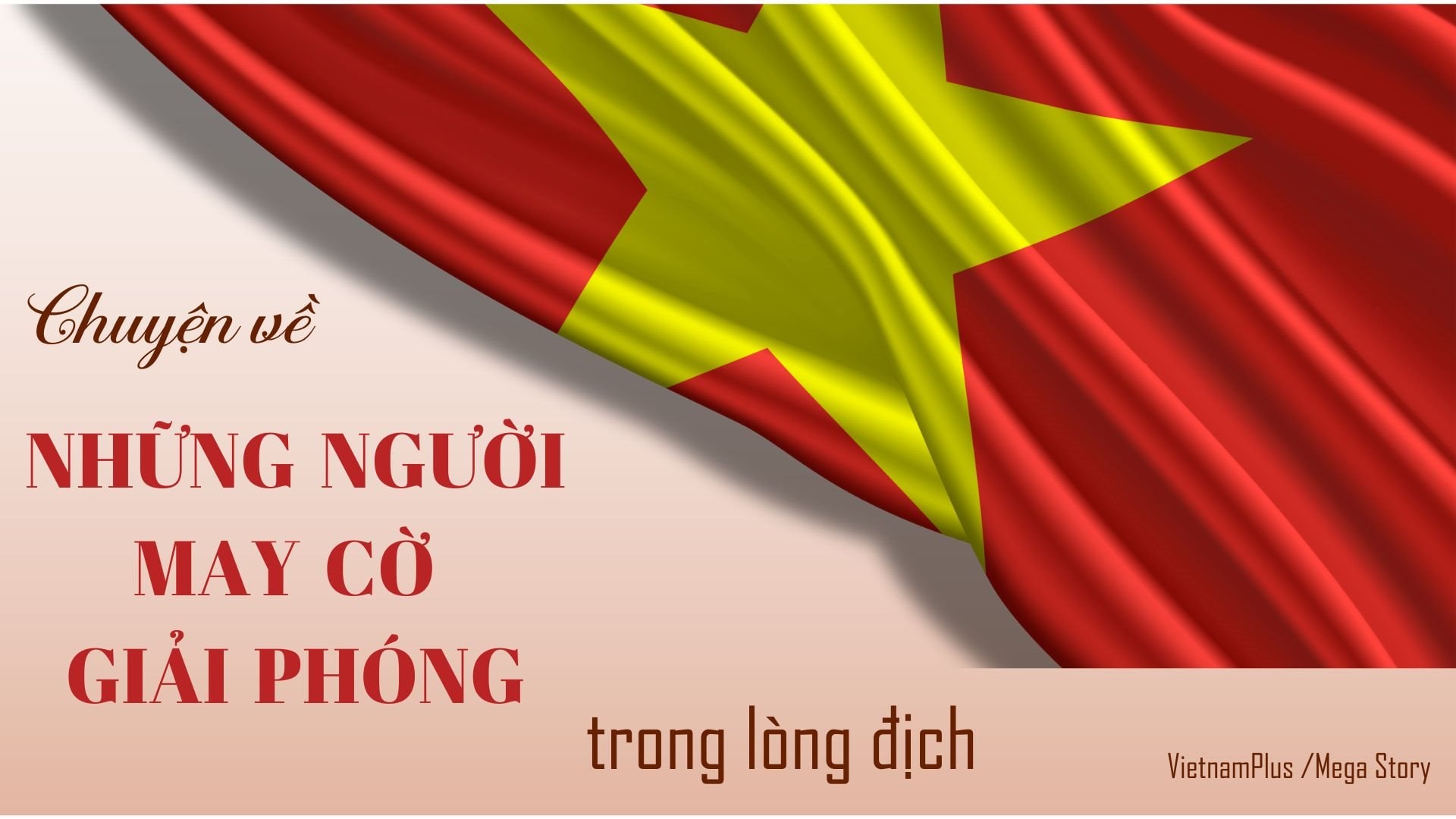
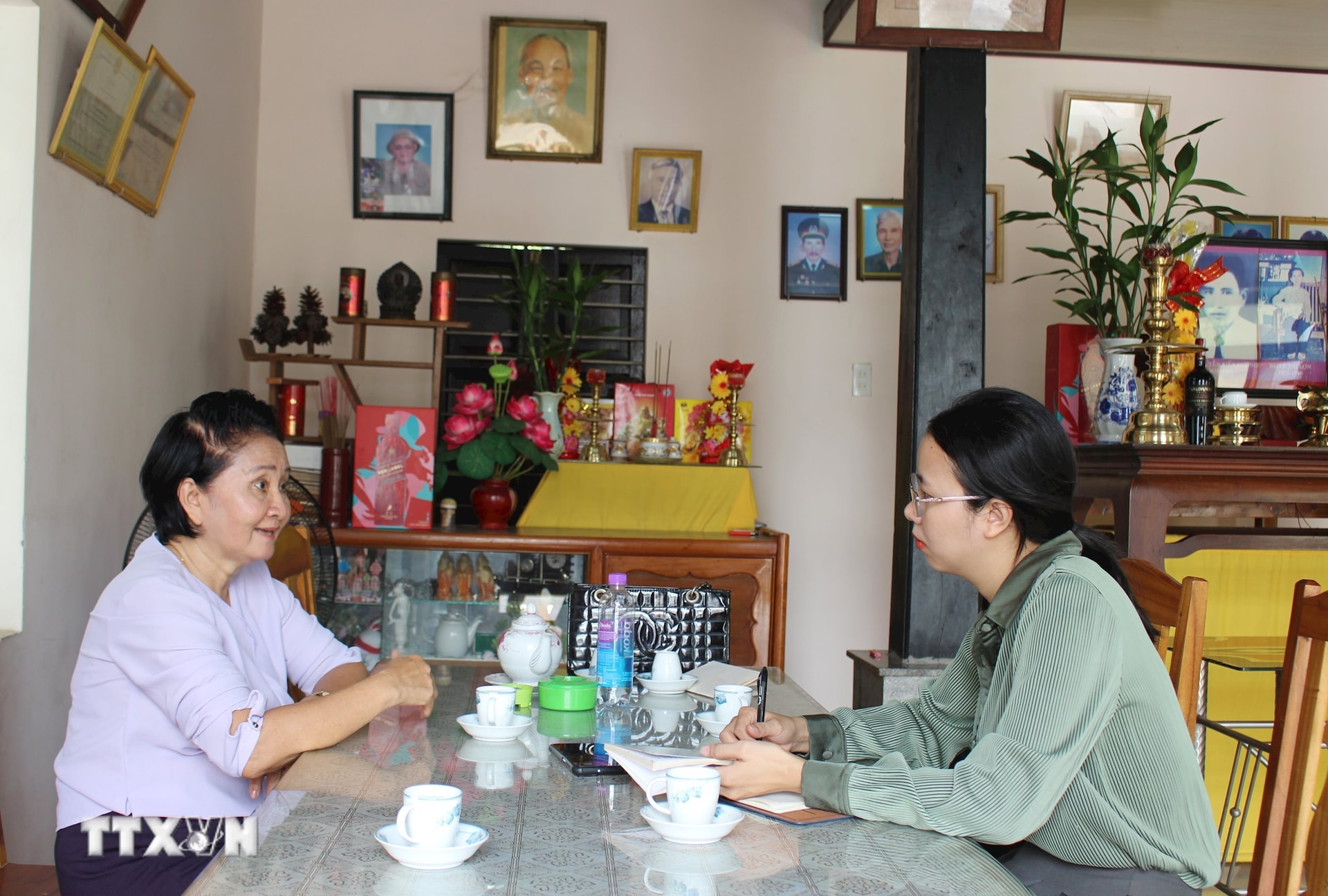
Ms. Bich was born and raised in a family with a revolutionary tradition. Her father, Nguyen Kien Duong, was a martyr; her mother, Le Thi Lon, was a Vietnamese Heroic Mother; and her older sister, Nguyen Thi Ngoc Oanh, was a Hero of the People's Armed Forces and a martyr.
At that time, Mrs. Bich's house was a hiding place for revolutionary cadres, so enemy troops ambushed her day and night in front of the house and in the garden.

"Back then, sewing a liberation flag deep within enemy territory was no easy task because the flag was large and easily spotted by the enemy," recalled Ms. Nguyen Thi Ngoc Bich.
Back in the last days of December 1967, Mrs. Bich's family was assigned a special task: to sew two liberation flags, measuring 3.5m long and 2.8m wide, to be hung at the Ninh Hoa district headquarters (now Ninh Hoa town) with the belief that the Tet Offensive and Uprising of 1968 would be victorious.
Because the liberation flag had three colors—blue, red, and yellow—buying them all from the same place at the same time would easily lead to detection by the enemy. Therefore, her family had to buy the fabric from many different places, buying a little at a time and hiding it carefully.
"Buying fabric was difficult, but sewing the flags was even harder. Sewing the flags could only be done at night because turning on the lights during the day would arouse suspicion, and opening the doors for light would easily lead to detection," Ms. Bich recounted.
On the days when the South Vietnamese army was having fun, the members of Mrs. Bich's family would frantically sew flags because the enemy was lax and not guarding strictly.
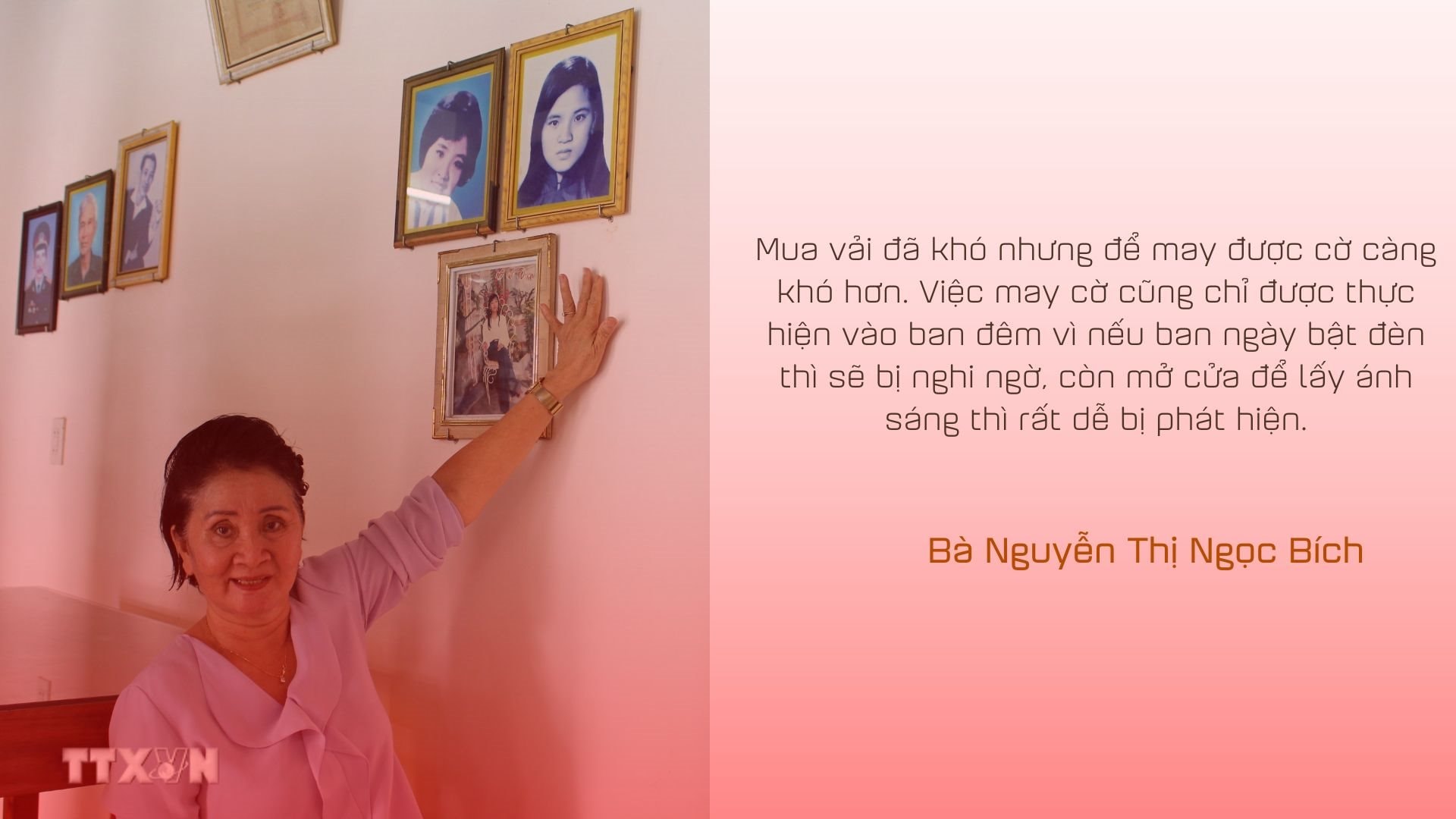
“On the night of the 28th of the 12th lunar month of 1967, outside in the yard and on the porch, a platoon of South Vietnamese soldiers lay sprawled on tarpaulins. They turned up the Saigon radio to listen to traditional opera and gamble with each other. They shouted, argued, and cursed loudly. Inside the house, the doors were tightly closed, and the electric lights shone. Family members hurriedly and frantically worked with their needles and thread to complete their tasks,” Mrs. Bich recalled.
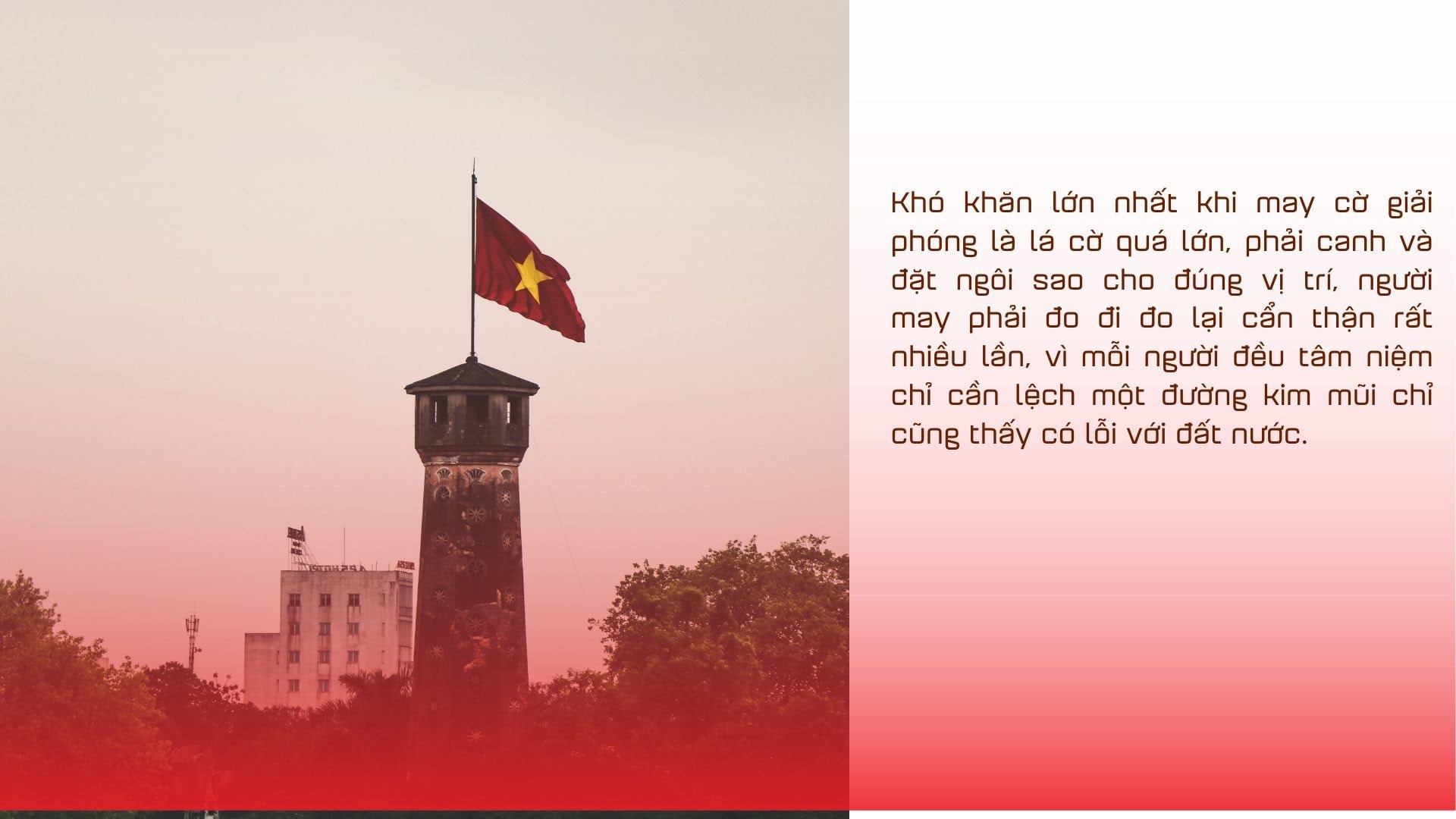
According to Ms. Bich, the biggest difficulty in sewing the flag was that it was so large, requiring careful measurement and placement of the star. Her mother and sisters measured and remeasured many times, because each of them believed that even a single misplaced stitch would be a disservice to the country.

To complete the task of sewing the flag under such challenging circumstances required close coordination among many family members.
When members of Mrs. Bich's family were tasked with sewing flags during the Tet Offensive of 1968, they considered it a sacred duty that had to be kept absolutely secret.
Ms. Bich recounted the time when the whole family was sewing flags. Because she was still young, Ms. Bich didn't sew the flags directly but was assigned another task: taking care of and training the dog to guard the family while they sewed the flags inside.
.jpg)
The liberation flag flies over Tan Son Nhat airport on April 30, 1975. (Source: VNA)
The dog, trained by Mrs. Bich, was extremely intelligent; it would immediately "send a signal" to the family if it detected any unusual movement from the enemy.
Meanwhile, Mr. Nguyen Kien Hien (currently 71 years old, residing in Ninh Hiep ward, Ninh Hoa town, Khanh Hoa province) - Ms. Bich's brother - shared that at the age of 15, he joined the revolution with the task of distributing leaflets in the area, so when his family sewed flags, he was assigned the task of guarding and sounding the alarm.
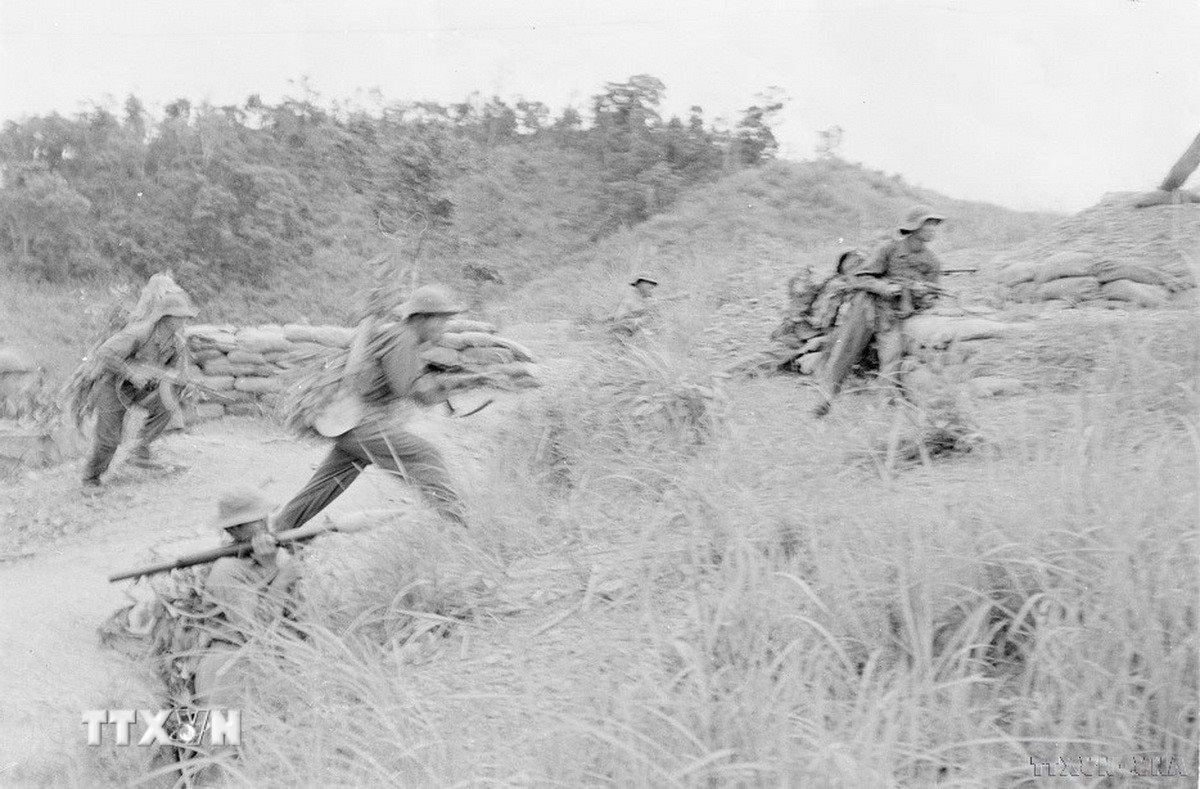
Company 3, Battalion 7 of the Tri Thien Liberation Army practices attacking enemy fortifications. (Photo: VNA)
After the golden star was sewn on and the flag was completed, everyone in the family was overjoyed and proud.
For Ms. Bich's generation back then, everyone hoped to contribute to the liberation of the country.

In April 1975, the general offensive to completely liberate South Vietnam took place; wherever our troops went, they liberated the area.
From March 26-29, 1975, when infantry units of the 10th Division were ordered to close in, forming four attack prongs against the enemy, determined to defeat the 3rd Parachute Brigade and open the "steel gate" on Phuong Hoang Pass (connecting Dak Lak and Ninh Hoa), the night of March 29, when "Phuong Hoang Pass turned to fire," was the signal for the infantry units of the 10th Division to attack.
Due to the "the enemy holds on, we are determined to capture" nature of the battle, which lasted fiercely for three days and nights. By the afternoon of April 1, 1975, a large part of the enemy forces had been annihilated, and the puppet army was demoralized and putting up only weak resistance.
Seizing the opportunity, the Division Commander decided to launch a final assault. That night, our troops bravely overwhelmed the enemy, quickly breaking through their defenses from west to east, eliminating the 3rd Parachute Brigade with nearly 4,000 enemy soldiers, and capturing all of their military equipment.
Within just a few days, the enemy's "steel gate" on Phuong Hoang Pass was completely melted down, opening the way for our troops to advance and liberate the delta. While the entire puppet army and government in Nha Trang-Khanh Hoa were shaken and in disarray, the morale of our soldiers rose very high.
On the morning of April 2, 1975, the 10th Division advanced to coordinate with local units to liberate Ninh Hoa (now Ninh Hoa town).
Every house displayed the Liberation Front flag; some flags, prepared for the Tet Offensive of 1968 and the 1972 occupation, were still brand new when brought out and hung.
On the very day of the liberation of her homeland, Ms. Bich, together with her mother - Heroic Vietnamese Mother Le Thi Lon - personally handed over two liberation flags to the local authorities, filled with joy at the liberation of her homeland.
According to the History of the Ninh Hoa District Party Committee 1930-1975, "just two days after the enemy's Phoenix defense line was broken (February 31 - April 2, 1975), Ninh Hoa district was liberated."
At 2 PM on April 2, 1975, the moment the 10th Division captured and hoisted its flag at the puppet regime's headquarters in Ninh Hoa district was a momentous historical event, marking the victorious end of 21 years of resistance against the US and 30 years of protracted, arduous, and sacrificial struggle against colonial and imperialist invaders by the army and people of Ninh Hoa district…”
In the article "Teacher Oanh" by Mr. Tran Quoc Thong (former Propaganda specialist of Ninh Hoa District Party Committee), included in the document "Ninh Hoa - Unforgettable Years (Volume 1)" published by the Propaganda Department of Ninh Hoa District Party Committee in 1995, it is stated that the two flags sewn by Mrs. Bich's family during the Tet Offensive of 1968 fluttered proudly on the day of liberation of their homeland, right at the Ninh Hoa district headquarters.
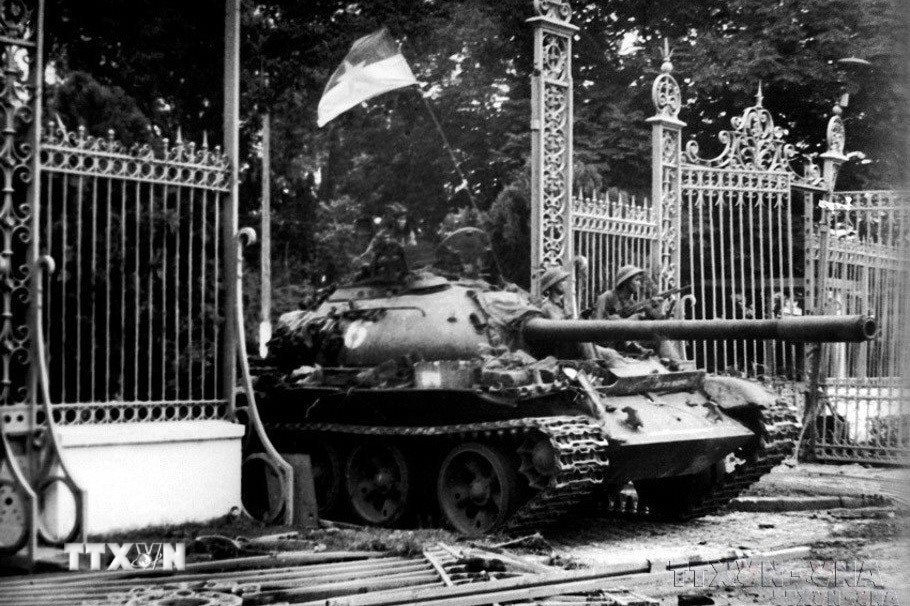
Liberation Army tanks captured the Independence Palace at noon on April 30, 1975, marking the end of the resistance war against the US, the complete liberation of the South, and the reunification of the country. (Photo: Tran Mai Huong/VNA)
According to (Vietnam+)
Source: https://mega.vietnamplus.vn/chuyen-ve-nhung-nguoi-may-co-giai-phong-trong-long-dich-o-khanh-hoa-6774.html



![[Photo] Closing Ceremony of the 10th Session of the 15th National Assembly](/_next/image?url=https%3A%2F%2Fvphoto.vietnam.vn%2Fthumb%2F1200x675%2Fvietnam%2Fresource%2FIMAGE%2F2025%2F12%2F11%2F1765448959967_image-1437-jpg.webp&w=3840&q=75)








































![[OFFICIAL] MISA GROUP ANNOUNCES ITS PIONEERING BRAND POSITIONING IN BUILDING AGENTIC AI FOR BUSINESSES, HOUSEHOLDS, AND THE GOVERNMENT](https://vphoto.vietnam.vn/thumb/402x226/vietnam/resource/IMAGE/2025/12/11/1765444754256_agentic-ai_postfb-scaled.png)









































Comment (0)