

According to Mr. Phan Van Mai, if the specific mechanism replacing Resolution 54 is implemented effectively, the flow of private investment and FDI into the city will be unblocked and could reach hundreds of trillions of VND.
This information was provided by the Chairman of the Ho Chi Minh City People's Committee, Phan Van Mai, at a press conference on the draft replacement for Resolution 54 on piloting special mechanisms and policies for the development of Ho Chi Minh City, held on the afternoon of May 18th. The meeting took place in the context of the draft having just received feedback from the National Assembly Standing Committee before being submitted to the upcoming 5th session of the National Assembly.
According to Mr. Mai, the fundamental difference between the draft and the previous Resolution 54 is its objective. Instead of focusing on mechanisms and policies to generate revenue as in Resolution 54, the new resolution focuses more on mechanisms and policies to attract social investment resources, remove obstacles in project procedures, and pilot new forms of investment. "If social investment is done well, the city will achieve hundreds of trillions of dong," Mr. Mai said.
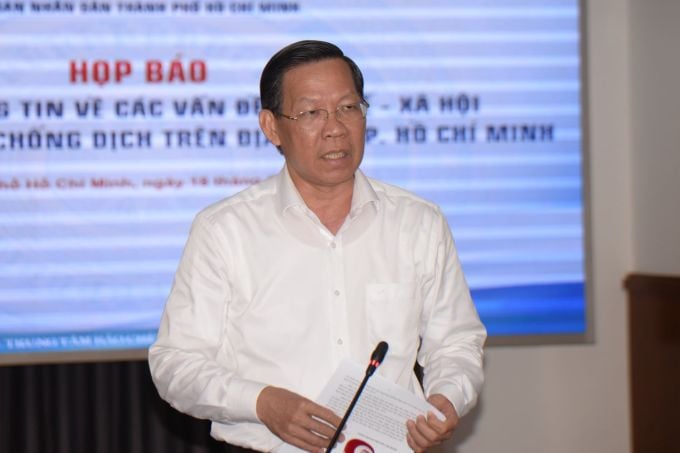
Chairman of the Ho Chi Minh City People's Committee Phan Van Mai at a press conference on the afternoon of May 18. Photo: Ha Khanh
The new resolution comprises 43 mechanisms and policies, divided into four groups: mechanisms and policies already included in Resolution 54; specific mechanisms and policies stipulated for other localities; specific mechanisms and policies included in draft laws to be amended in the future; and new mechanisms and policies not yet stipulated.
According to the head of the Ho Chi Minh City government, with these four groups of specific mechanisms and policies, the city will be able to remove many institutional obstacles and certainly create a great impetus for development. In particular, the new resolution will help the city to decentralize and delegate authority more promptly and proactively, removing the "mechanism constraints" to allow Thu Duc City to develop.
"The spirit is that Ho Chi Minh City is requesting to pilot mechanisms to create development and implement them to make practical contributions to the whole country, rather than asking for special privileges or favorable conditions for the city," Mr. Mai said.
Previously, the Director of the Department of Planning and Investment, Le Thi Huynh Mai, stated that attracting private investment is crucial for the city's development. However, in recent times, investment and business activities have faced numerous obstacles. Recently, the Prime Minister 's Special Task Force compiled a list of 214 difficulties encountered with investment and business projects, not including obstacles related to laws that have been identified and included in the amendment program.
According to Ms. Mai, the new resolution introduces new policy mechanisms not stipulated in Resolution 54, such as the Transport-Oriented Development (TOD) model; investment mechanisms for projects using the PPP method in the sports and culture sectors; BOT for projects upgrading, expanding, and modernizing existing roads; reintroduction of the BT contract model; and financial mechanisms for implementing greenhouse gas emission reduction measures through carbon credit exchange and offsetting mechanisms.
According to the head of the Department of Planning and Investment, Ho Chi Minh City has many important transportation projects that require large amounts of capital, but the budget is not sufficient to meet the needs. The proposal to apply the BT (build-transfer) and BOT (build-operate-transfer) models on existing roads must ensure a harmonious balance of interests between the state, the people, and businesses.
"The BT model itself is not flawed, but the implementation process has encountered obstacles and inconsistencies between laws, resulting in a lack of smooth execution," Ms. Mai said, adding that after the new resolution is issued, ministries, agencies, and Ho Chi Minh City will design regulations for effective implementation. The city will pilot the model first so that other provinces and cities can learn from the experience before applying it nationwide.
Le Tuyet
Source link

![[Photo] The captivating scenery of the fragrant maple forest in Quang Tri](/_next/image?url=https%3A%2F%2Fvphoto.vietnam.vn%2Fthumb%2F1200x675%2Fvietnam%2Fresource%2FIMAGE%2F2025%2F12%2F10%2F1765353233198_lan09046-jpg.webp&w=3840&q=75)
![[Photo] Explore the US Navy's USS Robert Smalls warship](/_next/image?url=https%3A%2F%2Fvphoto.vietnam.vn%2Fthumb%2F1200x675%2Fvietnam%2Fresource%2FIMAGE%2F2025%2F12%2F10%2F1765341533272_11212121-8303-jpg.webp&w=3840&q=75)

























![[Video] The craft of making Dong Ho folk paintings has been inscribed by UNESCO on the List of Crafts in Need of Urgent Safeguarding.](https://vphoto.vietnam.vn/thumb/402x226/vietnam/resource/IMAGE/2025/12/10/1765350246533_tranh-dong-ho-734-jpg.webp)

























































Comment (0)