

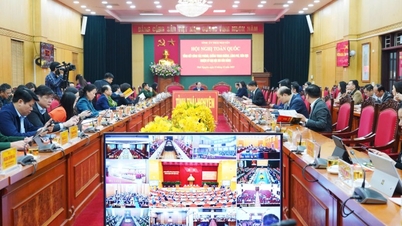
On the morning of August 31st, the Vietnam Institute for Development Strategy (VIDS), Ministry of Planning and Investment , in collaboration with the Konrad-Adenaeur-Stiftung Vietnam Institute (KAS), announced the report assessing the 500 largest private enterprises in Vietnam (VPE500) during the 2021-2022 period, a time when the economy faced the COVID-19 shock.

Policies for businesses need to be continuously improved to not only facilitate market entry but also help businesses survive and grow. (Image: bnews.vn)
Mr. Florian Constantin Feyerabend, Head of Konrad-Adenauer-Stiftung Vietnam, stated that the report not only analyzes how Vietnam's largest private enterprises have changed in this context and their resilience, but also answers the question of whether they are the backbone for the development of private enterprises in general.
As of December 31, 2021, Vietnam had 694,200 private enterprises, accounting for 96.6% of the total number of active businesses, employing 58.1% of the workforce, representing 59.3% of assets, and generating 57.8% of the net revenue of the business sector.
Private enterprises are largely small and medium-sized businesses established after the Doi Moi (Renovation) period. At the end of 2021, only 0.22% of businesses had 500 or more employees, lower than the overall rate of 0.52%, as well as 8.29% for foreign direct investment (FDI) enterprises and 19.52% for state-owned enterprises.
According to Dr. Nguyen Toan Thang, Head of the International Relations Department at VIDS, representing the research team, although present in 53 out of 63 provinces/cities, the VPE500 is concentrated mainly in the Red River Delta and Southeast regions (accounting for approximately 75%) and shows a slight upward trend. Generally, the VPE500 is being formed based on the infrastructure, resource, and market advantages of the localities. The VPE500 is distributed across all 21 first-level industries, with the highest concentration in manufacturing, trade, and construction.
Comparing the two years of COVID-19 with the year before, there was a significant fluctuation in the number of businesses entering and leaving the VPE500 list. In 2020, as many as 97 out of 500 businesses (19.4%) were no longer in the 2019 VPE500 ranking.
These businesses are concentrated in sectors heavily impacted by COVID-19, such as real estate and construction (23/89), trade (15/73), textiles (7/32), and food processing (9/70). Only a few sectors maintained their presence in the VPE500, these being those sectors considered to have benefited from COVID-19, such as information and communication, postal services, and electricity production and distribution.
By 2021, another 61 businesses had left the list, bringing the total number of departures over two years to 158, equivalent to 31.6%, and still concentrated in the heavily impacted sectors mentioned above. Furthermore, even for businesses that remained in the ranking, their rankings declined rapidly, with over 60% dropping more than 50 places. The overall exit rate for the manufacturing industry was 25.3%, lower than the general average of 28.0%.
Most businesses in the banking and insurance sectors maintained their positions in the rankings, and this group also had high rankings with little change in position. Similarly, businesses in the TOP 50 maintained their rankings, and their positions also changed less.
Clearly, during the COVID-19 period, the stability of the VPE500 was higher, implying that large businesses maintained their market position better than small and medium-sized enterprises.
The report also points out that, due to the superior performance and sustained growth rate of the VPE500 group compared to domestic private enterprises in general, the level of superiority in terms of scale and average business results of domestic private enterprises is significant.
On average during the period 2019-2021, the workforce size of a VPE500 enterprise was 160 times larger, and the average total assets were approximately 376 times higher than those of a domestic private enterprise in general.
Thanks to their scale and outstanding performance, VPE500 companies, despite representing a small percentage of the total number of businesses, make a significant contribution to the operations of domestic private enterprises. On average during the 2019-2021 period, VPE500 companies accounted for only 0.075% of the total number of domestic private enterprises, but they created jobs for 12% of the workforce, accounted for 28% of total assets, generated 18.4% of gross revenue, and contributed 18.4% of the state budget tax of the domestic private enterprise group.
According to the report, an analysis of the VPE500 and its relationship with domestic private enterprises in general shows that more specific policies are needed to build a force of large, stable private enterprises that can withstand major external shocks and increase the efficiency of the entire economy .
According to Dr. Nguyen Toan Thang, policies for businesses in the coming period need to be further improved in a way that not only facilitates businesses in entering the market but also helps them survive and grow. In particular, large businesses should be encouraged to invest in improving productivity and gradually shift towards in-depth growth.
Furthermore, the government has economic policies to promote business linkages, encouraging large enterprises, state-owned enterprises, and FDI enterprises to form joint ventures and partnerships with domestic small and medium-sized enterprises. At the same time, it aims to enhance the capacity of businesses to participate in global production networks, supply chains, and value chains; and to encourage and create a movement for each locality to build its own leading private enterprises based on local advantages and expand their operations nationwide.
However, Mr. Nguyen Tu Anh, Director of the General Affairs Department of the Central Economic Committee, argued that in order to build private enterprises that lead the market, the government must introduce policies to support their development.
"We need to filter these 500 businesses, then continue the survey to see what they need, so our report will be more meaningful. For example, how do businesses want to expand their market or scale... so we can find solutions, even though this depends on the businesses' resources," Mr. Tu said.
According to VNA
Source
![[Photo] Prime Minister Pham Minh Chinh holds a phone call with the CEO of Russia's Rosatom Corporation.](/_next/image?url=https%3A%2F%2Fvphoto.vietnam.vn%2Fthumb%2F1200x675%2Fvietnam%2Fresource%2FIMAGE%2F2025%2F12%2F11%2F1765464552365_dsc-5295-jpg.webp&w=3840&q=75)


![[Photo] Closing Ceremony of the 10th Session of the 15th National Assembly](/_next/image?url=https%3A%2F%2Fvphoto.vietnam.vn%2Fthumb%2F1200x675%2Fvietnam%2Fresource%2FIMAGE%2F2025%2F12%2F11%2F1765448959967_image-1437-jpg.webp&w=3840&q=75)




































![[OFFICIAL] MISA GROUP ANNOUNCES ITS PIONEERING BRAND POSITIONING IN BUILDING AGENTIC AI FOR BUSINESSES, HOUSEHOLDS, AND THE GOVERNMENT](https://vphoto.vietnam.vn/thumb/402x226/vietnam/resource/IMAGE/2025/12/11/1765444754256_agentic-ai_postfb-scaled.png)












































Comment (0)