

 |
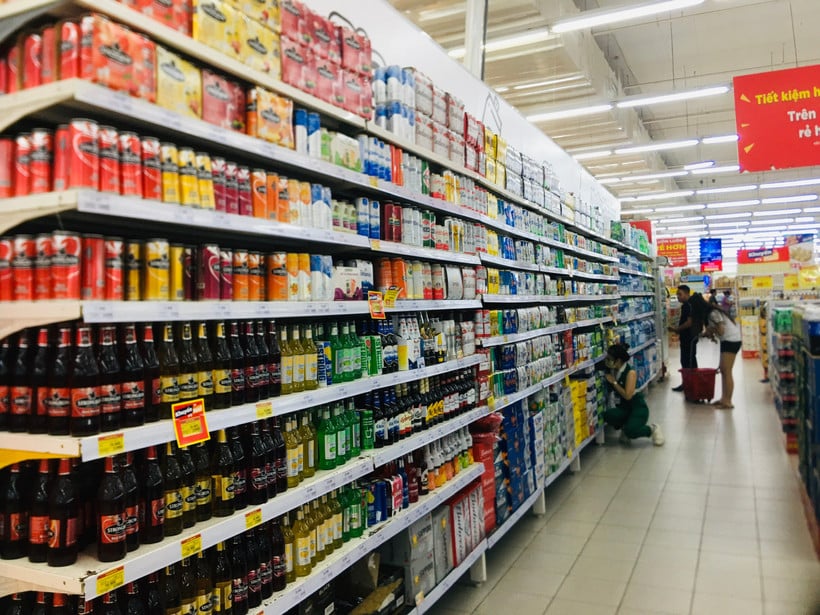
| In August, the food and beverage group decreased by 0.06%, partly due to a 0.18% drop in food prices. (Photo: Vietnam+) |
On September 6th, the General Statistics Office released the August Consumer Price Index (CPI), revealing a macroeconomic picture with price pressures remaining at a certain level.
Accordingly, the average CPI for the first eight months of the year increased by 3.25% compared to the same period in 2024, a manageable increase but still requiring close monitoring from management levels. Notably, rental housing prices and dining out continued to be the main factors driving the August CPI increase by 0.05% compared to July.
More specifically, compared to December 2024, the CPI in August increased by 2.18%, and compared to the same period last year, this index increased by 3.24%. Meanwhile, the core inflation index for the first eight months recorded an increase of 3.19% year-on-year, reflecting the relative stability of price factors that are not subject to seasonal or policy fluctuations.
Eight commodity groups saw price increases.
Analyzing this development in more detail, Ms. Nguyen Thu Oanh, Head of the Services and Prices Department of the General Statistics Office, shared detailed information about the affected groups of goods and services. Specifically, in August, eight groups of goods and services recorded price increases, contributing to the overall increase in the CPI.
Specifically, the housing, electricity, water, fuel, and building materials group increased by 0.21%, heavily influenced by various factors.
According to Ms. Oanh, rental prices increased by 0.28% due to increased demand in some localities as students return to major cities for the new school year. This puts pressure on the housing market in large urban areas. In addition, the August electricity price index increased by 1.01%, reflecting a one-month delay compared to other items as it was calculated based on July's revenue and consumption volume. The main reason is the prolonged hot weather, which caused a surge in electricity demand. Furthermore, the price of home maintenance materials also increased by 0.49% due to higher prices of bricks, sand, and stone as supply became scarce, production and transportation costs increased, while construction demand remained high.
Along with that, the education group also recorded a significant increase of 0.21%. She stated that the adjustment of tuition fees at some universities, private high schools, and private kindergens in some localities for the 2025-2026 school year was the main reason for the 0.21% increase in education service prices. On the other hand, products serving learning also tended to increase in price, such as paper products increasing by 0.9%, pens and other stationery and school supplies increasing by 0.71%, due to the demand for preparing for the new school year.
Furthermore, the demand for shopping in preparation for the new school year also significantly impacted the clothing, hats, and footwear sectors. In fact, many families increased their purchases of clothes and shoes for their children during this period. Specifically, the price of fabrics increased by 0.28%, tailoring services increased by 0.27%, footwear increased by 0.18%, ready-made clothing and footwear services both increased by 0.16%, and hats increased by 0.07%.
In addition, the beverages and tobacco group increased by 0.17%, the household equipment and supplies group increased by 0.11%, and the other goods and services group increased by 0.11%.
Core price pressures remain under control.
In contrast to the upward trend, three groups of goods and services recorded price decreases in August, contributing to curbing the overall CPI increase. Specifically, the postal and telecommunications group decreased by 0.04%. Ms. Oanh stated that smartphones and tablets decreased by 0.63%, landline phones by 0.23%, and regular mobile phones by 0.12%. This indicates that manufacturers and distributors are making efforts to lower prices to attract customers.
Notably, the food and beverage group decreased by 0.06%, partly due to a 0.18% drop in food prices. Ms. Oanh explained that the 2.42% decrease in pork prices was due to the complicated African swine fever outbreak in some localities, causing consumers to worry about food safety and origin. This led to a 1.72% decrease in animal fat prices, a 1.66% decrease in animal offal prices, a 0.84% decrease in frozen livestock meat prices, and a 0.42% decrease in processed meat prices. In addition, the prices of fresh and processed fruits also decreased by 1.51%.
The transportation group decreased by 0.11%, mainly due to adjustments in domestic fuel prices. Specifically, the diesel price index decreased by 2.06%, and the gasoline price index decreased by 0.2%. In addition, the price of used cars decreased by 0.58% and motorcycles decreased by 0.18%, due to businesses implementing promotional programs to support consumer purchases.
Besides the overall CPI, the General Statistics Office reported that core inflation (excluding food, fresh produce, energy, and state-managed items including healthcare and education services) increased by 0.19% compared to the previous month and by 3.25% compared to the same period last year. On average over the first eight months, core inflation increased by 3.19% year-on-year, lower than the 3.25% increase in the overall CPI.
"This discrepancy is mainly due to the prices of food, electricity, healthcare services, and education services, which are factors contributing to the overall CPI increase but are excluded from the core inflation calculation. This shows that, if we remove cyclical factors or those related to policy management, core price pressures remain fairly well controlled," Ms. Oanh explained.
The domestic gold market in August moved in line with global trends, reflecting concerns about macroeconomic conditions and global monetary policy. As of August 30th, the average world gold price was $3,418.45 per ounce, up 1.47% from the previous month.
"The main reason is the expectation that the US Federal Reserve (FED) will cut interest rates, weakening the USD. In addition, geopolitical instability, central bank buying activities, and strong demand for gold in Asian markets have also impacted world gold prices," Ms. Oanh further emphasized.
Domestically, the gold price index in August increased by 1.2% compared to July, by 48.62% compared to the same period in 2024, and by 36.51% compared to December 2024. On average over the first eight months of 2025, the price of gold increased impressively by 40.25% compared to the same period last year, demonstrating that gold remains a "safe haven" amidst inflation and instability.
In contrast to gold prices, the domestic USD exchange rate fluctuated in the opposite direction to the world price in August. As of August 30th, the USD price index on the international market reached 98.11 points, down 0.14% compared to the previous month. However, the domestic USD price index increased by 0.36% compared to July and by 4.43% compared to the same period in 2024, and by 3.67% compared to December 2024. On average, the USD price increased by 3.45% in the first eight months of 2025 compared to the same period last year, indicating that exchange rate pressure remains present domestically, possibly due to interest rate differentials, investment flows, or import demand.
Source: https://huengaynay.vn/kinh-te/cpi-tam-thang-tang-3-25-ap-luc-gia-ca-van-hien-huu-dang-ke-157507.html

![[Photo] Prime Minister Pham Minh Chinh holds a phone call with the CEO of Russia's Rosatom Corporation.](/_next/image?url=https%3A%2F%2Fvphoto.vietnam.vn%2Fthumb%2F1200x675%2Fvietnam%2Fresource%2FIMAGE%2F2025%2F12%2F11%2F1765464552365_dsc-5295-jpg.webp&w=3840&q=75)


![[Photo] Closing Ceremony of the 10th Session of the 15th National Assembly](/_next/image?url=https%3A%2F%2Fvphoto.vietnam.vn%2Fthumb%2F1200x675%2Fvietnam%2Fresource%2FIMAGE%2F2025%2F12%2F11%2F1765448959967_image-1437-jpg.webp&w=3840&q=75)


















































































Comment (0)