

Recently, on several real estate "markets," many investors in the suburban districts of Ho Chi Minh City are selling land plots and townhouses at drastically reduced prices to settle bank loans. For example, in An Nhon Tay commune (Cu Chi district), an investor is selling a plot of land over 800m2, combining residential and perennial crop land, for 5.9 billion VND.
The seller stated that this is a prime piece of land with a 30-meter wide road frontage, ideal for those wishing to build a vacation villa or a small warehouse. During the "land boom," this plot of land was priced at nearly 8 billion VND, with bank financing available up to 80%. However, currently, due to the owner's inability to repay the bank loan, they are selling it at a loss of nearly 2 billion VND.
Not far from there, in Xuan Thoi Dong, a plot of land nearly 1,000 square meters is also being offered for sale at 5.5 billion VND, equivalent to 5.5 million VND per square meter. The landowner stated that this is a distressed property being offered at a significantly reduced price, and the land use purpose has been changed from agricultural land to residential land. During the peak of the real estate market in early 2022, this plot of land was worth nearly 10 billion VND.
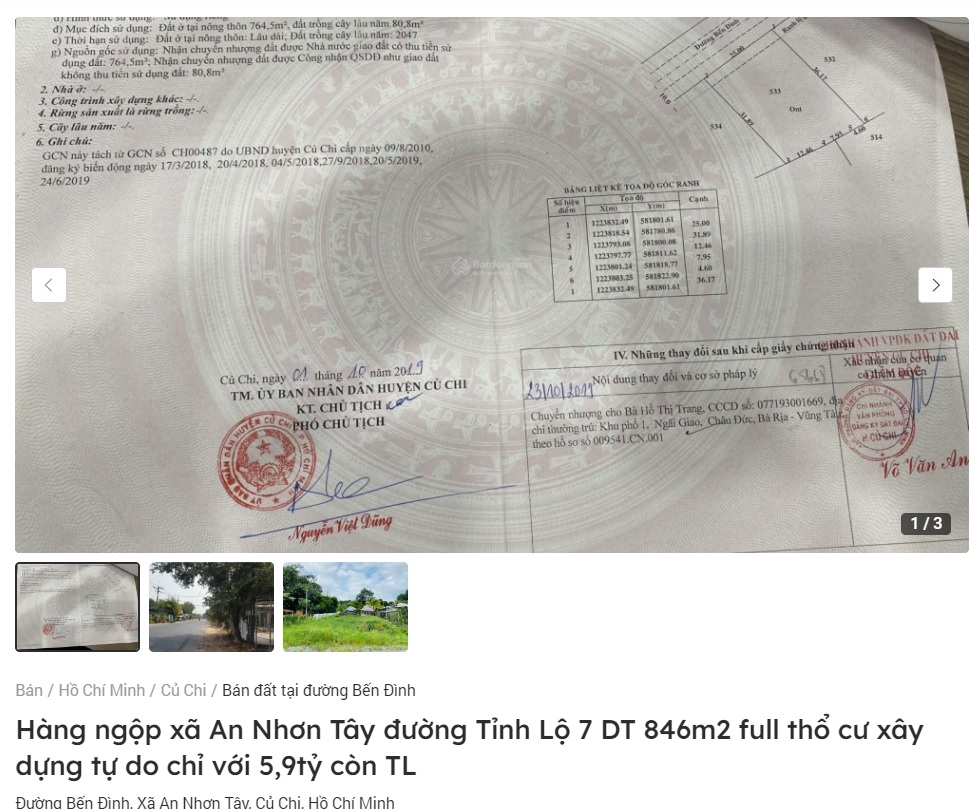
A distressed property listing with a loss-cutting price of nearly 1 billion VND.
Similarly, many land plots in areas such as Xuan Thoi Dong, Xuan Thoi Son, Xuan Thoi Thuong, and Dong Thanh in Hoc Mon district (Ho Chi Minh City) are also facing losses due to pressure from bank loans. For example, in Xuan Thoi Thuong, a 105m2 townhouse is being offered for sale at 6 billion VND. The seller stated that the house was previously priced at 6.7 billion VND.
However, due to the overall freeze in the real estate market, the aforementioned townhouse has yet to find a buyer after being listed for sale for a long time. This is also the predicament of many land and townhouse investors in suburban areas; they are still struggling with the decision of whether to continue lowering prices because they cannot find buyers or to borrow money to repay bank loans while waiting for the market to recover. It is known that during the previous "boom," land prices in Cu Chi and Hoc Mon were pushed up 2-3 times compared to 2018. Land prices only stabilized around mid-2022 and have gradually decreased until now.
Explaining the price increase, many experts believe that land plots in the outskirts of Ho Chi Minh City are highly valued by investors because land in the city center has already exceeded its real value, making long-term investment unsustainable. However, the land fever in the suburbs has also been warned about due to the risks of prices being pushed up too quickly during a period of market inflation. At the same time, in Hoc Mon, information about its potential upgrade to a district has been spread by many real estate brokers, further reinforcing investors' belief in the potential for successful investment there.
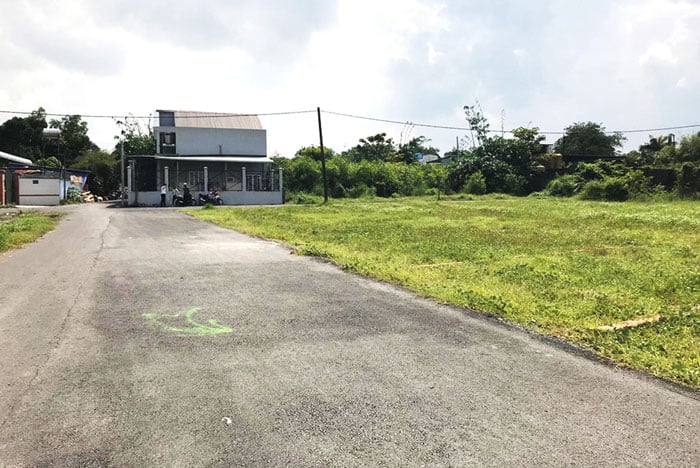
Plots of land with such attractive frontage used to attract a lot of competition from buyers.
Not only in districts far from the city center, but despite significant infrastructure development, the real estate market in Thu Duc City (Ho Chi Minh City) is also stagnating, with many listings for properties being sold at a loss. This applies not only to land plots, but also to detached houses and townhouses within urban areas, which have seen substantial price reductions.
Observations show that the areas with the highest number of distressed property sales in Thu Duc City are wards such as Long Truong, Phu Huu, and Long Phuoc. Advertisements for distressed sales, with price reductions ranging from 500 million to 2 billion VND, are constantly appearing on real estate websites.
The reason for the surge in distressed properties still stems from financial burdens from bank loans or investors wanting to cut losses to invest in other areas. In addition, many landowners say they need capital for their businesses after losing money during the COVID-19 pandemic.
Reportedly, the market for residential and agricultural land in the western part of Ho Chi Minh City has decreased by 15-30% compared to its peak. Coupled with weak liquidity due to investors waiting to buy at the bottom, many investors holding garden land, agricultural land, or even townhouses are unable to sell their holdings.
Source
























































































Comment (0)