

The Mausoleum of Qin Shi Huang is one of the "promised lands" that archaeologists, historians, and many experts and researchers are most eager to explore .
Earlier, in 1974, farmers in Shaanxi Province (China) stumbled upon one of the most sensational archaeological discoveries of the 20th century. Specifically, while digging in a field, they found fragments of clay human figures. But this was only the tip of the iceberg.
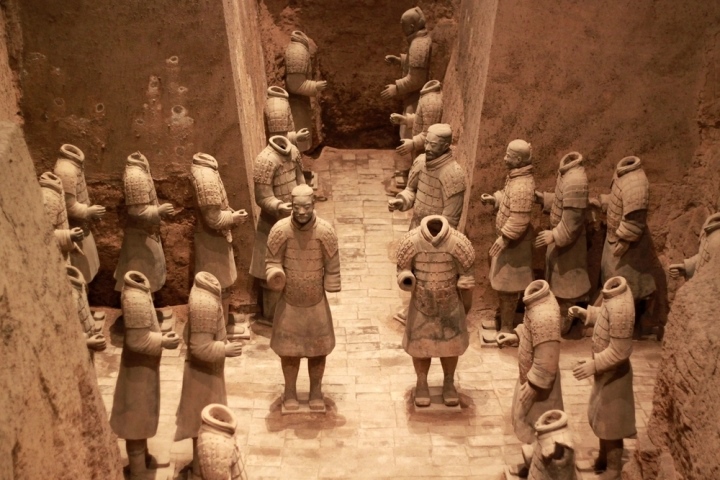
Archaeologists have found numerous terracotta warrior statues near the tomb of Qin Shi Huang.
Subsequent excavations revealed that the field lay on top of numerous pits containing thousands of life-sized terracotta statues of soldiers and warhorses. In addition, archaeologists found statues of officials, acrobats, and animals.
To date, experts have discovered a terracotta army of over 8,000 warrior statues in three pits located approximately 1.6 km northeast of the Mausoleum of Qin Shi Huang. The army's purpose appears to be to protect the tomb of Qin Shi Huang (259 BC – 210 BC), the first emperor in Chinese history.
In fact, experts and archaeologists have explored much of the surrounding cemetery. However, the tomb of Emperor Qin Shi Huang has never been opened. For over 2,000 years, it seems no one has ever looked inside this colossal tomb since the emperor was buried.
One of the most important and decisive reasons is that archaeologists are concerned that excavation could damage the tomb of Qin Shi Huang and lead to the loss of crucial historical information. Currently, if experts want to penetrate deeper into the tomb, they can only use invasive archaeological techniques, which are likely to cause irreparable damage.
One of the clearest examples is the excavation of Troy by archaeologist Heinrich Schliemann in the 1870s. Due to haste and simplistic thinking, this expert's actions destroyed almost every trace of the city he wanted to explore. Naturally, archaeologists certainly wouldn't want to lose patience and make the same mistake.
Archaeologists have proposed using non-invasive techniques to observe the inside of the tomb. One prominent idea is to use muons, subatomic particles formed when cosmic rays collide with atoms in the Earth's atmosphere. Muons can penetrate structures like an advanced form of X-rays. However, most of these proposals appear to be lagging behind in implementation.
What is the most terrifying "trap" in the tomb of Qin Shi Huang?
Furthermore, according to experts, intentionally opening the central tomb, where the remains of Emperor Qin Shi Huang are located, could also lead to many deadly dangers. According to the historian Sima Qian's records, about 100 years after Qin Shi Huang's death, the tomb of the famous emperor contained many traps designed to kill any intruder.
Historian Sima Qian wrote: “Palaces and viewing towers for hundreds of officials were built, and the tombs were filled with rare objects and magnificent treasures. Craftsmen were ordered to make crossbows and arrows to shoot anyone who entered the tombs. Mercury was used to simulate rivers, the Yangtze River, the Yellow River, and the great sea. They were set up to flow mechanically.”
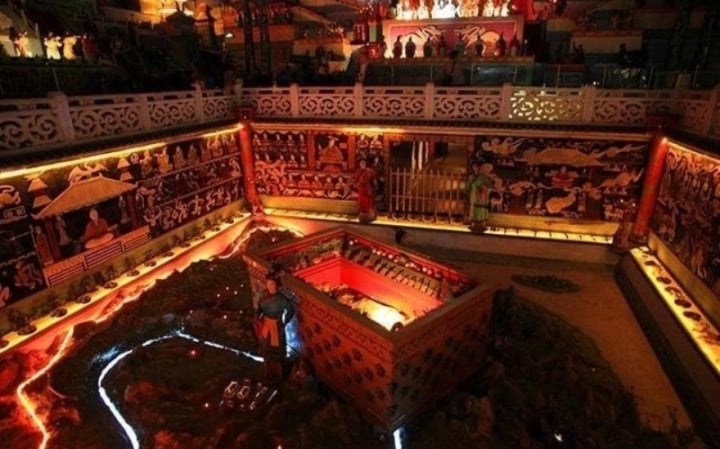
The tomb of Emperor Qin Shi Huang is believed to contain large amounts of mercury and deadly "traps".
Even though the weapons and traps are no longer effective after more than 2,000 years, the tomb of Qin Shi Huang still contains a huge reserve of liquid mercury that could kill anyone daring to trespass on the emperor's resting place. In fact, scientists have examined the area around the tomb and found significantly higher concentrations of mercury than would be expected in a typical area. This suggests that the historian Sima Qian's account is well-founded.
According to a study published in Nature in 2020, experts said that mercury is volatile and could escape through cracks (which appear inside the structure over time), and this investigation further strengthens ancient records about the central catacombs, which are believed to have never been looted or opened.
To this day, the Mausoleum of Qin Shi Huang remains a "difficult puzzle" for experts and scientists. The mausoleum is still sealed and has never been opened. In the future, with advancements in science and technology, experts may be able to discover and decipher the mysteries that have remained intact within this mausoleum for over 2,000 years.
(Source: Vietnamese Women Magazine)
Beneficial
Emotion
Creative
Unique
Wrath
Source



![[Photo] Prime Minister Pham Minh Chinh holds a phone call with the CEO of Russia's Rosatom Corporation.](/_next/image?url=https%3A%2F%2Fvphoto.vietnam.vn%2Fthumb%2F1200x675%2Fvietnam%2Fresource%2FIMAGE%2F2025%2F12%2F11%2F1765464552365_dsc-5295-jpg.webp&w=3840&q=75)
![[Photo] Closing Ceremony of the 10th Session of the 15th National Assembly](/_next/image?url=https%3A%2F%2Fvphoto.vietnam.vn%2Fthumb%2F1200x675%2Fvietnam%2Fresource%2FIMAGE%2F2025%2F12%2F11%2F1765448959967_image-1437-jpg.webp&w=3840&q=75)






































![[OFFICIAL] MISA GROUP ANNOUNCES ITS PIONEERING BRAND POSITIONING IN BUILDING AGENTIC AI FOR BUSINESSES, HOUSEHOLDS, AND THE GOVERNMENT](https://vphoto.vietnam.vn/thumb/402x226/vietnam/resource/IMAGE/2025/12/11/1765444754256_agentic-ai_postfb-scaled.png)










































Comment (0)