

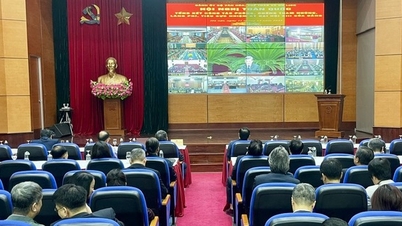
Recently, the Vietnam National Energy and Industry Corporation ( Petrovietnam ) and the Vietnam Petroleum Institute (VPI) organized a workshop on the “Sustainable Aviation Fuel Production Development Project (SAF) to 2030, with a vision to 2050”.
The workshop provided information on the market, technology trends, and potential for SAF production in Vietnam; proposed a roadmap for the application and development of the SAF value chain in Vietnam, along with appropriate mechanisms and policies to realize this roadmap.
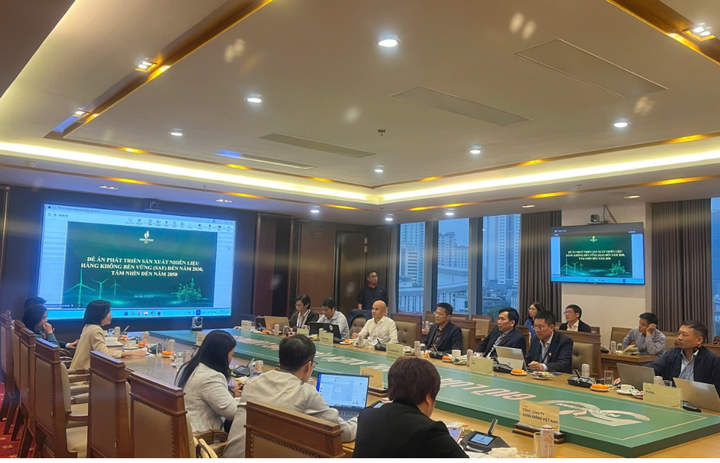
Dr. Le Xuan Huyen - Deputy General Director of Petrovietnam - chaired the workshop on "The SAF production development plan until 2030, with a vision to 2050".
At the workshop, VPI presented trends in the development of advanced SAF production technology and the experiences of several countries around the world in formulating SAF development policies.
Based on an analysis of the advantages, barriers, and challenges, VPI has developed scenarios regarding the potential availability of raw materials for SAF production (such as used vegetable oil (UCO), fish oil, municipal solid waste, microalgae, etc.), proposed suitable production technologies for each stage (prioritizing HEFA technology in the initial stage), and suggested appropriate solutions for implementing SAF production in Vietnam.
At the workshop, experts focused on discussing solutions to ensure the feasibility and sustainability of the Project, emphasizing the core issue of synchronized mechanisms and policies.
To attract investment, many opinions suggest that the Government should improve the legal framework for SAF, consider issuing a roadmap for applying a mandatory SAF blending ratio for flights departing from Vietnam (for example, a ratio of 1-2% by 2030); and build a mechanism for certifying the sustainable origin of this fuel to ensure compliance with the requirements.
Due to the significant price difference between SAF and traditional fuels, experts suggest that the Ministry of Finance consider applying appropriate tax rates to SAF in the initial phase to reduce the cost burden; and also recommend including SAF production projects in the list of priority projects eligible for preferential loans, especially from international and domestic sources for green development.
Regarding raw materials and technology, delegates suggested that further surveys and assessments are needed on the stability and sustainability of potential raw material sources (such as animal fat, UCO, agricultural by-products, and oilseed energy crops, etc.) to ensure a long-term and sustainable supply for SAF production plants in Vietnam.
The workshop also emphasized the need to establish a centralized and efficient raw material collection and processing system to optimize and ensure the input raw material supply chain; and assessed the feasibility of integrating the SAF supply chain into existing factories and infrastructure in Vietnam.
In Conclusion Notice No. 263/TB-VPCP dated May 26, 2025, the Government assigned Petrovietnam and the Vietnam National Petroleum Group (Petrolimex) to research and develop a "Saturate Fuel Oil Production Development Plan" to ensure domestic supply, aiming for exports to potential markets such as the European Union, contributing to achieving the net-zero emissions target by 2050.
Source: https://vtcnews.vn/petrovietnam-nghien-cuu-san-xuat-nhien-lieu-hang-khong-ben-vung-tai-viet-nam-ar992420.html


![[Photo] Closing Ceremony of the 10th Session of the 15th National Assembly](/_next/image?url=https%3A%2F%2Fvphoto.vietnam.vn%2Fthumb%2F1200x675%2Fvietnam%2Fresource%2FIMAGE%2F2025%2F12%2F11%2F1765448959967_image-1437-jpg.webp&w=3840&q=75)











































![[OFFICIAL] MISA GROUP ANNOUNCES ITS PIONEERING BRAND POSITIONING IN BUILDING AGENTIC AI FOR BUSINESSES, HOUSEHOLDS, AND THE GOVERNMENT](https://vphoto.vietnam.vn/thumb/402x226/vietnam/resource/IMAGE/2025/12/11/1765444754256_agentic-ai_postfb-scaled.png)

































Comment (0)