

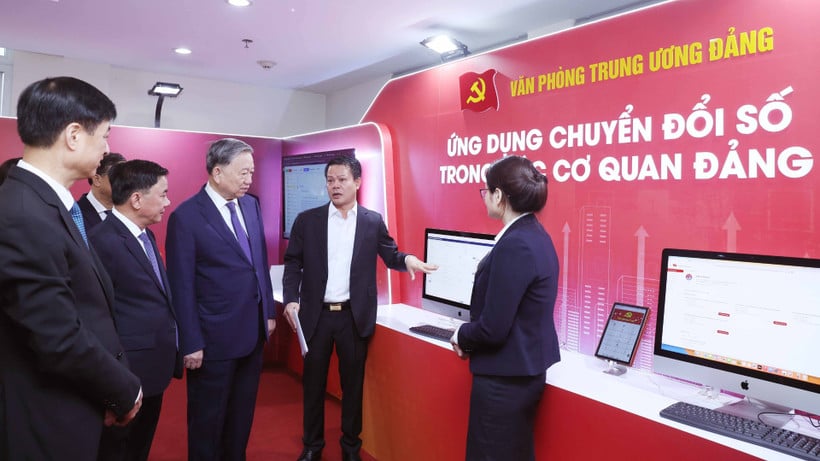
After nearly a year of vigorous and decisive implementation of solutions, comprehensive and revolutionary changes have been observed, contributing to the gradual modernization of the Party's working methods and meeting the requirements of the new era.
Further concretizing the implementation of digital transformation, the Party Central Committee Secretariat recently issued Regulation No. 384-QD/TW dated November 19, 2025, on connecting and sharing data between Party agencies and other agencies and organizations in the political system. The regulation establishes a unified legal framework, creating a foundation for the formation of a synchronized, secure, and confidential data-sharing environment, meeting the requirements of modern, data-driven governance.
According to Regulation No. 384-QD/TW, data connection and sharing are carried out on the basis of centralized management at the central level, interconnected between Party agencies, between Party agencies and organizations within the political system, as well as between the four Central Offices. This is an important step in standardizing data governance processes, identifying data owners, and unifying data management.
Setting an example and leading the way in digital transformation, the Central Party Office, in its role as the standing agency of the Steering Committee for Resolution No. 57-NQ/TW and the Steering Committee for Digital Transformation in Party agencies, has chaired and coordinated the drafting and proposing to the Central Committee, the Politburo , the Secretariat, and the Standing Committee of the Secretariat the issuance of many important documents in leading and directing the implementation of Resolution No. 57-NQ/TW on digital transformation in the Party system. After nearly a year of implementation, the digital platforms, databases, and shared applications have initially created substantive changes in working methods, with core applications already in use.
According to Comrade Dinh Quang Huy, Deputy Director of the Digital Transformation and Cryptography Department, Central Party Office, the operational management system for important digital platforms and applications has been deployed synchronously and effectively. Specifically, the operational management system, spanning from the central level to the grassroots, currently serves over 150,000 accounts, records over 160,000 daily accesses, and processes millions of document flows, including confidential and top-secret documents. The system for monitoring, supervising, and evaluating the implementation of resolutions, directives, and conclusions of the Central Committee has granted access to over 40,000 accounts, tracking nearly 1,800 tasks under 7 key resolutions; and has received and processed over 357 opinions from citizens and businesses regarding digital transformation in the political system.
The Party's data center has been comprehensively upgraded, ensuring the operational capacity of critical information systems. The dedicated data transmission network integrates modern security solutions, seamlessly connecting over 3,400 points, including central agencies, provincial Party committees, subordinate Party committees, and all 3,321 communes, achieving a 100% coverage rate.
The online conferencing system connecting the central level to the commune level has proven effective, contributing to cost reduction and creating a foundation for the stable, economical, and flexible deployment of large-scale shared platforms. The Party member database has completed its first phase and is currently cleaning and standardizing nearly 5 million records, ensuring that the data is "accurate, complete, clean, and active" for digital governance.
To effectively implement its assigned tasks, the Steering Committee for Digital Transformation in Party agencies organized large-scale training programs, including 10 in-depth training conferences on the application of artificial intelligence for over 50,000 participants, and 2 conferences on the application of AI in work; and training on the system for monitoring, supervising, and evaluating Central Committee resolutions for key officials. In addition, cybersecurity was absolutely ensured, and the digital awareness and skills of officials were enhanced through large-scale training programs, with over 723,000 officials participating in online training.
Besides the achievements, compared with the assigned tasks, there are still many shortcomings, limitations, and bottlenecks, such as: The understanding of regulations and legal frameworks for implementing the processing of work files in a digital environment in some Party agencies is still incomplete; the progress of document digitization is slow; the digitization of business processes has not met the required quantity; data is still scattered and fragmented, and a shared data warehouse has not yet been formed to serve analysis and management.
Digital transformation in Party organizations is a new and extremely urgent issue. Regulation No. 384-QD/TW requires Party organizations and other agencies and organizations within the political system to share and connect data in their respective areas of responsibility. Given the current situation, Party committees at all levels need to continue to provide decisive and consistent guidance, with concerted efforts and shared responsibility from Party organizations at the central level, provincial and city Party committees, especially the active participation of units at the commune, ward, and special zone levels. There needs to be responsible collaboration between leaders at all levels and the professional staff involved in digital transformation to ensure that the implementation of digital transformation and the connection and sharing of data are effective and substantive.
Source: https://nhandan.vn/day-manh-thuc-hien-hieu-qua-chuyen-doi-so-trong-cac-co-quan-dang-post929415.html









![[Video] Application of Biofloc technology in building an industrial-scale shrimp farming model](https://vphoto.vietnam.vn/thumb/402x226/vietnam/resource/IMAGE/2025/12/11/1765415061532_1765268925610-jpg.webp)







![[Video] The craft of making Dong Ho folk paintings has been inscribed by UNESCO on the List of Crafts in Need of Urgent Safeguarding.](https://vphoto.vietnam.vn/thumb/402x226/vietnam/resource/IMAGE/2025/12/10/1765350246533_tranh-dong-ho-734-jpg.webp)























































Comment (0)