

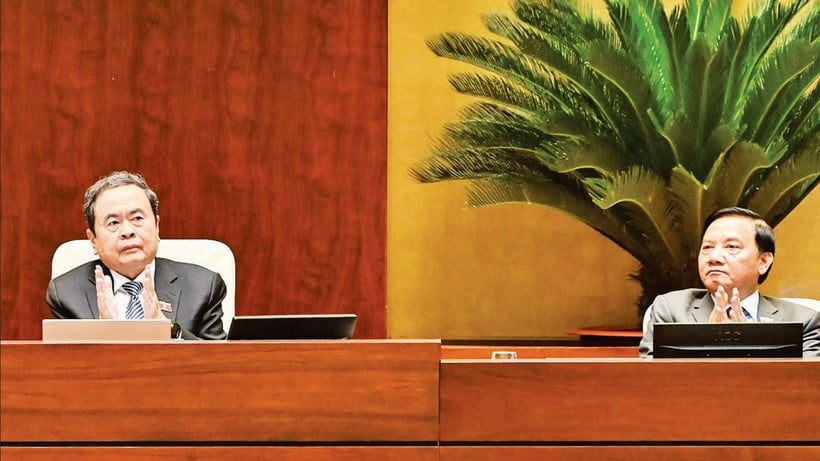
Increase the personal allowance for taxpayers to 15.5 million VND/month.
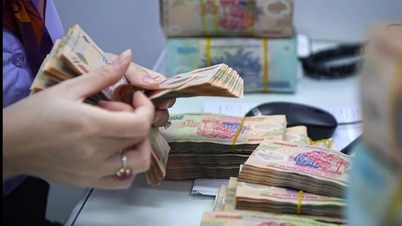
According to the amended Personal Income Tax Law passed by the National Assembly , the tax-exempt revenue threshold for household and individual businesses has been adjusted from VND 200 million/year to VND 500 million/year, and this amount is deductible before calculating tax based on a percentage of revenue; simultaneously, the corresponding value-added tax-exempt revenue threshold has been adjusted to VND 500 million; and a method of calculating income tax (revenue-expenses) has been added for household and individual businesses with revenue exceeding VND 500 million/year up to VND 3 billion, applying a tax rate of 15%.
These individuals are given the option of calculating the tax based on a percentage of their revenue. The law also stipulates that gold bars are taxed at a rate of 0.1% on the transfer price for each transaction, and assigns the Government the authority to regulate the tax threshold for gold bars, the time of application of the tax, and to adjust the personal income tax rate on gold bar transfers in accordance with the gold market management roadmap.
The personal allowance for taxpayers is set at VND 15.5 million/month (VND 186 million/year); the allowance for each dependent is VND 6.2 million/month. The Government will submit to the Standing Committee of the National Assembly regulations on personal allowance levels appropriate to the socio-economic situation of each period.
The personal allowance for taxpayers is set at VND 15.5 million/month (VND 186 million/year); the allowance for each dependent is VND 6.2 million/month. The Government will submit to the Standing Committee of the National Assembly regulations on personal allowance levels appropriate to the socio-economic situation of each period.
To maintain the replacement fertility rate, the Population Law has stipulated several measures, including: maternity leave for female workers for a second child is 7 months; for male workers, it is 10 working days when their wives give birth. Financial support is provided for childbirth to women from ethnic minority groups with very small populations, women in provinces and cities with birth rates below the replacement level, or women who have two children before the age of 35. Priority is given to purchasing, renting, or leasing social housing as prescribed by housing law for those with two or more children.
According to the Law on Saving and Combating Waste, those who fight against waste and their relatives will be protected by law and compensated if competent authorities fail to apply protective measures or apply them belatedly, causing damage to life, health, property, or mental well-being. Discrimination, imposing criteria, conditions, comments, or assessments that are detrimental to personnel work, rewards, or disciplinary actions against those who fight against waste and their relatives is strictly prohibited; as is the transfer, reassignment, or secondment of those who fight against waste while they are handling cases. May 31st of each year is designated as "National Day for Saving and Combating Waste".
The amended Press Law regulates various types of media in the new context, supplementing policies for media development and ensuring more feasible resources for implementation. The law also defines a leading multi-media press agency as one that encompasses multiple types of media and affiliated media agencies; has a specific financial mechanism; and is established in accordance with the Strategy for the Development and Management of the Press System approved by the Prime Minister. Along with print newspapers, online newspapers, radio, and television, the content channels of press agencies on social media become an official form of media product, but must fully comply with legal regulations and have a unified identifying mark when established on different social media platforms.
In this amendment, the Education Law clearly defines the legal status of educational institutions, the development of artificial intelligence in education and training, the system of diplomas and certificates of the national education system, and the unified use of a single set of textbooks for general education nationwide. Notably, students are allowed to skip grades and study at ages older or younger than the prescribed age.
With a high approval rate, the National Assembly voted to pass three resolutions: the Resolution on the results of the thematic supervision "Implementation of policies and laws on environmental protection since the Law on Environmental Protection 2020 came into effect"; the Resolution of the National Assembly on some specific and outstanding mechanisms and policies to achieve breakthroughs in education and training development; and the Resolution on the investment policy for the National Target Program on modernization and improvement of the quality of education and training in the period 2026-2035.
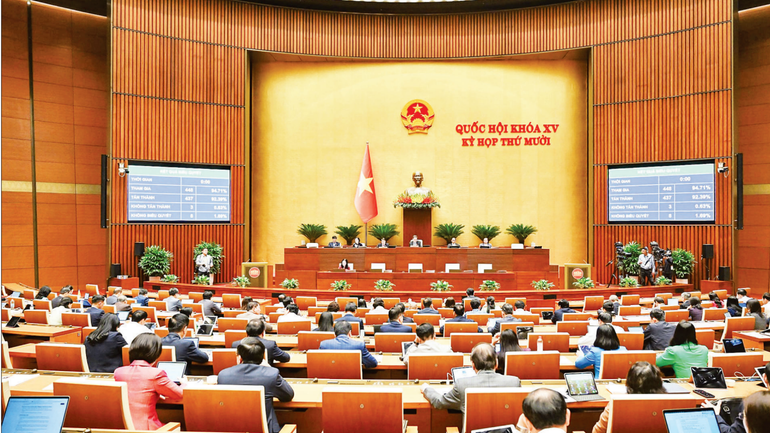
Recruiting, employing, and managing civil servants according to job positions.
In the afternoon session, with a high percentage of agreement, the National Assembly voted to pass: the Law on Execution of Criminal Sentences (amended); and the Law on Execution of Temporary Detention, Custody, and Prohibition from Leaving the Place of Residence.
The Law on Execution of Criminal Sentences (amended) stipulates that prisoners may donate tissues and organs when they meet the following conditions: voluntarily donating tissues and organs; donating tissues and organs to relatives of the prisoner; being in good health to donate tissues and organs and ensuring their health to continue serving their sentence after donation; bearing all costs of tissue and organ donation and self-care after donation; being convicted of a minor crime or a serious crime as a first-time offender with less than three years remaining to serve their sentence.
The Law on the Execution of Temporary Detention, Custody, and Prohibition from Leaving Residence stipulates that the National Assembly, People's Councils, and the Vietnam Fatherland Front shall supervise the activities of agencies managing and executing temporary detention, custody, and prohibition from leaving residence, as well as other agencies, organizations, and individuals related to temporary detention, custody, and prohibition from leaving residence, in accordance with the law.
The law also stipulates that women who are detained or imprisoned and are pregnant or raising children under 36 months old shall be provided with suitable accommodation, prenatal examinations, medical care, and a diet that ensures their health. Women who are detained or imprisoned and give birth shall be ensured a standard and quantity of food as directed by a medical officer or doctor, provided with necessary food, supplies, and medicine for the care of the newborn, and guaranteed time for breastfeeding during the period of nursing. The detention facility is responsible for processing the birth registration application. The People's Committee of the commune where the detention facility is located is responsible for registering and issuing the birth certificate; and simultaneously requesting the social insurance agency to issue a health insurance card for the child born.
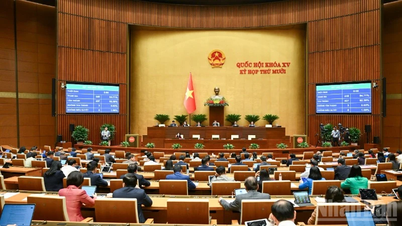
During the working session, the National Assembly passed the amended Law on Public Employees with a majority of National Assembly deputies voting in favor. The law transforms the method of managing public employees based on job positions, using job positions as the primary basis for recruitment, placement, evaluation, planning, appointment, training, and the implementation of policies and regulations for public employees. The rights and obligations of public employees in their professional activities outside of public service units are specifically regulated in the law, ensuring strict adherence.
Source: https://nhandan.vn/quoc-hoi-thong-qua-nhieu-luat-nghi-quyet-nham-thao-go-diem-nghen-the-che-post929408.html









![[Video] Application of Biofloc technology in building an industrial-scale shrimp farming model](https://vphoto.vietnam.vn/thumb/402x226/vietnam/resource/IMAGE/2025/12/11/1765415061532_1765268925610-jpg.webp)





































































Comment (0)