

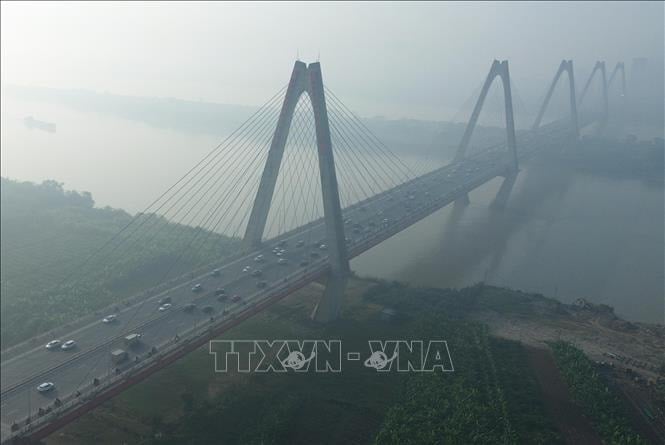
In response to the serious deterioration of air quality in recent days, the Chairman of the Hanoi People's Committee, Vu Dai Thang, has signed Directive No. 19/CT-UBND on strengthening urgent measures to control air pollution in the city.
Accordingly, the Chairman of the City People's Committee requested the Department of Agriculture and Environment to implement emergency measures under the coordination of the Ministry of Agriculture and Environment in cases of serious air pollution across regions, provinces, and borders. At the same time, the Department should proactively advise the City People's Committee on mechanisms for coordinating with provinces and cities in the region in controlling inter-regional and inter-provincial air pollution.
Simultaneously, inspect all solid waste treatment facilities; require units to ensure continuous operation and prevent the release of dust and odors; monitor environmental sanitation maintenance contracts according to the assigned levels to ensure sanitation quality on key routes; direct environmental sanitation units to increase dust suppression spraying and road cleaning. Furthermore, coordinate with press and television agencies to publish information on the current state and forecast of air quality and solutions to mitigate air pollution, conducting weekly public awareness campaigns.
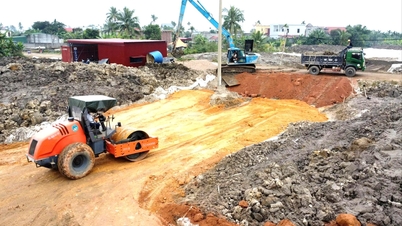
The Department of Construction is strengthening its strict supervision, requiring 100% of construction sites to implement rigorous dust control measures (shielding, washing vehicles before leaving the site, spraying mist to reduce dust, etc.); loose construction waste must be covered, sealed, or bagged at collection points on the construction site and during transportation to ensure that dust is not released into the environment. In addition, it is implementing a dust monitoring system (sensors, cameras) at 100% of construction projects larger than 1 hectare; and guiding investors and contractors of construction projects to install fixed misting systems to reduce dust in densely populated residential areas (at high-rise buildings).
In addition, the Department of Construction, in coordination with the City Police and the People's Committees of communes and wards, will proactively organize campaigns to inspect and handle construction and transportation activities in the area that pose a high risk of dust dispersal; and will not grant permits for excavation of roadbeds and sidewalks (except in cases of emergency) during the end of the year when air quality is severely polluted.
The City Police are organizing a concentrated campaign to inspect and strictly and publicly handle violations such as transporting construction materials without proper covering, causing material spillage; illegal burning of industrial solid waste and household waste, especially in craft villages and villages with traditional crafts; and to promptly synchronize technical infrastructure with AI-integrated security cameras and traffic surveillance cameras to serve inspection and monitoring work and to promptly detect and strictly handle violations.
The Department of Health, in coordination with media outlets and the People's Committees of wards and communes, advises people (especially the elderly, children, and those with underlying respiratory conditions) to minimize outdoor activities during periods when the VN_AQI (Air Quality Index) is high to protect their health. They are proactively developing disease response plans and requiring healthcare facilities in the inner city and areas at risk of air pollution to have contingency plans in place, including equipment and resources, to be ready to respond and serve the public in case of severe air quality deterioration affecting the respiratory systems of many people.
The Department of Education and Training announces and guides schools to limit outdoor activities for students during hours and days when air quality is at a "Poor" level or higher; and to temporarily suspend or adjust students' learning time when the Department of Agriculture and Environment issues a severe air pollution warning.
The Chairpersons of the People's Committees of communes and wards shall direct relevant agencies to strengthen inspection and supervision of construction sites in their areas, requiring investors and construction units to collect, transport, and process solid waste in accordance with regulations; strictly handle vehicles transporting construction materials and waste without proper covering, causing spillage on the road; and handle acts of burning household solid waste, straw, and agricultural by-products in violation of regulations, causing environmental pollution.
Simultaneously, review, strictly manage, and organize environmental inspections of industrial waste sources and activities involving burning processes in craft villages and industrial production facilities within the managed area according to the assigned responsibilities. Organize weekly (Saturday and Sunday) general environmental sanitation and raise awareness of environmental hygiene in the area; mobilize the participation of the community to monitor polluting activities in the area, in order to promptly report to the relevant authorities for handling in case of detecting violations of dust and exhaust emissions.
The City People's Committee emphasized that the Chairpersons of the People's Committees of communes and wards must be held accountable to the Chairperson of the City People's Committee if the burning of garbage, the accumulation and dumping of waste and debris in violation of regulations cause pollution in their areas.
In recent times, urbanization, along with increased traffic, construction, and production activities, has generated large amounts of air pollution and dust. Particularly in recent days, extreme weather patterns such as thick fog, low temperatures, and temperature inversions have caused the AQI index in the capital to reach "bad" and "very bad" levels, directly impacting the health of the people…
Source: https://baohaiphong.vn/ha-noi-cap-bach-kiem-soat-o-nhiem-khong-khi-529247.html


![[Photo] General Secretary and President To Lam and the President of the Philippines hold talks.](https://vphoto.vietnam.vn/thumb/1200x675/vietnam/resource/IMAGE/2026/06/01/1780286997787_anh-man-hinh-2026-06-01-luc-11-09-43.png)


























































Comment (0)