

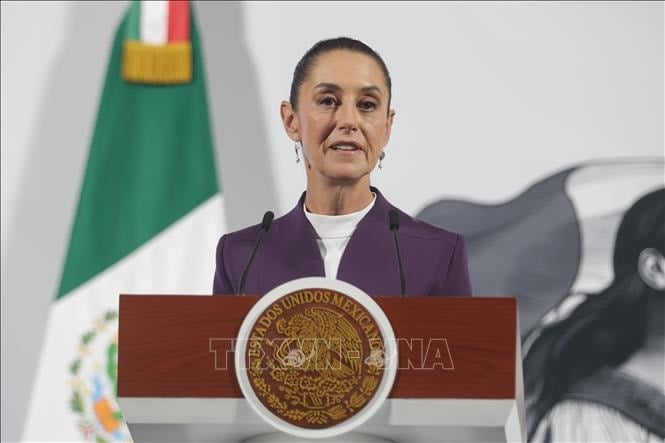
In a list published on December 8th, the New York Times noted that in his first year in office, President Sheinbaum contributed to drawing attention to Mexico's indigenous fashion by wearing traditional embroidered clothing and taking strong measures against major brands that copied designs from local Mexican artisans.
Speaking at a press conference that same day, President Sheinbaum expressed pride that the weavers, embroiderers, and loom weavers of Mexico, the majority of whom are women, are a source of national pride. The female head of state stated that many of the outfits she wore were gifts received during her trips across the country, designed and selected by a group of seamstresses who helped create huipil – traditional garments hand-embroidered and featuring other indigenous patterns.
President Sheinbaum emphasized that these were not the usual expensive brands, but rather fabrics purchased and used to design the garments herself. The Mexican leader expressed gratitude for the American newspaper's recognition, but stressed that those who truly deserved thanks were the indigenous Mexican women artisans for their creativity and the beauty they imbued in every stitch.
Ms. Sheinbaum highlighted that each embroidered motif not only embodies effort and skill but also tradition, history, and heritage, showcasing the creativity of women, primarily indigenous Mexican women. She noted that the Mexican government is aiming to support these female artisans in accessing more markets, both domestically and internationally.
The American newspaper praised President Sheinbaum's elegant style, while also mentioning the Mexican government's strong measures against major brands producing counterfeit versions of the country's traditional embroidered textiles.
In August, the sports brand Adidas issued a public apology after being criticized for “cultural appropriation” when it drew inspiration from the traditional huarache sandals of the Yalálag community in Oaxaca state, Mexico, for its “Oaxaca Slip-On” shoe. Adidas's public apology came after President Sheinbaum emphasized that huarache is “collective intellectual property,” and therefore requires “compensation” and compliance with heritage protection laws.
Source: https://baolamdong.vn/tong-thong-mexico-ton-vinh-phu-nu-ban-dia-sau-binh-chon-cua-new-york-times-409562.html
![[Photo] Prime Minister Pham Minh Chinh holds a phone call with the CEO of Russia's Rosatom Corporation.](/_next/image?url=https%3A%2F%2Fvphoto.vietnam.vn%2Fthumb%2F1200x675%2Fvietnam%2Fresource%2FIMAGE%2F2025%2F12%2F11%2F1765464552365_dsc-5295-jpg.webp&w=3840&q=75)

![[Photo] Closing Ceremony of the 10th Session of the 15th National Assembly](/_next/image?url=https%3A%2F%2Fvphoto.vietnam.vn%2Fthumb%2F1200x675%2Fvietnam%2Fresource%2FIMAGE%2F2025%2F12%2F11%2F1765448959967_image-1437-jpg.webp&w=3840&q=75)








































![[OFFICIAL] MISA GROUP ANNOUNCES ITS PIONEERING BRAND POSITIONING IN BUILDING AGENTIC AI FOR BUSINESSES, HOUSEHOLDS, AND THE GOVERNMENT](https://vphoto.vietnam.vn/thumb/402x226/vietnam/resource/IMAGE/2025/12/11/1765444754256_agentic-ai_postfb-scaled.png)





































Comment (0)