

On the morning of December 5, the National Assembly discussed in the hall the investment policy of the National Target Program (NTPP) on new rural areas, sustainable poverty reduction, and socio -economic development in ethnic minority and mountainous areas until 2035.
Build a separate component for ethnic minority and mountainous areas
Delegate Pham Thi Kieu ( Lam Dong ) expressed her agreement with the plan to integrate 3 national target programs into a single program to reorganize resources, ensure consistency in management, reduce overlap, and increase efficiency and transparency in implementation.
Delegates also agreed to deploy the program nationwide, while giving appropriate priority to each ethnic minority and mountainous region, and areas with many difficulties and the highest specific requirements.

Delegate Pham Thi Kieu (Lam Dong). Photo: National Assembly
However, according to the female delegate of Lam Dong province, integration must be accompanied by the principle of not mixing 3 programs which have different goals, implementation mechanisms and approaches. In particular, the socio-economic development program for ethnic minority and mountainous areas not only aims to promote development but also to address problems accumulated over many generations.
This is the only program that directly impacts the most vulnerable groups, living in the most difficult areas and in an important position for political and social stability. Therefore, when designing the integrated program, Ms. Kieu suggested that the National Assembly and the Government clarify some major orientations to ensure that the program is both unified and still maintains the necessary depth.
The first is to build a separate component for ethnic minority and mountainous areas with goals, scope and mechanisms appropriate to the specific characteristics. “This is a requirement to ensure that the most core issues in the specific areas are not merged into universal goals, avoiding the situation where the specific characteristics are obscured during the integration process,” the female delegate emphasized.
The second is to allocate resources based on the actual level of difficulty instead of averagely by administrative unit. The most difficult areas must be given the strongest priority, because if allocated equally, the program will no longer maintain its humanity and the goal of narrowing the development gap between regions.
Third is to clarify the central role of ethnic affairs agencies in managing specific components. This is not to create an additional intermediate level but to ensure continuity in ethnic policies, avoid disruption when switching to an integrated model and promote management experience that has been proven through many stages.
"Practice shows that the state management agency for ethnic affairs is the unit that best understands regional characteristics, has a grasp of the area, has data, and has the capacity to directly deploy to the community," the delegate concluded.
On that basis, she proposed that the investment policy announcement should clearly state: "The state management agency for ethnic affairs is the unit in charge of component 2, coordinating with ministries and branches in implementation". This is a necessary step to ensure continuity in operation, in accordance with the spirit of Conclusion Announcement No. 4665 dated November 27, 2025 of the National Assembly Standing Committee.
In addition, the delegates also proposed that the National Assembly's resolution should include the following content: "The Ministry of Agriculture and Environment is the agency in charge of the program according to the Law on Public Investment; the Ministry of Ethnic Minorities and Religions is the focal point for managing and organizing the implementation of component 2, ensuring consistency throughout and suitability to the specific conditions of ethnic minority and mountainous areas."
“If the integrated program is designed according to these orientations, I believe we will have a more modern, more effective and more humane management model. This is not only a public investment program but also a foundation to gradually narrow the development gap, strengthen national solidarity and ensure sustainable and comprehensive development of the country in the coming years,” said the female delegate from Lam Dong province.
At least 70% of the central budget capital is prioritized for ethnic minority and mountainous areas.
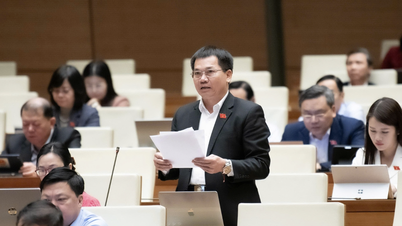
Delegate Ha Sy Dong (Quang Tri) - Member of the Economic and Financial Committee of the National Assembly proposed to assign the Ministry of Ethnic Minorities and Religions to preside over the component of the socio-economic development program for ethnic minority and mountainous areas until 2035, as the unified focal point.
At the same time, he also said that it is necessary to strongly decentralize the locality in selecting project portfolios, especially small projects with simple techniques; simplify the investment process; clearly define the personal responsibilities of the head and the mechanism for evaluating and handling delays. In particular, there needs to be a "legal safety zone" for officials to dare to think and act, in line with the directive spirit on protecting dynamic and creative officials.

Delegate Ha Sy Dong (Quang Tri). Photo: National Assembly
In addition, he also expressed concern that the requirement to mobilize 33% of local budget capital and 28% from businesses and the community is not feasible for poor provinces, where the regular budget still has to depend on the Central Government.
“I propose to redefine the appropriate matching ratio, especially for mountainous provinces, remote and isolated areas – where even 10% matching is a challenge. At the same time, it is necessary to clearly stipulate the allocation principle: at least 70% of the central budget capital must be prioritized for ethnic minority and mountainous areas, of which at least 40% for particularly difficult areas, ensuring investment in the right core poor areas, right focus”, delegate Ha Sy Dong said and agreed with the opinion of assigning localities to review and decide on their own.
Regarding investment content and policy components, delegate Ha Sy Dong noted that it is necessary to clearly define: Support for production development is the fundamental, key factor that determines the actual effectiveness and sustainability of the program.
In addition, it is necessary to continue to pay attention to synchronous investment in other essential contents that have a direct impact on people's lives such as: People's infrastructure, job conversion, processing development, sustainable forestry, domestic water, residential land, and production land for ethnic minorities in mountainous and border areas.
“I propose to stipulate the highest priority rate for the production development component, because solving employment and increasing income is the most important; building a mechanism to select enterprises and cooperatives as the core in the value chain; strengthening preferential credit policies instead of providing free support; at the same time strongly promoting the digital economy, digital trade, and digital infrastructure in difficult areas,” the delegate suggested.
Delegates from Quang Tri province proposed to include in the resolution a requirement to publicize the entire list, capital, progress and results of projects on a digital platform; and assign the Fatherland Front and the community to monitor using digital tools in real time. This is a prerequisite to ensure the program achieves the highest efficiency and prevent negativity.
To ensure feasibility and accountability, Mr. Dong also proposed that the National Assembly stipulate that the Government should report mid-term in 2029 on progress, disbursement and efficiency; and at the same time apply a set of independent KPI indicators to evaluate and serve as a basis for capital allocation for the 2031-2035 period. This is an important requirement, ensuring that the program does not fall into the situation of "setting high targets at the beginning of the period - asking for adjustments at the end of the period".
The program consists of two components:
Component 1: General contents implemented nationwide; general contents aimed at building new rural areas, sustainable poverty reduction, and socio-economic development in ethnic minority and mountainous areas.
Component 2: Specific contents of socio-economic development in ethnic minority and mountainous areas. This component includes 5 groups of contents. These are specific policies, with additional investment for ethnic minority and mountainous areas, and subjects related to ethnic minority and mountainous areas.
Vietnamnet.vn
Source: https://vietnamnet.vn/nen-giao-bo-dan-toc-va-ton-giao-chu-tri-chuong-trinh-phat-trien-vung-dtts-mn-2469676.html


![[Photo] Cat Ba - Green island paradise](/_next/image?url=https%3A%2F%2Fvphoto.vietnam.vn%2Fthumb%2F1200x675%2Fvietnam%2Fresource%2FIMAGE%2F2025%2F12%2F04%2F1764821844074_ndo_br_1-dcbthienduongxanh638-jpg.webp&w=3840&q=75)

































































Comment (0)