

This morning, discussing in the hall about the investment policy of the National Target Program on new rural areas, sustainable poverty reduction, and socio -economic development in ethnic minority and mountainous areas until 2035, many delegates mentioned the heartbreaking damage caused by the recent historic floods.
Many families who had just escaped poverty fell back into poverty after just one flood.
Expressing great interest in the goal of adapting to climate change, delegate Nguyen Thi Mai Hoa ( Dong Thap delegation) said that all three areas: new rural construction, sustainable poverty reduction, and socio-economic development in ethnic minority and mountainous areas must be associated with climate change adaptation.
“The past few months have shown that the devastation is so terrible that many families who have just escaped poverty have fallen back into poverty after just one flood. The cost of overcoming the consequences of natural disasters is often much greater than the cost of proactive investment in the past,” the delegate stated.
From there, she proposed separating “climate change adaptation” into a major content in the common goal.

Delegate Duong Khac Mai ( Lam Dong delegation). Photo: National Assembly
Sharing the same concern, delegate Duong Khac Mai (Lam Dong delegation) said that looking back at the damage caused by recent storms and floods to transport infrastructure, facilities and people's property, we see the extent of the loss is extremely heavy. Many regions and families that have just escaped poverty are back at the starting point.
“Some opinions say that with the recent flood situation, many households have completely escaped poverty because there is nothing left to be poor about,” Mr. Duong Khac Mai stated the painful reality and suggested that the Government re-evaluate the program’s capital level to see if it meets practical requirements.
Funding for program implementation
Phase 2026-2030: The program is expected to mobilize at least 1.23 million billion VND. Of which, the central budget will directly support about 100,000 billion VND and will continue to be balanced to supplement according to demand.
Local budget is about 400,000 billion; capital combined from other programs and projects is about 360,000 billion; policy credit capital is more than 22,600 billion; the rest is business capital and contributions from the community and people.
Phase 2031-2035: The Government will submit to the National Assembly for decision on resources based on the implementation results of the first phase.
According to him, the Government needs to forecast and arrange large enough reserve resources to handle problems arising in the context of increasingly profound impacts of climate change, where storms, floods, landslides, and droughts may occur more frequently and severely.
“The important thing is that no matter how difficult the conditions are, the program must reach its final destination,” Mr. Duong Khac Mai emphasized.
Natural disasters shatter hopes for the future
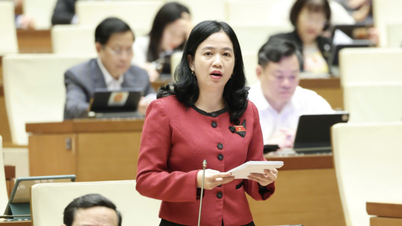
Delegate Chau Quynh Dao (An Giang delegation) commented that the rate of re-poverty is still high, especially in ethnic minority and mountainous areas. One of the important causes of this situation is natural disasters.
“Vietnam is a small country but all year round it has to struggle against 'storms in the morning and fires in the afternoon'. In 2025 alone, Vietnam will have to face more than 20 types of natural disasters. Natural disasters are frequent, fierce, exceeding historical levels on a large scale,” the female delegate cited the recent floods in the four provinces of Dak Lak, Gia Lai, Khanh Hoa, and Lam Dong, with total damage reaching more than VND8,900 billion.
According to her, although the Government and the community have implemented many measures to prevent natural disasters and respond promptly, they still cannot avoid the tragedy of many households, their life-saving assets; electricity, roads, schools, stations, and dykes being swept away by the water overnight; and lives being lost, including children.

Delegate Chau Quynh Dao (An Giang delegation). Photo: National Assembly
“Natural disasters not only sweep away infrastructure but also shatter aspirations for the future of the most severely affected areas,” concluded a female delegate from An Giang province.
She believes that sustainable poverty reduction at this time must be adaptation, must be strengthening people's resilience to the severe impacts of natural disasters.
However, according to the delegate, the financial solutions group only mentioned credit loans without paying attention to a very important financial tool: insurance.
Currently, the insurance participation rate is very low. Life insurance only covers about 11-11.7% of the population. In particular, agricultural insurance, the most heavily and directly affected sector, has only had 16,700 out of 9 million agricultural households participating in the three years since its launch, a very low number.
Delegates analyzed that when insurance has not yet played its inherent role, the financial burden falls on people in disaster areas, then on the state budget, which has to spend tens of thousands of billions of dong each year to overcome the consequences. Banks are in a state of bad debt, the community has to continuously call for relief, the solutions are not fundamental.
Therefore, delegate Chau Quynh Dao proposed that the Government and the National Assembly consider a number of solutions to make insurance truly a capital protection tool, helping people rebuild quickly and escape poverty sustainably.
Vietnamnet.vn
Source: https://vietnamnet.vn/qua-tran-lu-lich-su-nhieu-nha-da-thoat-han-ngheo-vi-khong-con-gi-de-ngheo-2469731.html
![[Photo] 60th Anniversary of the Founding of the Vietnam Association of Photographic Artists](/_next/image?url=https%3A%2F%2Fvphoto.vietnam.vn%2Fthumb%2F1200x675%2Fvietnam%2Fresource%2FIMAGE%2F2025%2F12%2F05%2F1764935864512_a1-bnd-0841-9740-jpg.webp&w=3840&q=75)

![[Photo] National Assembly Chairman Tran Thanh Man attends the VinFuture 2025 Award Ceremony](/_next/image?url=https%3A%2F%2Fvphoto.vietnam.vn%2Fthumb%2F1200x675%2Fvietnam%2Fresource%2FIMAGE%2F2025%2F12%2F05%2F1764951162416_2628509768338816493-6995-jpg.webp&w=3840&q=75)












































































Comment (0)