

Tran Anh Tuan, head of the Ho Chi Minh City Business Management Innovation Board, proposed allocating 1 trillion VND from the funds currently deposited in banks to support workers.
The national treasury currently has over 1 trillion VND in surplus funds as of May 2023. During this morning's socio-economic discussion, Mr. Tran Anh Tuan stated that this figure indicates a very large surplus of funds that cannot be spent.
"We can flexibly arrange and provide immediate support to workers and those who have lost their jobs; or build rental housing in export processing zones and industrial parks, and provide training and retraining for workers," Mr. Tuan suggested.
This representative said that, in the context of a very difficult economic situation, these solutions will help channel unused capital into stimulating demand and revitalizing the economy.
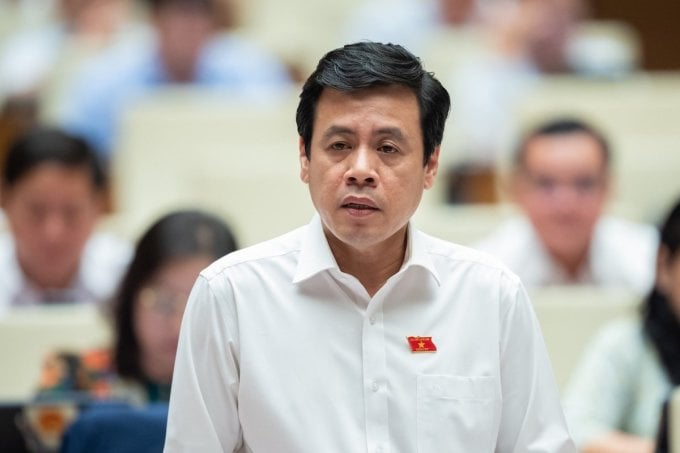
Mr. Tran Anh Tuan, Head of the Ho Chi Minh City Enterprise Management Innovation Board, speaks at a discussion on socio-economic issues on May 31st. Photo: Hoang Phong
Speaking to VnExpress on May 25th, Minister of Finance Ho Duc Phoc stated that the large amount of surplus funds is mainly due to bottlenecks in the disbursement of public investment capital. Currently, this money is deposited at the State Bank of Vietnam at an interest rate of 0.8% per year. Mr. Phoc suggested that the law must be amended, possibly using one law to amend multiple laws, including amending the Law on Public Investment, in order to overcome this situation.
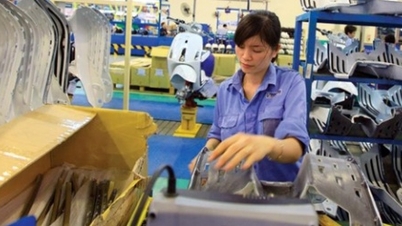
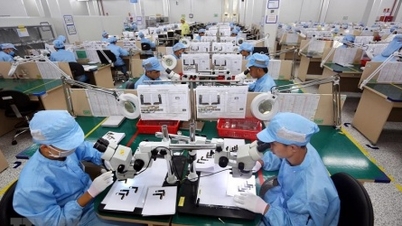
The Ministry of Labor, War Invalids and Social Affairs has also noted the situation of workers being laid off, having their working hours reduced, or losing their jobs due to businesses decreasing orders and scaling back production.
According to the agency's report, in the first quarter of this year, nearly 294,000 workers were laid off, a decrease of 2,000 compared to the end of 2022, with the majority in foreign-invested enterprises (83%).
However, the number of unemployed workers reached 149,000, an increase of 39,000 compared to the previous quarter, concentrated in the textile and garment industry (19%); leather and footwear (18%), and the production of electronic components and products (17%). Job losses and reduced working hours were concentrated in provinces with many industrial parks and export processing zones, such as Dong Nai with 32,600 workers, Binh Duong with 21,700 workers, and Bac Ninh and Bac Giang with 14,000 and 7,700 workers respectively.
A survey conducted by the Private Economic Development Research Board (Board IV) and VnExpress with over 8,340 workers at the end of April showed that 31% of respondents were unemployed. Finding new opportunities is very difficult in the current context.
Committee IV recommends that the Prime Minister immediately provide support to businesses to maintain and restore production and business activities, thereby indirectly supporting workers. The government could also consider preferential loans such as loans for businesses to pay salaries or train workers. In addition, to help workers return to the market smoothly, central and local governments should also support them with courses to improve their skills and foreign language proficiency.
During the discussion, National Assembly delegates also expressed concern about the current difficulties faced by businesses . Mr. Hoang Duc Thang, Deputy Head of the Quang Tri delegation, said that domestic businesses are facing the risk of dissolution, bankruptcy, and takeover.
The deputy head of the Quang Tri provincial delegation cited the example of large Thai corporations that currently own many leading businesses in various sectors from manufacturing to retail in Vietnam, earning billions of USD from dividends. This, according to him, makes the already weak manufacturing sector even more fragile.
At the same time, a series of stringent and unreasonable procedures in fire safety, bottlenecks in vehicle inspection, and high interest rates are further blows that knock businesses out right in their own backyard.
"The government needs to clearly identify and immediately remove the bottlenecks, because businesses are the backbone of the economy; if they thrive, the country will prosper, and if they weaken, the country will face difficulties," he remarked.
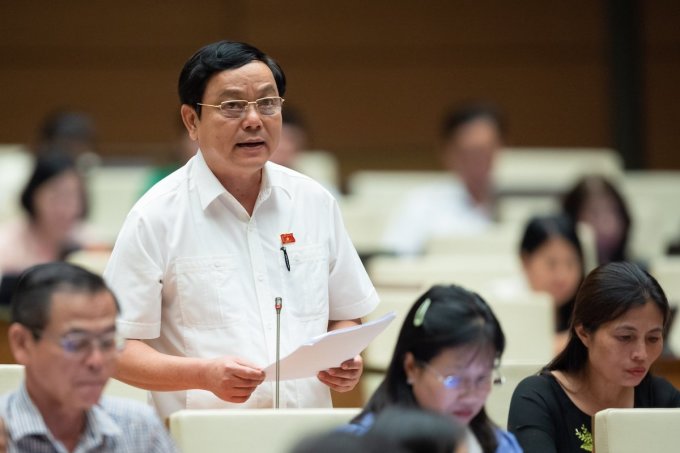
Mr. Hoang Duc Thang, Deputy Head of the Quang Tri Delegation, speaks at the socio-economic discussion session on May 31st. Photo: Hoang Phong
Also mentioning the high lending interest rates that are causing a "bottleneck" in the flow of capital to businesses, Ms. To Ai Vang, Deputy Head of the Soc Trang Provincial Task Force, suggested that the State Bank of Vietnam needs to manage credit more flexibly, by allocating a total credit limit to banks at the beginning of the year and managing it based on a plan established through an agreement between the bank and its customers.
"Monetary policy needs to avoid situations where rates accelerate in the first half of the year, then run out of room at the end of the year, or are suddenly tightened, causing businesses to disrupt their investment, production, and business plans," Ms. Ai Vang noted.
In addition, monetary authorities have flexible and diverse lending mechanisms, especially unsecured loan packages based on the effective operating time and cash flow of businesses. Commercial banks are reviewing all procedures and credit conditions, increasing businesses' access to loan capital, accelerating the disbursement of interest rate support packages, and restructuring repayment terms to help businesses alleviate difficulties.
Meanwhile, Mr. Tran Anh Tuan suggested that banks need to ease lending procedures for businesses, especially small and medium-sized enterprises. For example, instead of requiring businesses to have collateral, they should consider the feasibility of the project to ensure a "better supply of funds".
Mr. Hoang Duc Thang proposed that the Government immediately abolish unreasonable and overly restrictive administrative regulations and procedures for businesses. At the same time, authorities should minimize inspections and audits and facilitate the flow of credit into the economy.
"Only through decisive action and the creation of a favorable environment for production and business can enterprises recover and the country grow," he said.
Source link


















![[Photo] Prime Minister Pham Minh Chinh holds a phone call with the CEO of Russia's Rosatom Corporation.](/_next/image?url=https%3A%2F%2Fvphoto.vietnam.vn%2Fthumb%2F1200x675%2Fvietnam%2Fresource%2FIMAGE%2F2025%2F12%2F11%2F1765464552365_dsc-5295-jpg.webp&w=3840&q=75)

















































Comment (0)