

The United Nations Educational , Scientific and Cultural Organization (UNESCO) has just listed the art of hand-carving on metal, including copper, silver and gold, with geometric, plant or astrological motifs, on the list of intangible cultural heritage.
The nomination dossier was submitted by 10 Arab countries, including Tunisia, Algeria and Morocco.
According to a VNA correspondent in North Africa, in the Maghreb region, traditional metal carving techniques are mainly passed down from father to son, however, to meet new demands, some artisans have added machine carving techniques.
In Tunisia, artisan Mohamed Amine Htiouich, 37, became acquainted with this profession at the age of 15 in his family workshop in the old town of Tunis.
Mr. Htiouich expressed concern about the risk of losing the profession and said he was willing to provide free training to young people.
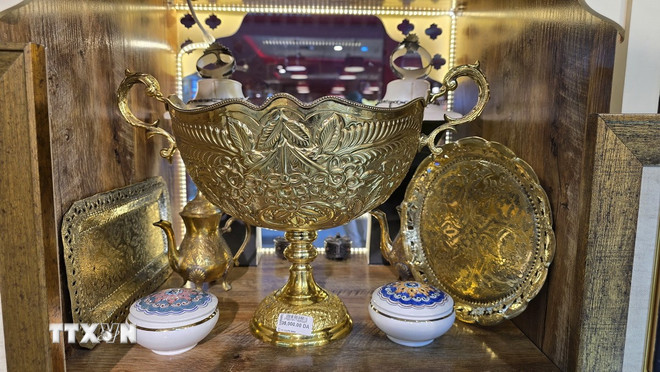
Metal carving in Tunisia dates back to the ancient city of Carthage and evolved from a blend of Islamic civilization, Mediterranean traditions, Berber heritage and Eastern influences. According to the Tunisian National Office of Crafts, there are currently 439 artisans specializing in the craft.
In Morocco, where crafts play an important role in tourism , most carvers work in modern workshops.
Abdelilah Mounir, a bronze seller in the city of Fès, believes that UNESCO's recognition of metal carving will bring benefits to tourism and trade.
Artisan Mohamed Moumni, who works near the Moroccan capital Rabat, said demand for the product is high, but “it is increasingly difficult to find skilled workers,” although training centers remain open for young people to study.
In Libya, the post-2011 instability has made the metal carving profession difficult. Artisan Youssef Chouchine said the development of the profession has been largely driven by market demand, while lack of support from the authorities. Most older artisans have left the profession because of low income.
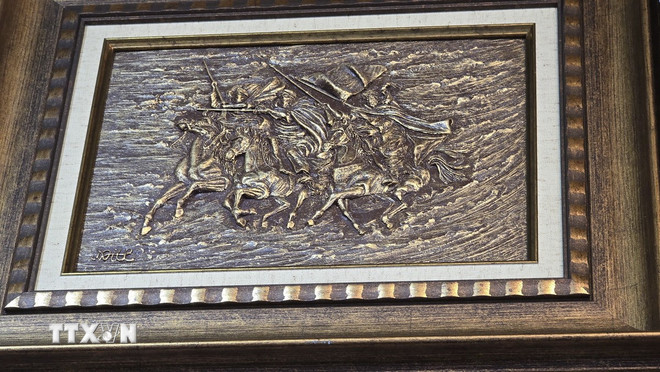
In Algeria, despite the lack of official support programs, carved metalwork is popular. Gold and silver jewelry is considered an indispensable part of wedding attire, with each region having its own characteristics.
Young artisan Walid Sellami, 37 years old, after falling in love with carving from a small jewelry shop, taught himself the craft via the Internet for 2 years.
He said the carving craft is “beautiful and delicate,” and while UNESCO’s inscription “doesn’t change much” in his daily work, he would be proud if the craft were more widely recognized in the region./.
Source: https://www.vietnamplus.vn/doc-dao-nghe-cham-khac-kim-loai-arab-duoc-vinh-danh-la-di-san-van-hoa-the-gioi-post1080474.vnp
![[Photo] Worshiping the Tuyet Son statue - a nearly 400-year-old treasure at Keo Pagoda](/_next/image?url=https%3A%2F%2Fvphoto.vietnam.vn%2Fthumb%2F1200x675%2Fvietnam%2Fresource%2FIMAGE%2F2025%2F12%2F02%2F1764679323086_ndo_br_tempimageomw0hi-4884-jpg.webp&w=3840&q=75)
![[Photo] Parade to celebrate the 50th anniversary of Laos' National Day](/_next/image?url=https%3A%2F%2Fvphoto.vietnam.vn%2Fthumb%2F1200x675%2Fvietnam%2Fresource%2FIMAGE%2F2025%2F12%2F02%2F1764691918289_ndo_br_0-jpg.webp&w=3840&q=75)





























![[Video] Protecting World Heritage from Extreme Climate Change](https://vphoto.vietnam.vn/thumb/402x226/vietnam/resource/IMAGE/2025/12/03/1764721929017_dung00-57-35-42982still012-jpg.webp)


































































Comment (0)