

Vietnamese-Korean excavation
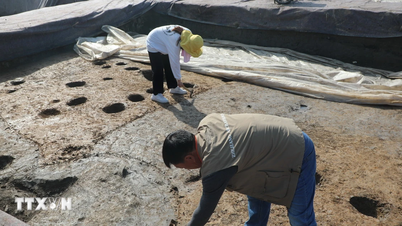
The national treasure, the Go Cay Tram burial jar, was discovered during excavations in 2018-2019 by Vietnamese and Korean researchers. The Vietnamese team consisted of experts from the Oc Eo Cultural Relics Management Board and the University of Social Sciences and Humanities (Vietnam National University, Ho Chi Minh City). The Korean team included experts from the Daehan Institute of Cultural Heritage and Seoul National University.
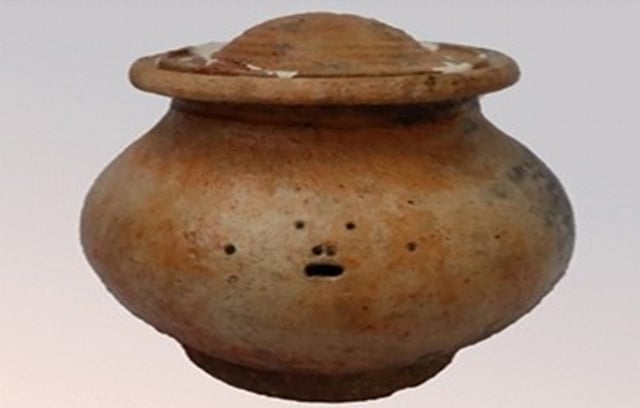
Treasures from the Go Cay Tram burial jar
PHOTO: PROVIDED BY THE DEPARTMENT OF CULTURAL HERITAGE
"The outstanding value of the Go Cay Tram jar burial site lies in the fact that the original artifacts were discovered during an archaeological excavation with clearly defined stratigraphy, and the site's structure was meticulously processed with a high degree of scientifically accurate information gathered," according to the national treasure dossier.
The Go Cay Tram burial site was unearthed at a depth of approximately 0.5 meters. A coffin-like vessel lay face up in the center of the burial site, its mouth covered by a disc-shaped lid with a hook-shaped rim that fit snugly against the opening. Research by expert Lee Yong-cheol (South Korea), published in 2023, indicated that the burial vessel contained fine, porous, dark gray soil, along with human remains including a portion of the jawbone with teeth belonging to a child approximately 7-8 years old. Also found inside were burial artifacts: a small piece of gold, and 16 monochromatic glass beads (multisalah), 15 of which were lemon yellow and one brown.
The coffin jar is a type of ceramic vessel with a spherical body, gently tapering shoulders, a constricted neck, a wide, bulging body, and a shallow, rounded base, creating a slightly flattened shape. The low base flares out proportionally with the mouth. The jar is made of fine, yellow-orange ceramic. However, much of the glaze has worn away, leaving only the base layer, which is a pale pinkish-brown with mottled gray-black patches.
According to Associate Professor Bui Chi Hoang, a member of the National Heritage Council, what is special about this site is that the intact burial jar was discovered in the stratigraphic layer of an archaeological excavation pit. It can be said that this is the only intact burial jar relic to date in studies of the Oc Eo culture in Southern Vietnam. Furthermore, the tomb is unique because while the relic dates back to the 4th-5th centuries based on stratigraphy and burial goods, the pottery used for the coffin belongs to the 1st-3rd centuries.
Telling stories about customs
At the conclusion of the excavation, expert Lee Yong-cheol highly praised the artifacts, noting that the perforated pottery vessel displayed facial features and had holes at the bottom. This phenomenon has not been recorded on any other pottery artifacts of the same type in the Oc Eo culture. The Korean research team stated: "This burial vessel was produced specifically for the purpose of making coffins, and the human face motif is the first of its kind discovered in Southeast Asia. This is a highly valuable academic achievement of this excavation."
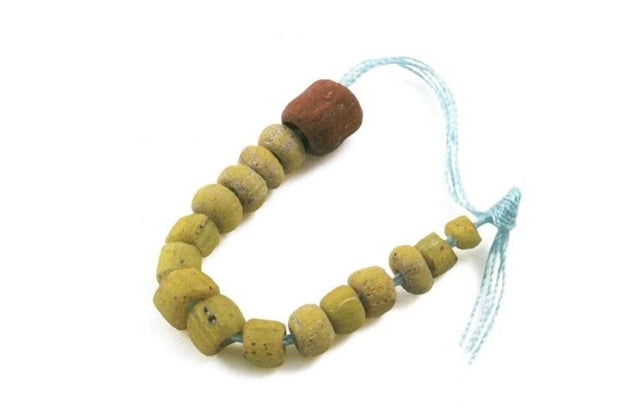
Funeral offerings made of glass beads
PHOTO: PROVIDED BY THE DEPARTMENT OF CULTURAL HERITAGE
Associate Professor Bui Chi Hoang believes that another valuable aspect of this national treasure is that it reveals a burial tradition. In other words, the intangible cultural value of the artifact is immense. According to Associate Professor Hoang, the Go Cay Tram tomb shows a close relationship with the tradition of burial using jar coffins. The burial goods in this tomb also show similarities with jar tomb clusters in the Southeast region, the transitional area between the East and Southwest of Vietnam. Therefore, this is evidence of cultural and commercial exchange between this region and the Southeast, especially the connection from the coastal area of South Central Vietnam to the Can Gio area.
The burial goods found in the Go Cay Tram jar tomb, including glass bead necklaces and gold artifacts, provide evidence of the highly developed trade and cultural exchange during this period, which is considered the peak stage of the Oc Eo culture.
Scientists also highly value the ceramic vessel and lid of the burial jar. These are typical artifacts of the Oc Eo culture, products of the cultural exchange, reception, learning, and transformation of the ancient inhabitants of the Mekong Delta with foreign cultural elements (from India). "These are complete originals of typical pottery from the early Oc Eo culture period, characterized by standardized shapes and aesthetic concepts of the early Oc Eo period," the treasure dossier states. Therefore, this artifact can help identify the aesthetic thinking and pottery-making techniques of the Oc Eo culture period. (to be continued)
Source: https://thanhnien.vn/doc-la-bao-vat-quoc-gia-mo-vo-co-khac-hinh-mat-nguoi-185250424220630691.htm


![[Photo] Prime Minister Pham Minh Chinh holds a phone call with the CEO of Russia's Rosatom Corporation.](/_next/image?url=https%3A%2F%2Fvphoto.vietnam.vn%2Fthumb%2F1200x675%2Fvietnam%2Fresource%2FIMAGE%2F2025%2F12%2F11%2F1765464552365_dsc-5295-jpg.webp&w=3840&q=75)


![[Photo] Closing Ceremony of the 10th Session of the 15th National Assembly](/_next/image?url=https%3A%2F%2Fvphoto.vietnam.vn%2Fthumb%2F1200x675%2Fvietnam%2Fresource%2FIMAGE%2F2025%2F12%2F11%2F1765448959967_image-1437-jpg.webp&w=3840&q=75)








































![[OFFICIAL] MISA GROUP ANNOUNCES ITS PIONEERING BRAND POSITIONING IN BUILDING AGENTIC AI FOR BUSINESSES, HOUSEHOLDS, AND THE GOVERNMENT](https://vphoto.vietnam.vn/thumb/402x226/vietnam/resource/IMAGE/2025/12/11/1765444754256_agentic-ai_postfb-scaled.png)

















































Comment (0)