

Dr. Nguyen Quang Bay, Head of the Endocrinology - Diabetes Department at Bach Mai Hospital (Hanoi), believes that prescribing outpatient medication for extended periods (over 30 days according to the new regulations of the Ministry of Health , effective from July 1, 2025) offers many advantages but also raises some issues related to disease control.
Firstly, patients are having fewer follow-up appointments. Some patients become complacent when their condition stabilizes, neglecting to monitor blood sugar and blood pressure, failing to maintain exercise, having irregular eating habits, and easily stopping medication.
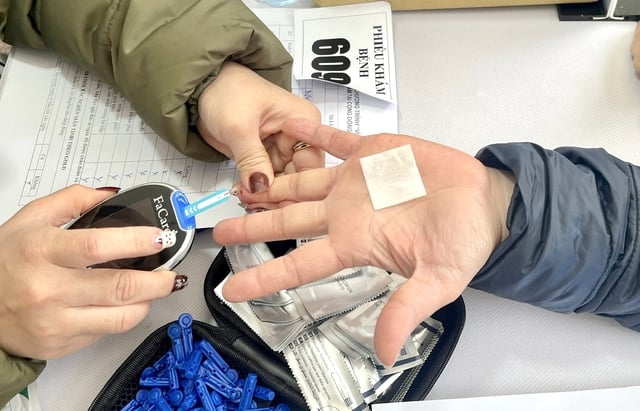
People with diabetes or other chronic diseases need to monitor their health and adhere to their prescribed outpatient medication regimen.
PHOTO: LIEN CHAU
Secondly, not having regular check-ups makes it easy to miss early warning signs of complications, or to forget follow-up appointments, leading to running out of medication. For patients undergoing general treatment and using many different medications, the situation of having too much or too little medication is even more likely to occur.
Dr. Nguyen Quang Bay noted: Chronic diseases require lifelong treatment. Stability is only temporary; if treatment is not maintained correctly, the disease can worsen at any time. Therefore, patients need to carefully read their prescriptions before leaving the hospital and ask questions immediately if anything is unclear. Medications should be stored carefully, especially insulin, which needs to be kept refrigerated. Avoid mixing up medications when there are multiple patients in the household. People with diabetes need to take or inject medication on time; they can set an alarm or keep medication in an easily accessible place to ensure adherence to treatment.
At the same time, it is necessary to monitor health indicators such as blood sugar and blood pressure at home or at the health center. If any abnormalities occur, do not wait until your scheduled follow-up appointment; see a doctor immediately or call your doctor or the hospital hotline. Schedule your follow-up appointment 3-5 days in advance to avoid missing your medication deadline.
Regarding cancer patients, Associate Professor Pham Cam Phuong, Director of the Center for Nuclear Medicine and Oncology - Bach Mai Hospital, stated that outpatient prescriptions for more than 30 days, up to a maximum of 90 days, are currently issued for three diseases: thyroid cancer, breast cancer, and non-small cell lung cancer.
However, Associate Professor Pham Cam Phuong emphasized: "These diseases are only treated and stabilized once patients are ready to receive medication every three months, for a maximum of 90 days." But it's also important to note to staff, doctors, and patients that cancer can progress, recur, or metastasize at any time. Therefore, if patients experience unusual symptoms, worsening symptoms, coughing, chest pain, discomfort, or any other abnormalities, they should seek medical attention promptly, rather than waiting until their medication runs out before their scheduled appointment.
At the same time, the doctor will decide whether to prescribe medication for 30, 60, or 90 days, or possibly 1-2 weeks earlier, depending on the most recent examination, and will also give appropriate instructions.
Doctors are responsible for providing detailed instructions to patients.
To better serve outpatients with prescription requirements exceeding 30 days, Dr. Nguyen Quang Bay shared: At the hospital, relevant departments need to proactively adjust procedures; prepare sufficient medication to meet the increased dispensing volume, which is 2-3 times higher than normal; strengthen staffing in the examination, prescription, and dispensing stages; and upgrade the information technology system to ensure smooth communication between doctors, the drug warehouse, and the pharmacy. Simultaneously, doctors are responsible for providing detailed guidance to patients: which medications can be prescribed for 30, 60, or 90 days, scheduling specific appointments; and providing the hospital's hotline, Zalo, or application so patients can contact them if they experience unusual symptoms or need further information.
Source: https://thanhnien.vn/don-thuoc-ngoai-tru-dai-ngay-luu-y-can-biet-voi-nguoi-co-benh-man-tinh-185250707204118561.htm


![[Image] Close-up of the newly discovered "sacred road" at My Son Sanctuary](/_next/image?url=https%3A%2F%2Fvphoto.vietnam.vn%2Fthumb%2F1200x675%2Fvietnam%2Fresource%2FIMAGE%2F2025%2F12%2F13%2F1765587881240_ndo_br_ms5-jpg.webp&w=3840&q=75)














































































Comment (0)