

The school only has one vice principal, while the school has up to 10.
Information from universities indicates that the number of members in the governing board varies considerably, with a maximum of 11 and a minimum of 2. In public universities, the most common board size is 3-4 people, while private universities typically have 5-6. The vice-chancellor plays a crucial role in the administration and management of educational activities.
Ho Chi Minh City University of Industry has a training scale of approximately 40,000 students, trainees, and researchers. Currently, the management board consists of 3 members: the rector and 2 vice rectors.
Hanoi Open University, with over 37,000 students, has a rector and three vice-rectors. Tra Vinh University, with over 36,000 students, has a rector and three vice-rectors. Hanoi University of Industry, with nearly 34,000 students, has a rector and three vice-rectors. Ho Chi Minh City University of Industry and Trade, with over 20,000 students, currently has a management board of three: a rector and two vice-rectors. Foreign Trade University, with 18,000 students, has two vice-rectors. Many other large public universities also have one to two vice-rectors.
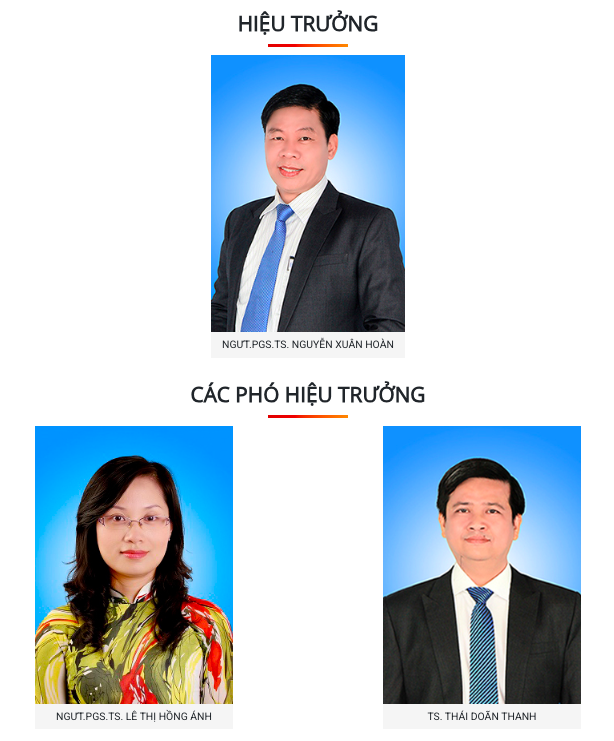
Board of Directors of Ho Chi Minh City University of Industry and Trade. The university currently has over 20,000 students.
PHOTO: HUIT
Ho Chi Minh City Open University, with nearly 40,000 students, currently has only a rector and one vice-rector. The University of Transport and Communications, with over 22,000 students, also currently has only one vice-rector…
In private universities, many have a larger number of members on the board of directors, at least twice and up to five times more than in public universities. Vice-rectors are assigned to oversee specific areas, such as admissions, training, scientific research and international cooperation, finance, and external relations.
For example, Nguyen Tat Thanh University, Hoa Sen University, Hong Bang International University, and Gia Dinh University each have 6 vice rectors; Van Lang University, Ho Chi Minh City University of Economics and Finance, Dong A University of Technology, and Eastern University of Technology each have 5 vice rectors; and Nam Can Tho University has 4 vice rectors…
However, there are also some private universities with very few members on their boards of directors, such as Thang Long University with only two vice-rectors, and Yersin University in Da Lat with only one vice-rector…
The university with the largest board of directors is arguably Ho Chi Minh City University of Technology, with 11 members, including 10 vice-rectors.
Explaining why the board of directors has 11 members, Ms. Nguyen Thi Xuan Dung, Director of the Communication Center at Ho Chi Minh City University of Technology, said: “This number is appropriate for the scale of training and the increasingly expanding scope of activities of the university. Currently, the university offers more than 60 undergraduate majors, 16 master's degree programs and 3 doctoral programs, with more than 30,000 students, trainees and researchers enrolled.”
According to Master Xuan Dung, the school has a large workload and a multi-disciplinary, multi-sectoral management model that requires a leadership team with sufficient resources to be in charge of each specialized area, ensuring that all operational activities are implemented synchronously, continuously, and effectively.
"The university is also actively promoting business cooperation, international linkages, science and technology, and ensuring quality and student services at multiple campuses, so a large management board is necessary to meet the actual needs," shared Ms. Xuan Dung.
The document specifies how many deputy principals are allowed.
The regulations for universities issued by the Prime Minister in 2014 (applicable to both public and private universities) state that each university may have no more than 3 vice-rectors. In special cases, for universities with a total enrollment of over 20,000 full-time students and assigned the task of training master's and doctoral students, 1 or 2 additional vice-rectors may be added after obtaining the approval of the Minister of Education and Training.
Therefore, the maximum number of vice rectors for a public university with fewer than 20,000 students is 3, while for a university with more than 20,000 students it is 5.
However, this regulation expired in 2020. The regulations on university leadership personnel were replaced by Government Decree 99 of 2019, which details and guides the implementation of some articles of the Law amending and supplementing some articles of the Law on Higher Education.
Accordingly, Clause 2 of Article 13 of this decree states that higher education institutions have the right to autonomy in organizational structure and personnel.
Specifically, public higher education institutions exercise autonomy in organizational structure and personnel management as stipulated in the Law on Higher Education, the Law amending and supplementing certain articles of the Law on Higher Education, and current regulations on the establishment, reorganization, and dissolution of public non-profit units; on the number of employees and job positions in public non-profit units; and have the right to autonomy in organization, structure, and personnel management to perform professional tasks, but are not allowed to increase the number of salaried employees or the salary levels (including both salary and allowances) from the salary fund provided by the state budget.
According to Government Decree 83 of 2024, amending Decree 120 of 2020 on the establishment, reorganization, and dissolution of public non-business units, it states: For public non-business units that partially self-finance their recurrent expenditures, and public non-business units whose recurrent expenditures are fully covered by the state budget, the average number of deputy heads of units within the organizational structure of ministries and ministerial-level agencies shall not exceed 3 per unit.
Thus, this new regulation allows public universities to have a maximum of 3 vice-rectors, regardless of whether the number of students exceeds 20,000, as stipulated in the 2014 University Charter.
This is considered inadequate, as even large universities with 20,000-40,000 students are limited to a board of directors consisting only of the president and three vice-presidents, making it difficult to handle the large workload and maintain quality governance.
For private higher education institutions, autonomy in organizational structure and personnel is exercised in accordance with the Law on Higher Education and the Law amending and supplementing certain articles of the Law on Higher Education. At the same time, they are responsible for publicly disclosing their organizational structure and legal representatives on the school's website. This means that private universities are not required to have only three vice-rectors like public universities.
Dr. Vo Van Tuan, Vice Rector of Van Lang University, commented: "The number of vice rectors a private university has depends on its actual operational situation, including factors such as scale and development orientation...".
Source: https://thanhnien.vn/mot-truong-dh-duoc-bo-nhiem-toi-da-bao-nhieu-pho-hieu-truong-185251212214903482.htm


![[Photo] Prime Minister Pham Minh Chinh attends the Conference summarizing and implementing tasks of the judicial sector.](/_next/image?url=https%3A%2F%2Fvphoto.vietnam.vn%2Fthumb%2F1200x675%2Fvietnam%2Fresource%2FIMAGE%2F2025%2F12%2F13%2F1765616082148_dsc-5565-jpg.webp&w=3840&q=75)










































































Comment (0)